Showing posts with label Bonnard (Pierre). Show all posts
Showing posts with label Bonnard (Pierre). Show all posts
Monday, September 30, 2013
Is Balthus the "Crazy Cat Lady" of Modern Art?
When London’s Tate Gallery asked the French painter Balthus
for some personal details to include in a 1968 retrospective
exhibition, Balthus replied via telegram: “No biographical details.
Begin: Balthus is a painter of whom nothing is known. Now let us look at
the pictures. Regards. B.” But how do you look at an exhibition such as
the Metropolitan Museum of Art’s Balthus: Cats and Girls—Paintings and Provocations
and not ask who this man and artist was? Cats may slink around the
paintings, but the real provocation in the show’s title comes from
Balthus’ long-controversial portraits of young, pre-teen girls, who pose
with a mixture of feline grace and tweenage awkwardness that results
in, if not child pornography, at least erotic unease for the viewer.
Often cats appear as the only on-canvas observers of these
models—wide-eyed voyeurs that might serve as stand-ins for the artist
himself, whose life-long fascination with cats remains the one personal
detail he freely shared. Is Bathus modern art’s “crazy cat lady”—the
eccentric whose harmless obsessions taken to the extreme reveal a
darker, psychological truth? Please come over to Picture This at Big Think to read more of "Is Balthus the 'Crazy Cat Lady' of Modern Art?"


Friday, October 3, 2008
Champagne Wishes

After studying the law and practicing for some time as a lawyer, as his father wished, Pierre Bonnard finally put the art classes he had been taking on the side to use and decided to become an artist. Born October 3, 1867, Bonnard searched for his big break, which came in 1899 when he received the commission to design a poster for France-Champagne (above). Bonnard’s Japonisme-influenced depiction of bubbly effervescently teeming over the brim of the glass captured the imagination of a generation of French graphic artists, including Henri de Toulouse-Lautrec, who mimicked Bonnard’s style and became Bonnard’s friend in 1891. With the money he made from this poster, Bonnard finally quit his law job and became a full-time artist. “Our generation always sought to link art with life,” Bonnard said years later. “At that time, I personally envisaged a popular art that had everyday applications.” Bonnard’s calligraphic lines with their flowing movement helped usher in the age of Art Nouveau, which dreamed of bringing art into every facet of everyday life.
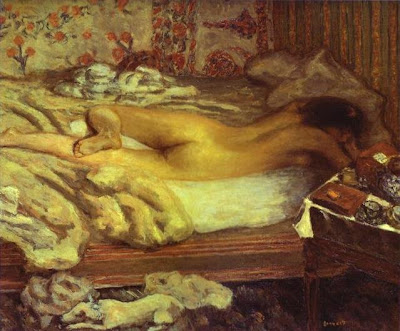
Bonnard interacted with many of the Impressionists of his day. Siesta (above, from 1899), one of many paintings in which Bonnard used his young wife as a model, shows the influence of Edgar Degas and his treatment of the female form. Bonnard helped found the group Les Nabis in the 1890s. Following the philosophy of Paul Gauguin if not Gauguin’s specific technique, Bonnard and others looked to infuse the subjects of Impressionism, such as the female nude, with a sense of spirituality and awe. In works such as Siesta and Indolence (also 1899), Bonnard transforms the nude female body into a religious artifact, literally pulsating with energetic color. The same primal force Gauguin found in the woman of the islands Bonnard found in the women of France, specifically his beloved wife.

In 1926, Bonnard moved to the French Riviera, where he remained for the rest of his life. Works such as Landing Stage (above, from 1938-1939) show Bonnard’s love for the blue skies and water of the Riviera—the blue that Henri Matisse claimed he had been searching for all his life. Although Bonnard opened up his palette to a whole new world of color, he never embraced Fauvism or any other new art movement of the first half of the twentieth century. Bonnard carried on in his personalized Post-Impressionist fashion until his death in 1947, five years after the passing of his beloved wife. It’s hard to think of Impressionism stretching past the horror of Nazism and World War II, but Bonnard outlived even those movements in history. Like a fine bottle of champagne, Bonnard kept bubbling along and never stopped being the life of the party.
Tuesday, January 15, 2008
Attention Must Be Paid
 Henri Fantin-Latour, A Schumann Piece (Un morceau de Schumann), 1864, Etching on chine appliqué. Smart Museum of Art, University of Chicago, Purchase, Paul and Miriam Kirkley Fund for Acquisitions, 2006.97.
It’s hard to believe now, but concert goers in the days of Mozart would casually talk over the music, oblivious of the genius in the air all around them. The modern concept of silently experiencing music comes with the age of Beethoven and the Romantics, who elevate music to the status of an art form equal to that of the visual arts. With that change came a revolution in how the visual arts “saw” music, or more accurately, how the visual arts depicted the experience of appreciating music. In the exhibition Looking and Listening in Nineteenth-Century France currently at the Smart Museum of Art, the development of this relationship is examined through works such as Henri Fantin-Latour’s A Schumann Piece (above), which captures a moment in which the musicians perform Robert Schumann’s music as the intimate parlor audience watches them. This dynamic of the performer and listener provides a fertile field for the scholars writing in the exhibition catalogue to work within “the nexus of art history, musicology, history of science, and psychology,” as the introduction states.
 Honoré Daumier, Mr. Babinet warned by his concierge of the arrival of the comet (Monsieur Babinet prévenu par sa portière de la visite de la comète), from the series La Comète de 1857 (The Comet of 1857), published in Le Charivari on September 22, 1858, Lithograph on original newsprint. Smart Museum of Art, University of Chicago, Purchase, Paul and Miriam Kirkley Fund for Acquisitions, 2005.31.3.
Originating in an interdisciplinary course conducted in the Spring of 2007 by the co-curators of the exhibition—Martha Ward and Anne Leonard—Looking and Listening in Nineteenth-Century France approaches the subject from multiple angles using a variety of artists. Honoré Daumier saw the new fascination with viewing, aided by technical innovations such as the telescope (above), and recognized, as Julia Langbein writes in her essay, “that ultimately those who lose themselves in observation make themselves vulnerable to be observed” and, therefore, the subject of caricature. Consequently, as Leonard writes in her essay, this results in “viewers’ self-consciousness about being on display while they behind the ostensible objects of display” in art galleries. The appreciation of art, whether painting or music, suddenly became a subject of interest in itself. Passively listening or looking would never be as “pure” again after such heightened consciousness.
 Émile-René Ménard, Homer, c. 1885, Oil on canvas. Smart Museum of Art, University of Chicago, Purchase, Gift of Mr. and Mrs. Eugene Davidson, 1980.4.
Émile-René Ménard’s Homer (above) neatly encapsulates this controversy over sensory experience. “With eyes cast in different directions, their contrasting demeanors make for an odd combination of vacant starting, languorous sensuality, and plebian profile,” Ward writes in her essay on the painting. “All of these figures could be said, in some sense, to be blind to everything but their inner experience, including the viewer’s presence.” Ménard’s uses the blind poet Homer to symbolize the blindness of the creative artist totally immersed in the creative act, while the figures listening (or not) catalogue the different levels of immersion for those experiencing the creative act of another.
 Henri-Michel-Antoine Chapu, Joan of Arc at Domremy, c. 1870–74, Cast bronze. Smart Museum of Art, University of Chicago, Purchase, Gift of the Friends of the Smart Gallery, 1986.12.
Elayne Oliphant examines the religious component of this sensory submission to the power of art. Looking at depictions of Joan of Arc such as Henri-Michel-Antoine Chapu’s Joan of Arc at Domremy (above) and Jules Bastien-Lepage’s Joan of Arc Listening to the Voices, Oliphant designates Joan as the ultimate audience. “To be absorbed in the task of contemplation,” Oliphant writes, “implies that one has overcome the distractions of the material world and, therefore, is capable of perceiving and understanding God’s words.” Where Joan heard the word of God through her powerful faith, the common patron of the arts can hear the artist’s message, regardless of the medium, through an equal leap of faith in the power of art to communicate. Joan of Arc thus becomes a patron saint for the newly enlightened viewer and listener of the increasingly secular nineteenth century.
 Pierre Bonnard, Illustration for Le petit solfège illustré, by Claude Terrasse, Paris: Ancienne Maison Quantin/Librairies-Imprimeries Réunies, 1893, Printed book. Smart Museum of Art, University of Chicago, Purchase, Paul and Miriam Kirkley Fund for Acquisitions, 2007.106.
The true love of music so many nineteenth-century French artists had greatly helped forge this new connection and exploration between visual art and music. Michael Tymkiw examines how Fantin-Latour’s wide-ranging appreciation of the music of Robert and Clara Schumann, Berlioz, and, above all, Richard Wagner inspired him to illustrate those works, especially those relating to operas or ballets. (A CD accompanying the catalogue contains selections from many of the works Fantin-Latour and the other artists reacted to artistically, allowing for a truly multimedia experience that brings both the art and the music more fully to life. Many kudos to the developers of this catalogue for taking advantage of the available technology to provide this great enhancement.) Odilon Redon later viewed Fantin-Latour’s images as too illustrative, more reductive than truly in the spirit of the music. “My drawings inspire and do not provide definitions,” Redon wrote. “They do not determine anything. Just like music, they place us within an ambiguous world of the indeterminate.” With such striving for indeterminancy, Redon’s art truly aspired to the state of music itself, linking the wordless expressivity of the visual with that of the auditory explicitly. On a different level, Pierre Bonnard explicitly integrated visual art and music in his innovative drawings for a musical instructional book (above) that used amusing figures to illustrate musical notation in hopes of bringing this new way of "seeing" music to the next generation.
I’ve always toyed with the idea of art and music pairings, similar to the way that foodies obsess over wine and food pairings. The idea of walking through the MoMA while listening to John Coltrane, completely immersed in the dual experience and oblivious of everything else, always struck me as something to put on my personal “bucket list.” Looking and Listening in Nineteenth-Century France cuts to the heart of that interaction between the two media and how the whole is so much greater than the individual parts. In many ways, the nineteenth-century was a paradise for such cultural experiences. Although recorded music was not yet in existence, more people played instruments in the home, allowing for a more direct experience with the music. Classical music and the opera held a much more prominent position in the entertainment world than today, when they are both relegated to tiny, niche markets. Even the visual arts have fallen victim to the decline of arts education in America, leaving many museums empty and in financial peril. Looking and Listening in Nineteenth-Century France allows us to look back at that fertile time of true multimedia and, perhaps, regardless of the wonders of surround sound and IMAX theaters, make us conscious of what we’re truly missing.
[Many thanks to the Smart Museum of Art for providing me with a review copy of the catalogue to Looking and Listening in Nineteenth-Century France and for the images from the exhibition.]
Tuesday, November 27, 2007
Wrestling with Gauguin

When Les Nabis first gathered as a group and took the Hebrew word for “prophets” as their name, Paul Gauguin shone as their guiding star for what an artist should be. Along with Pierre Bonnard and Edouard Vuillard, Maurice Denis created the greatest works of the Nabis school. Born November 25, 1870, Denis first saw Gauguin’s paintings in an exhibition of Impressionist and Synthetist works in 1889, including his Vision after the Sermon: Jacob's Struggle with the Angel (painted in 1888). Denis staged his own version of that Biblical battle in Jacob's Battle with the Angel (above, from 1893), which copies Gauguin’s own use of flat expanses of color but does away with the framework of Breton ladies to claim the vision as entirely Denis’ own.

Denis’ spirituality took a much more orthodox path than Gauguin’s. His The Road to Calvary (above, from 1889) shows the strong influence of Italian Renaissance art, which Denis later saw first hand in trips to Tuscany and Umbria in the 1890s. In The Road to Calvary, Denis composes the scene with striking originality, showing the influence of Japonisme in the strong lines of the cross cutting across the image, directing the eye of the viewer up and into the picture. The procession of darkly clad women leading up to Christ dominates the lower half of the picture. By making Christ himself faceless, Denis removes all focus on representation and concentrates it on the emotional aspects of the scene. Small details such as the golden flowers springing up from the ground serve to echo the silhouetted spears and weapons of the soldiers leading Christ to the place of his execution, adding to the pathos through juxtaposition.

In addition to his overtly religious works, Denis helped foster the Symbolist movement in France, developing illustrations for the writings of André Gide, Paul Verlaine, and Maurice Maeterlinck as well as the musical scores of Claude Debussy. Denis soon branched out into designing patterns for carpets, creating designs for stained glass and mosaic panels for churches, and even painted ceramics. Despite this versatility, Denis remained an innovative painter, creating works such as Spots of Sunlight on the Terrace (above, from 1890) that bleed with acidic color in a way that would not be duplicated until Henri Matisse and the Fauves or Emil Nolde and the German Expressionists many years later. Denis and Les Nabis greatly deserve a reevaluation in art history circles as much more than a stepping stone between Gauguin and the Post-Impressionists and the Fauvists.
Thursday, November 15, 2007
A Prophet in His Own Land

As part of Les Nabis, Edouard Vuillard painted some of the most innovative interiors of his generation. Born November 11, 1868, Vuillard fostered the visionary (“Nabis” means “prophet” in Hebrew) in paintings such as The Green Interior or Figure in front of a Window with Drawn Curtains (above, from 1891), which takes a simple interior and places a distorting, transforming lens in front of it. Although fellow Nabis Pierre Bonnard and Maurice Denis painted in a similar style, Vuillard truly brought a visionary taste for color to his works, prophetically setting the stage for the many later color innovations of the Fauves and Matisse.

Vuillard’s career as a painter parallels the rise of the photographic camera in Europe as something available to the masses. Freeing painting from the obligation to be true photographically, artists felt the license to go completely wild with their technique, straying further and further from realism. The slippery slope greased by the Impressionists gets steeper with Post-Impressionist movements such as the Nabis. Vuillard’s Octagonal Self-Portrait (above, from 1890) glows with unreal color, something Matisse would copy in his portrait of his wife, The Green Stripe. Vuillard also takes the additional step of blurring all detail, as if he had moved during the exposure of a photographic plate.

Like so many French artists, Vuillard loved the Louvre, haunting those halls frequently and copying the masters all around him. The influence of Vermeer on his interiors begins with their shared love of simple genre scenes (in this case, women sewing) and their shared love of how light fills a room. Where Vuillard departs from Vermeer is in his total disregard for detail, something Vermeer painted obsessively. Instead, in Length of Thread or Interior with Sewing Women (above, from 1893), Vuillard simply suggests the women sitting and the aspects of the room around them, placing his highest priority on the light flooding the room, which obliterates the features of the woman on the right. The textures of the drapes and wallpaper appear to vibrate from the juxtaposition of light and dark, elevating beyond mere ornamentation and becoming fellow actors within the painting. The shaky outline of the dark figure in the center, with her back towards us, similarly creates the illusion of movement. Vuillard lived another 47 years after painting these images, which represent the height of his career, perhaps never again finding such a powerful way to convey his unique ideas.
Wednesday, October 3, 2007
An Open Window

Surrounded by the powerful art and personalities of the Fauvists and the Cubists in early twentieth century France, Pierre Bonnard could have easily succumbed to their influence. Instead, Bonnard, born on this date in 1867, sought out his own path, choosing as his subject the simple facts of his life and his love of his companion Marthe. With works such as The Open Window (above, from 1921), Bonnard opened a window onto his heart, allowing us to see it in all its color, boldness, and intimacy. I find this embracing, open aspect of Bonnard to be almost as arresting as his wonderful ability to bring fresh color to even the most everyday scene.
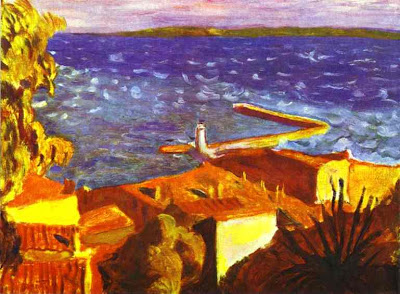
In 1889, Bonnard entered a design for a French champagne company looking to spice up their advertising campaign. Bonnard’s winning entry later influenced the great master poster designer Henri Toulouse-Lautrec, whom Bonnard met in 1891. Although he was influential to some degree, Bonnard himself resisted all influences and schools. His involvement in Les Nabis, the “prophets” who revolutionized much of French printmaking at the turn of the century, was the rare occasion in which he joined any group. Even while painting the same South of France as Henri Matisse in works such as Saint-Tropez, Pier (above, 1912), Bonnard remains realistic enough to avoid falling into Fauvism yet still captures and amplifies the glorious colors of the Riviera. Matisse famously claimed that the Riviera’s skies had the blue he’d been searching for all his life, and then turned the idea of realistic color on its head. Bonnard saw that same blue and made it his own without changing one thing.

In paintings such as Indolence (above, from 1899), Bonnard paints the intimate part of his life with amazing openness. Bonnard met the woman in Indolence, Marthe, in 1893 and spent the rest of his life with her, yet waited thirty-two years before he married her. So much of Bonnard’s work is an open window on his intimate life, including his relationship with Marthe. Many of the interiors he paints show her sitting at a table, eating or drinking, doing the everyday things that all people do. Bonnard’s paintings are in many ways love letters to Marthe, showing her how amazing their life was together, how even the quietest moments resonated with color and energy for him. Such a display perhaps speaks of a greater commitment than any ring ever could.
Subscribe to:
Posts (Atom)


