Showing posts with label Delaunay (Robert). Show all posts

Friday, March 18, 2011

Circle of Friends: Marc Chagall and Company


“[I]n La Ruche you either came out dead or famous,” Marc Chagall said of the Parisian refuge of bohemian artists from Eastern Europe that he called home during his first Paris period. French for “the beehive,” La Ruche buzzed both with creativity and camaraderie during Chagall’s time there. The circle of friends Chagall formed around himself influenced not only his art but widened his spirit as he witnessed a world far bigger than the Vitebsk village he left behind. In Paris Through the Window: Marc Chagall and His Circle at the Philadelphia Museum of Art, visitors gain access to Chagall’s circle of friends and get a sense not of a “hive mind,” but rather of a unity born of diversity sharing the same hardships and passions. Please come over to Picture This at Big Think to read more of "Circle of Friends."

[Image: Marc Chagall, French (born Belorussia), 1887-1985. Paris Through the Window, 1913. Oil on canvas, 53 1/2 x 55 3/4 inches (135.8 x 141.4 cm). Solomon R. Guggenheim Museum, New York, Solomon R. Guggenheim Founding Collection, By gift 37.438. © 2010 Artists Rights Society (ARS), New York/ADAGP, Paris.]

[Many thanks to the Philadelphia Museum of Art for providing me with a review copy of the catalog to, the image above from, and other press materials for Paris Through the Window: Marc Chagall and His Circle, which runs through July 10, 2011.]

[A REQUEST AND A CONTEST: Please consider making a donation to help the people of Japan. Some of the organizations doing good in that terrible situation are Doctors Without Borders and The Red Cross. Please consider helping in some way. And if you do send a donation, mention it in the comments to this or any other post and I’ll put your name in a contest to win a copy of See/Saw: Connections Between Japanese Art Then and Now by Ivan Vartanian and Kyoko Wada (my review here). Honor rules apply, so you do not need to send “proof” of a donation. Also, the contest is open only to U.S. residents (but anyone can donate, of course). Contest ends at midnight EDT on April 1, 2011 and a name will be pulled from a hat the next day.]

Wednesday, July 30, 2008

Sibling Rivalry


What must it have been like growing up the brother of Marcel Duchamp? Gaston Duchamp, better known as Jacques Villon, must have felt overshadowed at times by his little brother, twelve years his junior. Born July 31, 1875, Villon took his new name in honor of French poet François Villon and set out to create his own type of poetry separate from that of his famous sibling Marcel and his lesser-known artistic siblings Raymond and Suzanne. In prints such as The Cards (above, from 1903), Villon shows his debt to the works of Henri de Toulouse-Lautrec, whose stunning graphic style swept through Europe and changed the way Villon and other graphic artists who followed went about their work. While Marcel delved into the deep thought experiments of Dada and Surrealism, Villon traveled in Fauvist, Cubist, and Abstract Impressionist circles, slowly moving away from the Post-Impressionism of Toulouse-Lautrec to a more modern look.


Villon excelled at printmaking and etching. The Checker Table (above, from 1920) shows Villon trying his hand at Cubist etching. (I wonder if Villon and Marcel, famous for his love of chess, ever squared off over a board or two.) The board and the table it rests on seem to be disassembling themselves off into space, much like Marcel’s Nude Descending a Staircase, No. 2 painted eight years earlier. Like Marcel and so many other European artists, the 1913 Armory Show served as a coming out party for Villon, introducing his art to an American audience for the first time. While some of those artists met resistance from the American markets, Villon found a second home and acceptance for his more accessible Cubist works such as The Checker Table.


While Marcel always seemed to be an art movement unto himself, always wary of labels and the very nature of institutionalized art itself, Villon seems more at home in groups, helping others find an audience. Although Marcel and Raymond also helped form the Puteaux Group that included Francis Picabia, Robert Delaunay, and Fernand Leger, Villon more than his brothers organized the Section d'Or exhibitions that brought those innovative artists to the public eye. In Villon’s Self-Portrait from the 1950s (above), he seems almost forbidding, perhaps poking fun at his open, inviting character. Marcel always seems to be in exile from himself and art, while Villon always seems secure in his place in the world and art-making. Perhaps the younger brother could have learned a few things from his older brother. Just the choice of the graphic medium, with its easy reproduction and often illustrative nature, speaks of Villon’s greater desire to communicate in contrast to his still-befuddling, often overshadowing younger brother.

Tuesday, February 5, 2008

A Series of Tubes


An artist that should find a place in U.S. Senator Ted Stevensheart, Fernand Leger took the Cubism of Braque and Picasso and rounded it off, creating his own form of Cubism later known as Tubism. (And, no, surfers did not call it “tubular.”) Born February 4, 1881, Leger painted works such as The Card Players (above, from 1914) while still under the influence of Italian Futurism. In The Card Players, Leger creates players more machine than human, consisting of a series of tubes connected together more than anything resembling flesh and blood. A friend of other abstract artists such as Robert Delaunay and Francis Picabia, Leger painted in an increasingly abstract style up to his involvement in World War I, which changed his work immensely as the marriage of man and machine no longer seemed like such a fine idea.


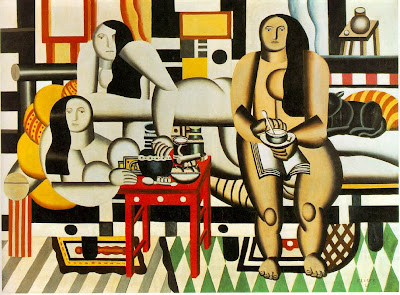
After the war, Leger returned to a more classical style of painting in works such as Three Women (above, from 1921). The rounded forms and cylinders of Tubism remain, but Leger paints here flesh and blood rather than the cold, hard steel of The Card Players. Like many artists between the wars, Leger couldn’t return to a purely abstract style or develop a purely classical one, so he creates hybrids such as Three Women, a unique take on the nude that borrows from everyone from the Greeks up to Cezanne in portraying the nude female body. Whereas some of his abstract brethren, such as Picabia, followed the path of chaos even further after the Great War, Leger stepped back from the precipice and reevaluated his art.


While living in the United States during World War II, Leger became less and less abstract in his style, creating works such as Three Musicians (above, from 1944). Like Picasso’s Three Musicians , Leger takes advantage of the interplay of the three figures and their instruments to create interesting contrasts of color and shape. Unlike Picasso, one of the sources of his early Tubist Cubism, Leger no longer relies on heavy distortion of the human form. Their faces are stylized masks in many ways, but nothing like the excessive primitivism of Picasso’s faces. Near the end of his life, Leger turned to Socialism in hopes of making a better world. His desire to bring a sense of humanity to the often cruel twentieth century succeeded in humanizing his art.

Monday, January 7, 2008

Through Thick and Thin


Before World War II, Nicolas de Stael painted mainly representational works. When hostilities erupted, de Stael responded to reality with greater and greater abstraction. Born January 5, 1914, de Stael met Jean Arp and Sonia and Robert Delaunay in the South of France in 1941 and followed their example in creating his first abstract paintings. de Stael painted Marathon (above) in 1948, but it represents much of his early work in the thick application of impasto. Like the Abstract Expressionists in America, de Stael’s paints in an athletic, physical style that naturally drew him to paint several sports scenes. The struggle of the straining marathoner mirrors the struggles de Stael encountered in finding acceptance and monetary success. Two years before he painted Marathon, de Stael’s wife died from malnutrition.


de Stael first found success in his abstract works based on recognizable landscapes, such as his Mount Sainte-Victorie (above, from 1954). To paint the same mountain that Cezanne made famous took a lot of courage, which de Stael certainly had. de Stael painted often with a palette knife, thickly working the paint onto the surface, similar to the technique of Chaim Soutine. Although de Stael knew and befriended Georges Braque, one of the founders of Cubism, I find it hard to see much influence in his work. de Stael’s unique blend of different influences, many of which concentrated on the use of color to express emotion, adds up to a school unto itself in many ways. This stylistic isolation found a counterpart in de Stael’s personal life, as depression forced him to pull away from his artistic peers. Many see de Stael’s work as a forerunner of Color field painting, which I agree with if you place his work next to that of Hans Hofmann, who also served as an inspiration to the Color Field artists but never truly became one of them.


de Stael finally succumbed to the worst elements of his depression in 1955 and took his own life by leaping from the balcony of his eleventh story studio. Blue Reclining Nude (above, from 1955) remained as one of his final works, a bold simplification of the human form that harks back to Picasso’s Blue Period and looks forward to the Color Field artists, again, in its use of broad areas of color composed of thinly applied paint. The artist who began working with such a heavy hand ended with a lighter touch. Sadly, nothing could lighten his heavy heart.

Thursday, January 3, 2008

The Baron of Color


The man Franz Marc once called “August Vonderfarbe” or the Baron of Color, August Macke, was born on this date in 1887. In works such as Woman in a Green Jacket (above, from 1913), Macke showed his penchant for bold yet harmonious color as a means of expressing his inner life. Through Marc, Macke met Wassily Kandinsky and joined the German Expressionist group Der Blaue Reiter, taking Kandinsky’s spiritual and almost mystical concepts of art and color and applying them to his own art. Like Matisse, one of his earliest influences, Macke demonstrates a pitch perfect sense of how to take apparently dissonant colors and make them work beautifully together, just as the central green jacket of the painting above serves as the central, key note of the entire composition.


In Girls Under Trees (above, from 1914), Macke's interaction with the Orphic painter Robert Delaunay in Paris in 1912 shines through. Delaunay’s style of colorful Cubism fills the landscape of Macke’s pastoral scene. It’s amazing to think of just how quickly Macke assimilated all of these different influences and yet continued to follow his own path. Equally amazing is his ability to continue to create such beautifully composed and balanced work as the equilibrium of Europe teetered in the days leading up to World War I. Unlike his friend Marc, who linked specific colors to certain emotions or states of mind, Macke never made his color choices so specific, choosing instead an overall effect. Perhaps this difference allowed Macke to maintain his composure as the world turned upside down.


Macke’s last, unfinished painting is aptly named Farewell (above, from 1914). In September 1914, just the second month of World War I, Macke died at the front in Champagne, France. In this final work, Macke, the lord of color, finally allows the dark days to intrude upon his painting. The somber figures wandering in the scene seem to be in mourning, as if returning from a funeral. Rather than the verdant backdrops of his earlier works, the landscape behind the dark-clad mourners seems unreal, made up of discordant shards instead of a coherent picture of the world. It’s interesting to wonder just how Macke would have finished his Farewell, which in its present state so aptly captures that moment of unrest in Europe as well as the unrealized promise of his tragically short life and career.

Friday, November 16, 2007

Designing Woman


“He who knows how to appreciate color relationships, the influence of one color on another, their contrasts and dissonances, is promised an infinitely diverse imagery,” Sonia Terk Delaunay once said. Born November 14, 1885, Sonia Delaunay and her husband Robert created some of the most powerful images of the Orphic school, such as her Electric Prisms (above, from 1914). Electric Prisms takes full advantage of Sonia’s incredible grasp of color relationships, playing the different tones off of one another, with all the subtle concordances and dissonances, as if she were playing on a musical instrument one of the compositions of her musical contemporaries Les Six.


Sonia and Robert followed the mystic lead of the Czech painter Frantisek Kupka, whose spirituality energized the earliest Orphic works. In many ways, Orphism stands at the intersection where turn of the century spiritualism, new color theories, and new musical innovations such as jazz all collide. Sonia’s Rhythm (above, from 1938) explicitly calls to mind this musical side of Orphism, where colors are meant to wash over the viewer like a symphony, appealing to the soul and the senses more than the rational mind. During their lifetime together, from their marriage in 1910 to Robert’s death in 1941, Sonia assumed a secondary role, allowing Robert’s art to take center stage. After his death, however, Sonia assumed her rightful place.


In 1964, the Louvre staged a retrospective exhibition of Sonia’s work, making her the first living woman artist so honored. In 1975, she became an officer of the French Legion of Honor. These accolades come not only in response to Sonia’s painting, but also for her work in theater design and fashion. Sonia’s startlingly designed (and startlingly uncomfortable) knitted wool swimsuit (above, from 1928) helped usher in a new age of fashion in the twentieth century linked to the latest art movements. With such designs, Sonia helped blur the line between fine art and fashion for future designers. By raising the previously disregarded area of textiles to the level of fine arts, Sonia paved the way for future artists such as Judy Chicago to create The Dinner Party, which incorporates all the supposedly lower, feminine arts in an epic work of grand art and feminism. Fittingly, Judy Chicago left a place at the table (albeit as one of the floor tiles) for Sonia Delaunay, one of the grand dames of modernism.

Body Color


With his shaved head and long, monkish robe, Johannes Itten cut an interesting figure in the halls of the Bahaus, where he taught the famed “preliminary course” from 1919 to 1922 that prepared his students for the diversified curriculum of that famed art school. Born November 11, 1888, Itten created a whole new way of looking at color, combining his own unique spiritual life and love of music to develop a nuanced, multifaceted approach to color, as can be seen in teaching tools such as his Farbkreis (above, from 1961). “He who wants to become a master of color must see, feel, and experience each individual color in its many endless combinations with all other colors,” Itten once wrote. “Colors must have a mystical capacity for spiritual expression, without being tied to objects."


Itten practiced the Mazdaznan faith, a religious health movement based on a combination of Christianity and Zoroastrianism that emphasized vegetarianism, breathing exercises, and the cultivation of the body. Before starting each class, Itten would make his students perform gymnastic exercises to loosen them up and free their bodies as much as their minds for his teachings. Itten wanted his students to feel color in their bodies as much as see it through their eyes and experience it in their minds. His book, The Art of Color, contains many of his almost mystical ideas on color and still inspires students today. In works such as Die Begegnung (above, from 1916), Itten put his theories into practice, creating images remarkably similar to those of the Orphic artists Frantisek Kupka and Sonia and Robert Delaunay.


Today, Itten is a forgotten figure, known only as a color theorist to intrigued specialists or as one of the many colorful characters who passed through the doors of the Bauhaus during its heyday. Space Composition I (above, from 1944) shows both Itten’s strengths and his weaknesses. In Space Composition I we see Itten composing an intricate web of color contrasts and dissonances, choosing each color with the surrounding colors in mind, maximizing each piece for maximum effect. Itten plays games with color like a chessmaster, thinking many moves ahead and seeing the whole board in a way that others simply can’t. I’ve tried to untangle for myself Itten’s color theories, but he is light years beyond me, which may be his weakness. Tied to such powerful ideas about the use of color, many of Itten’s works look like school exercises—elaborate color wheels rather than organic works of art. I just can’t feel the color in his works the way he hoped one would, which is probably more my weakness than his.

Monday, September 24, 2007

Bohemian Mystic


As a young man, Frantisek Kupka worked as a medium at séances, bridging the gap between this world and the next. Kupka, born September 23, 1871, used this true belief in the mystical and transcendent and created a form of abstract art that bridged the worlds of Fauvism and Cubism in works such as Planes by Colors, Large Nude (above) from 1909. This portrait of his wife Eugenie throbs with bright Fauvist color, taking the experiments of Henri Matisse even further, yet also incorporating Pablo Picasso’s Cubist explosion of the figure by seemingly looking into the insides of the body in an eerie prophesy of an MRI machine.


In works such as 1919’s The Colored One (above), Kupka uses explosively expressive color and evocative shapes to create an image totally divorced from this plane of reality to suggest higher planes. Born in Dobvuska, Bohemia, Kupka was truly a wild Bohemian, intensely spiritual in all aspects of his life. Although Kupka studied under Sequens and Eisenmenger, two minor members of the devoutly Christian German art school known as the Nazarenes, his spirituality never takes any orthodox form. He actually painted quite naturalistically until 1906, when he felt the constrictions of realism too greatly. After the transitional stage in which works such as The Large Nude were painted, Kupka allowed himself total freedom from recognizable subjects. “The work of art, being itself abstract reality,” Kupka once said, “needs to be made up of invented elements.”


Kupka composed with colors and geometric shapes the way musicians compose with notes and rhythms. He recognized this parallel and titled many of his works with musical terms, such as Amphora: Fugure in Two Colors (above) from 1912. Robert and Sonia Delaunay were greatly influenced by Kupka’s paintings and modeled their own Orphism style after his abstractions. This “fugue” seems fresh and striking even today in the evocative gestures and movement within the image. Kupka tries to pull the viewer into his realm of possibility, the spiritual plane of pure art freed from the bonds of the physical. With his contributions to the new ways of seeing in modern art, Kupka opened the doors for later abstract artists to explore and represent their own personal spiritual lives.

Friday, May 18, 2007

Facing the Stars


We will bring you brushes paints and canvas
That you may spend your sacred leisure in the
light of truth Painting
as you once did my portrait
Facing the stars


From the epitaph on Henri Rousseau’s grave by his friend, poet Guillaume Apollinaire


Henri Rousseau, French Post-Impressionist famous for his primitive style, was born on May 21, 1844. Although he only began painting in his 40s, he dedicated his life to art after his retirement at 49 from his job as a tax collector. Almost entirely self-taught, Rousseau painted in a style entirely his own, “facing the stars” and following them according to his own blissful whim.

Aside from some advice from Jean-Leon Gerome, Rousseau’s art education was entirely self-inflicted. One of the downsides of this lacking is the sad condition of much of his work today due to his poor technique and choice of student-grade paints. However, the benefit of his fresh outlook and child-like wonder, such as in the Carnival Evening above, more than make up for any technical difficulties. I’ve seen Carnival Evening at the PMA many times and like to think of Rousseau himself as one of the figures dwarfed by the scenery, looking up and facing the stars.


The Sleeping Gypsy (above) , perhaps Rousseau’s most famous painting, comes to life in an episode of the children’s show Between the Lions (one of Alex’s favorites) in a story about how stories are constructed. Rousseau used jungles and exotic animals and figures to construct stories far beyond the everyday life of a Parisian tax collector.

A select few artists, such as Picasso and Robert Delaunay and Sonia Terk Delaunay, recognized Rousseau’s greatness early on, but it took many years for him to receive wider acceptance. Apollinaire’s epitaph for Rousseau begins “We salute you, Gentle Rousseau.” In the often violent world of modern art, Rousseau offers a gentler, more playful alternative.

Thursday, April 12, 2007

Taking Second Place


The Orphic painter Robert Delaunay was born on this date in 1885, but it is his wife Sonia Terk Delaunay that captures my imagination today. (Robert’s Forms Circulaires is above and Sonia’s Electric Prisms is below.)


Critics justly praise Robert Delaunay’s use of color, which is as bold and joyous as anything the Fauves used. But Sonia Delaunay’s use of color, not only in her paintings but also in her textiles and fashion designs, is equally striking, if not more so just for its diversity of media.

“From the day we started living together, I played second fiddle and I never put myself first until the 1950s,” Sonia once said (quoted in Whitney Chadwick’s Women, Art, and Society, 3rd ed., page 261). Despite playing “second fiddle” until well after Robert’s death in 1941, in 1964 Sonia became the first living female artists to have a retrospective exhibition at the Louvre. What she could have accomplished if she had decided not to devote more energy to Robert’s career is one of the great “what if?” questions of art.

Sonia Delaunay’s story makes me think of other women who have voluntarily played a more supportive role at the expense of their own art. Lee Krasner, wife of Jackson Pollock, and Susan MacDowell Eakins, wife of Thomas Eakins, both come to mind. Krasner’s work appears at the MoMA near Pollock’s and looks similar enough to make you wonder sometimes where the influences begin and end. Susan Eakins studied under Thomas Eakins at the PAFA and was an award-winning student. (Susan’s painting in the Thomas Jefferson University gallery may be the only Eakins’ painting at TJU not currently up for bid, but only because it’s on loan to them.) I’ve looked at Susan Eakins’ work and often thought how easy it is to dismiss her as just Thomas’ wife and student, but, as with Sonia Delaunay and Lee Krasner, how far they could have gone if the roles in their marriages had been reversed will never be known.