Showing posts with label Freud (Lucian). Show all posts
Showing posts with label Freud (Lucian). Show all posts
Tuesday, September 16, 2014
The Naked Truth About the Nude in Art
When you get down to the bare facts, there’s no genre of art older
than that of the nude. The bare human figure—male and female, but more
often female—commands attention as much as it makes us turn away in
modesty or, worse, shame. The duality of that “truth” of the nude as well as our reaction to it is the slippery subject of Being Nude: The Skin of Images
by Jean-Luc Nancy and Federico Ferrari (translated by Anne O’Byrne and
Carlie Anglemire). Nancy and Ferrari argue for “something true right at
the skin, skin as truth” as the exposing of flesh “reveals is that there
is nothing to be revealed, or that there is nothing other than
revelation itself, the revealing and what can be revealed, both at
once.” At times a hard philosophical road to slog, Being Nude
gives you a multidimensional, multimedia, multigenerational musing on
the nude that may not lay all the facts perfectly bare, but will leave
you looking at and thinking about the nude in a different way than ever
before. Please come over to Picture This at Big Think to read more of "The Naked Truth About the Nude in Art."


Thursday, March 27, 2014
Jasper Johns and Art History in the Making
“Regrets, I’ve had a few,” Frank Sinatra warbled in “My Way,”
before adding wistfully, “But, then again, too few to mention.” Sinatra
sang that song at the end of a long, successful career as a titan
turning back and surveying the long road behind him and the shorter one
ahead. A similar kind of retrospection turns the Museum of Modern Art in New York City’s new exhibition Jasper Johns: Regrets, which runs through September 1, 2014, into a survey of art history in the making. Not only is the show about canonical artist Jasper Johns’
latest additions to art history, but also about the history of making
art, of taking different raw materials and media and entering the
process of creating art. For a relatively small show on a tightly
targeted subject, Jasper Johns: Regrets hits the mark beautifully and raises a triumphant flag signaling that art and art history aren’t dead just yet. Please come over to Picture This at Big Think to read more of "Jasper Johns and Art History in the Making."
Monday, December 3, 2012
Is Glenn Beck’s Obama in Pee Pee the Last Shot Fired of the ‘80s and ‘90s Culture Wars?
The sight of a grown man trying to stuff a bobbing plastic doll into a jar of what he claims to be his own urine is a sad thing, but when that man is right-wing commentator Glenn Beck making a strange comment about freedom of speech combined with a hateful symbolic act against the President, it’s not surprising. Beck tweely titles his artwork Obama in Pee Pee (shown above), but let’s call it what it is—Piss Obama, a 35-years-too-late reply to Andres Serrano’s Piss Christ, one of the landmark works of the late ‘80s/early ‘90s “culture wars” pitting conservatives versus liberals in the battle for artistic expression. Beck hopes to piss off liberals with this act, but what he might have actually achieved is firing the last shot (squirt?) of the culture wars, proving perhaps once and for all that those cruel days are over. Please come over to Picture This at Big Think to read more of "Is Glenn Beck’s Obama in Pee Pee the Last Shot Fired of the ‘80s and ‘90s CultureWars?"
Tuesday, May 1, 2012
Why the Olympics Is About Sports and Art

Sunday, April 29, 2012
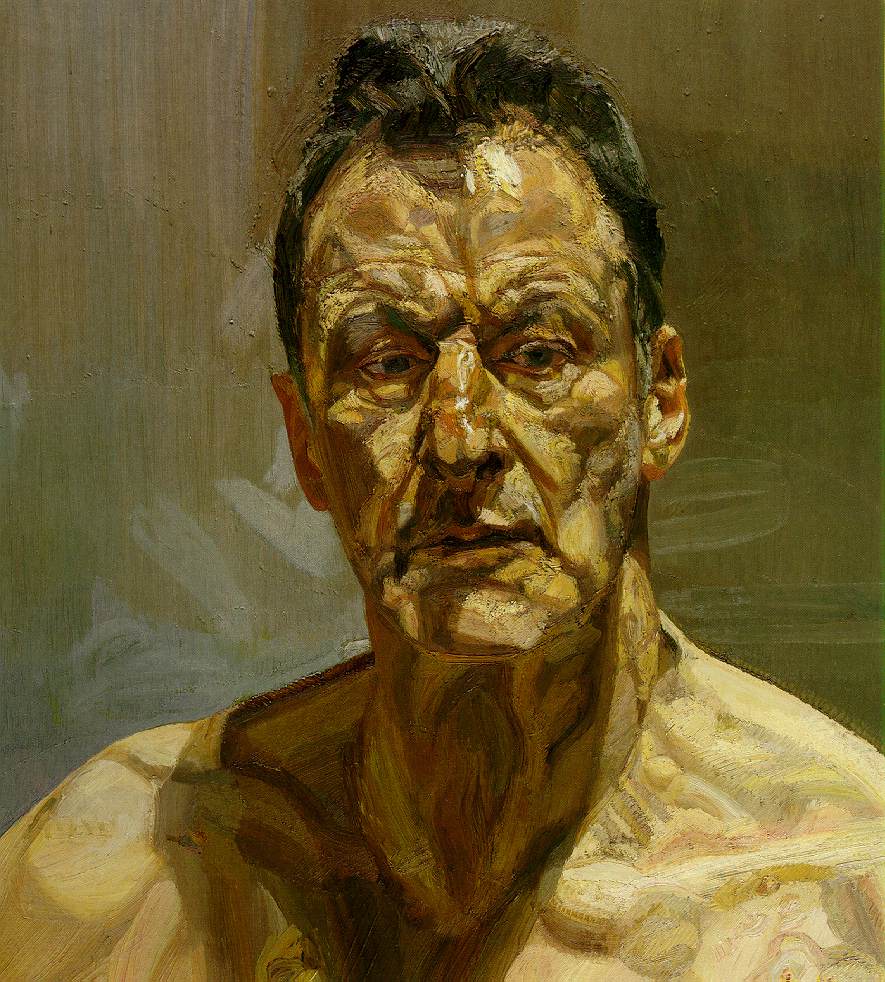
How Lucian Freud Painted Himself by Painting Others

[Image: Lucian Freud. Reflection
(Self-portrait), 1985 (detail). Copyright: Private Collection, Ireland, The Lucian Freud Archive.
Photo: Courtesy Lucian Freud Archive.]
[Many thanks to the National Portrait Gallery, London, England, for the image above and other press materials from the exhibition Lucian Freud Portraits, which runs through May 27, 2012. Many thanks to Yale University Press for providing me with review copies of Lucian Freud Portraits by Sarah Howgate with Michael Auping and John Richardson and Lucian Freud Painting People, introduction by Martin Gayford, appreciation by David Hockney, and foreword by Sarah Howgate.]
Subscribe to:
Posts (Atom)