Showing posts with label Gainsborough (Thomas). Show all posts

Wednesday, June 30, 2010

Double Vision: “Seeing Double” at the Yale Center for British Art


If imitation is the sincerest form of flattery, then John Scarlett Davis must have been the sincerest flatterer in all of England in 1829. In the exhibition Seeing Double: Portraits, Copies and Exhibitions in 1820s London, the Yale Center for British Art solves the “puzzle” of Davis’s painting The Interior of the British Institution Gallery (shown), which caused a stir in the London art scene of 1829 in ostensibly recreating an exhibition of Old Masters hosted in 1829 by the British Institution, a London-based art organization run by collectors and connoisseurs. “Ostensibly” becomes the key word in examining Davis’ painting, as the Yale Center’s research shows just what kind of liberties Davis took in his recreation and to what ends he took those liberties. Please come over to Picture This at Big Think to read more of "Double Vision."


[Image: John Scarlett Davis, The Interior of the British Institution Gallery, 1829. Oil on canvas. Yale Center for British Art, Paul Mellon Collection.]


[Many thanks to the Yale Center for British Art for providing me with press materials for Seeing Double: Portraits, Copies and Exhibitions in 1820s London, which runs through September 19, 2010.]

Monday, April 13, 2009

Power Player


I got a lot of funny looks when I gushed over a portrait by Thomas Lawrence while attending a wedding last November. In an upstairs gallery of the mansion where the wedding took place, a portrait by Lawrence that I had never seen stood beside examples by Joshua Reynolds, Thomas Gainsborough, and Allan Ramsay, reuniting the four greatest British portraitists of the late eighteenth and early nineteenth century. Born April 13, 1769, Lawrence may have been the most talented of the bunch, a child prodigy who started drawing pastels of the patrons of his father’s inn and rose to become painter to first King George III and later King George IV . Lawrence’s portrait of Caroline Amelia Elizabeth of Brunswick (above, from 1804) shows the future queen consort of George IV in younger days. Lawrence alludes to her troubled marriage to the wild Prince Regent by placing her left hand, upon which she wore her wedding ring, in dark shadow. The full extent of Caroline’s marital woes most likely reached Lawrence’s ear during sittings for many portraits over the years. Rumors persist that Lawrence and Caroline even carried on an affair. If so, it was just another self-destructive behavior for Lawrence, who allowed alcoholism and financial irresponsibility to limit how far he could take his gift.


After the defeat of Napoleon in 1815, the Prince Regent IV commissioned Lawrence to paint all the great European heads of state involved in that victory, who had gathered together at the Congress of Vienna. Lawrence painted Pope Pius VII (above) in 1819. Pius VII received credit for fighting Napoleon in the end, although he attended Napoleon’s self-coronation and played ball with the emperor when it suited papal purposes. The real importance of Lawrence’s portrait of Pope Pius VII comes in the amazing fluidity of the drapery and textures. Lawrence recognized the great potential of popish pomp and squeezed every last ounce of juice out of it. Always aware of the history of art, Lawrence measured his achievement against that of Raphael’s Julius II, Titian’s Paul III, and Velázquez’ Innocent X. Lawrence owned one of the finest collections of Old Master drawings in the world, so the greats of the past were always near at hand. A classicist at heart, Lawrence even helped acquire (for good or ill) the Elgin Marbles for England. Lawrence produced many non-portrait works of great beauty and power, but it was with his portraits that he made his fame and fortune, thus overshadowing the depth of this great, forgotten master.


I like to compare Lawrence with John Singer Sargent. Both owned immense, precocious talent that made their art seem lightweight and all surface with no depth. Both, however, were more than just portraitists of the rich and famous, as scholars now struggle to establish. Lawrence’s portrait of Margaret, Countess of Blessington (above, from 1822) certainly captures the surface flash of her good looks and beautiful finery, but it also reproduces the vivacity of her personally. Host of one of the foremost literary salons of her day, Lady Blessington was much more than a pretty face. The first time I saw a portrait by Lawrence it was this sense of life in the eyes that intrigued me to learn more about him and his art. Sadly, I’ve also seen some lesser Lawrence, including the portrait at that wedding, which seemed a later work, when Lawrence’s light was beginning to dim. It’s amazing to tally up just how much a simple innkeeper son achieved through artistic talent and personal charisma (he almost became an actor!), but even that seems a paltry sum considering just how far he could have gone.

Monday, March 23, 2009

Kingmaker


The Van Dyck and Britain exhibition currently at the Tate Britain rightfully places Anthony Van Dyck at the origin of the golden age of eighteenth century portraiture in England, the “father” of Reynolds, Gainsborough, Ramsay, and Lawrence. Born March 22, 1599, while his contemporary Diego Velázquez – aggrandized in paint Philip IV of Spain, Van Dyck depicted King Charles I of England and Scotland to his best advantage. Sensing the increasing weakness of the Catholic Church as the Protestant Reformation dragged on, European monarch seized the opportunity to employ the fine arts for propaganda much as popes had for centuries. Van Dyck’s Charles I of England at the Hunt (above, from 1635) shows the king in all his merciless glory, celebrating the murderous hunt with a sneer. Charles I subscribed to the idea of the Divine Right of Kings, that god-given right of royalty to the throne that no earthly power could deny. Charles I fought with anyone and everyone, including his own parliament. Popularity was not a priority. Van Dyck here lavishes on the king the brilliant brushwork he learned from Peter Paul Rubens, giving the mortal king an almost mythical sheen reserved for Olympic gods. Charles I, of course, believed it was his due.


During his reign it was almost as if Charles I courted controversy. He married Henrietta Maria of France, a Catholic, over the objections of parliament and the English people, who were weary of decades of religious strife tearing the nation apart. Van Dyck painting of Charles I and Queen Henrietta Maria with Charles, Prince of Wales and Princess Mary (above, from 1632) stood as a big middle finger to the country. Charles I set Van Dyck up as the official court painter and provided him with a studio close enough that the royals could walk back and forth from their regular sittings. Van Dyck became absurdly rich by the standards of artists of the time and even scored a knighthood for his work. Soon the appeal of being painted by Van Dyck spread to the rest of English nobility and Van Dyck became the go-to artist for those looking to immortalize their social standing.


Making Charles I look good was literally a tall order. To create the illusion of grandeur for a king that stood less than five feet tall, as Charles I did, Van Dyck resorted to many tricks, the most notable of which was the equestrian portrait. Van Dyck’s Charles I on Horseback (above, from 1635) raises the king up while lowering the sights of the viewer. The low horizon makes us feel as if we’re standing at stirrup level, craning our neck up at a towering monarch rather than a diminutive despot. Charles I’s antics eventually led to the English Civil War and the Cromwellian Interregnum. After a series of battles, Charles I was captured and tried and literally cut down to size—headfirst. The head that Van Dyck painted over and over fell victim to regicide. After Charles II regained the throne in 1660, Charles I was canonized by the Church of England, but Van Dyck had canonized him long before.

Monday, December 8, 2008

The Art of Love


Ovid’s got nothing on this pair. Many years of love and laughter to Lisa and Paul (above). Annie and I attended their beautiful wedding at the majestic Glen Foerd Mansion just north of Philadelphia along the Delaware River. From the elegant ceremony to the great food to the riotous dancing, it was a night to remember for everyone. (Annie thinks Lisa’s a genius for circumventing the whole “who’s going to sit with whom” drama of a seating arrangement by letting people sit wherever and with whomever they wanted.)

An added delight for me was the chance to see the mansion’s art gallery. Annie and I made our way upstairs to the gallery during the cocktail hour and the first thing that caught my eye was a large portrait centered on the far wall. I immediately said to Annie, “That’s a Lawrence!” And it was by Sir Thomas Lawrence, one of my favorite portraitists of the late eighteenth and early nineteenth century. (I wasn’t allowed to take photos in the gallery, but a photo appears here. The Lawrence is the large full-figure portrait at the end of the hall flanked by two smaller portraits.) In terms of composition and style, the Glen Foerd portrait reminded me of Lawrence’s portrait of Elizabeth Farren at the Met, but this portrait didn’t have the same liveliness. Lawrence at his best paints eyes with a startling energy and life, but these were a little lifeless, leading me to suspect that it was a later, lesser work, but still interesting. Surrounding the Lawrence were examples of the work of all the other great British portraitists of the period: Joshua Reynolds, Thomas Gainsborough, and Allan Ramsey (a portrait of Queen Charlotte herself). The Big Four of the time of King George III were all there.

Annie and I then toured the room and saw a Rembrandt (or at least attributed to the school of Rembrandt), a Rubens, an early Van Gogh from the early The Potato Eaters period, and a Monet landscape. My head was still spinning as Annie and I made our way down the stairs for the toasts and post-cocktail hour festivities.

So, once again, all the best, Lisa and Paul, and thanks for giving us a night out without Alex and a chance to see the beauty of the past as well as the beginning of your beautiful future together. Cheers!

Wednesday, October 15, 2008

No Ordinary Painter


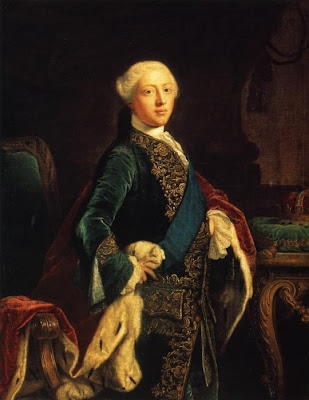
After taking the Grand Tour, and painting the portraits of others on that nineteenth century rite of cultural passage, Allan Ramsay found himself named “Painter in Ordinary” to England’s King George III, besting the greatest portraitists in England for the post. Born October 17, 1713, Ramsay painted the king in full regalia in his Portrait of George III (above, from 1762). Since the days of Elizabeth I, royal portraiture carried a giant load of metaphorical weight. Ramsay’s relaxed, warm style suited the new “look” that the king wanted for himself and the royal family—still seated firmly in the position of power but also conscious of the oncoming Age of Enlightenment and its challenges to entrenched, enthroned authority. Whereas Elizabeth I requested portraits posing her literally astride the globe like a colossus with all traces of humanity covered up by voluminous gowns, George III wanted viewers to see him as a man first and foremost, albeit a man with considerable power. Ramsay, the “Painter in Ordinary,” made the ordinary look extraordinary with his own extraordinary skills.


Sir Joshua Reynolds, Thomas Gainsborough, and Sir Thomas Lawrence would follow Ramsay’s lead as they founded the golden age of British portraiture in the generation just after Ramsay’s peak years. That trio followed Ramsay not only in portraying the trappings of power, but also in painting more tender, “behind the throne” scenes such as Ramsay’s Queen Charlotte with her Two Children (above, from 1765). Queen Charlotte widely patronized the arts and clearly recognized the more subtle skills of Ramsay. Instead of asking for the royal treatment, Queen Charlotte chose to have her and her two children painted more naturally, as if they were simply a well-off mother with her beloved children and not the queen and the heirs to the throne. Ramsay’s skill in painting the children with the same tenderness shown to them by their mother matches the attentiveness he gives to the beautiful fabrics they wear.


Ramsay’s talents extended beyond just the visual arts. Like his father, also Allan Ramsay, Ramsay wrote poetry and dabbled in other forms of writing, cultivating the rich, cultured existence of a gentleman of the time. Ramsay certainly knew the works of David Hume when he painted his portrait (above) in 1766. Hume’s naturalistic philosophy based on the idea that reality is only what we perceive empirically and not something we can reason out, succinctly described in An Enquiry Concerning Human Understanding (bane of freshman Philosophy students everywhere, myself included), fits in well with Ramsay’s style of painting. Rather than construct a grand narrative and alter the facts to fit that narrative, Ramsay instead painted exactly what was before him—the grand and the small, the superhuman and the humanly fragile. The gentle treatment of Hume in his portrait may attest to Ramsay’s finding of a kindred spirit in the philosopher. Sadly, Ramsay fell from a ladder in 1770 and injured his painting arm beyond repair. After finishing one last royal portrait despite excruciating pain, Ramsay left his post and an assistant completed the unfinished works. Ramsay spent his final years in Italy, writing and reading yet always pining for the days when he could paint the ordinary in his extraordinary fashion.

Monday, March 24, 2008

More Than Just a Beard


I’ve never succeeded at growing facial hair resembling anything respectable, but if I could, no Maynard G. Krebs soul patch for me. I want a Van Dyck. Born March 22, 1599, Anthony Van Dyck is far, far more than a snazzy beard. The star pupil of Peter Paul Rubens, Van Dyck found his greatest subject and patron in Charles I of England, shown above in a triple portrait (from 1635-1636) painted to be sent to Italy instead of Charles I himself for a portrait bust by Bernini. (That royal head would fall from those shoulders a decade later in the English Civil War, beginning the English Interregnum.) Van Dyck painted Charles I from literally every angle—wearing the trappings of power, on horseback, etc.—all with the same stylish facial hair that the Flemish artist himself sported so eponymously.


Although he’s most famous for his portraits of the powerful, Van Dyck also painted religious and mythological scenes. In Susanna and the Elders (above, from 1621-1622) Van Dyck shows his mastery of the Rubenesque nude he learned at the feet of the master. It’s fascinating to look at these non-portraits of Van Dyck’s and see a dramatic flair completely missing from the almost aloof depictions of royalty. Van Dyck certainly knew his audience, whether it was a royal patron desiring a portrayal as a fearless leader or the buyer of a ostensibly religious yet still salacious work such as Susanna, a common excuse for a “religious” nude in the same vein as the “acceptable” nudes posing as Aphrodite or other goddesses.


In addition to Rubens, Titian, Veronese, and the Italian masters Van Dyck studied firsthand in Italy for six years left a lasting impression on his art. The two young men shown in Van Dyck’s Lord John Stuart and His Brother Lord Bernard Stuart (above, from 1638) could be taken for young mythological gods if not for their seventeenth century dress. The same disdain the Olympians showed for the common people appears on the faces of these young noblemen in Van Dyck’s double portrait. It’s not a pretty picture in terms of showing the humanity of the upper class, as few portraits of that time aimed to do, but Van Dyck is masterful in his painting of the rich textures and fabrics of their clothing. The soft leather of their riding boots is beautifully modeled. The gloves hanging from the grasp of the boy on the right fall perfectly. In many ways, the storied history of English portraiture—Joshua Reynolds, Thomas Gainsborough, Thomas Lawrence, and others—begins with Van Dyck, a Flemish import.

Wednesday, December 5, 2007

Finish What You Started


How many Americans today could identify the classic portrait of George Washington on the one dollar bill as copied after the work of Gilbert Stuart? Fewer would even know that the original work (aka, The Athenaeum Portrait; above, from 1796) was never finished, just like the companion portrait of Martha Washington. Born December 3, 1755, Stuart earned a reputation as both the finest American portraitist of his time and the unreliable, debt-ridden, exasperating artist who failed to deliver time and again. Stuart lived large and well beyond his means, enjoying the company of the rich and powerful, including the men who would become the first six presidents of the United States, all of whom Stuart painted, or at least began painting.


Although born in the American colonies and beginning a career as an artist there, Stuart traveled to England to complete his training in 1775 as the hostilities that would become the American Revolution began. Whereas artists such as John Singleton Copley remained in America and adapted from portraits of the upper class to portraits of the new mercantile class, Stuart followed the money and continued to paint members of the upper class. His portrait of William Grant, better known as The Skater (above, from 1782) shows the influence of Benjamin West, who befriended and taught his fellow former colonist. Stuart soon commanded prices rivaling those demanded by Joshua Reynolds and Thomas Gainsborough. Unfortunately, success spoiled Stuart and his spendthrift ways forced him to flee to Ireland in 1787 to avoid debtor’s prison.


Stuart returned to America in 1793, after the Revolution. He soon began painting the new nobility of the young American nation, earning the distinction of being one of the few artists to have painted both King George III and George Washington. Stuart’s finished portrait of George Washington (aka, The Lansdowne Portrait; above, from 1796) shows the founding father in an almost royal pose, incongruous with the ideal of the early republic. When the nation’s capital moved to Washington, DC, Stuart opened a studio there in 1803 to be close to the seat of power. Stuart’s personal charisma made him the favorite portraitist of many of his subjects, charming even the curmudgeonly John Adams with his conversational skills. Sadly, like his contemporary Thomas Lawrence’s alcoholism, Stuart’s financial incompetence stood in the way of him achieving even greater things in art.

Wednesday, July 18, 2007

Royal Flush


Few painters have ever dominated the taste and style of their time so completely as Sir Joshua Reynolds, one of the great triumvirate of grand-style portraitists of 18th century England along with his rivals Thomas Gainsborough and Thomas Lawrence. Reynolds served as the first President of the Royal Academy of Art. From that seat, he dictated the standards of art in his Seven Discourses on Art and created guidelines for art education that influenced several generations after him.


Reynolds painted anyone and everyone of note in 18th century England. He developed a reputation as an intellectual as well as an artist (not always the same thing), buddying up with luminaries such as the author Dr. Samuel Johnson, philosopher and politician Edmund Burke, and Shakespearean actor David Garrick. Reynolds portrait of Johnson (above) displays his affinity for his subject, seemingly catching the good Doctor in mid thought, his pen just about to preserve it for posterity, Boswell no doubt just off stage preserving the preservation in his famed Life of Johnson.

Of all Reynolds’ celebrity portraits, my favorite remains that of author Lawrence Sterne. Anyone who has read The Life and Opinions of Tristram Shandy, Gentleman (a rollicking good read, I assure you) will recognize the devilish glint in Sterne’s eye. Sterne’s grin always brings to my mind the phrase “sidelong pickerel smile” from Theodore Roethke’s poem “Elegy for Jane (My student, thrown by a horse).” Amidst all the trappings of power and hobnobbing with celebrity, Reynolds never lost his ability to capture that spark of individuality in his subjects.


Of course, Reynolds’ coziness with royal power (as shown in his portrait above of George III, pre-American Revolution and pre-Madness) didn’t endear him to everyone. William Blake, Reynolds’ slightly younger contemporary, condemned Reynolds in the margins of his copy of Seven Discourses on Art, saying that “This Man was Hired to Depress Art.” Blake, perhaps jealously but justifiably, railed on further:

This is the opinion of Will Blake: my Proofs of this Opinion are given in the following Notes...

Having spent the vigor of my Youth and Genius under the Oppression of Sr Joshua & his Gang of Cunning Hired Knaves Without Employment & as much as could possibly be Without Bread, The Reader must Expect to Read in all my Remarks on these Books Nothing but Indignation& Resentment. While Sir Joshua was rolling in Riches, [James] Barry was Poor & Unemploy'd except by his own Energy; [John Hamilton] Mortimer was call'd a Madman, & only Portrait Painting applauded & rewarded by the Rich & Great. Reynolds & Gainsborough Blotted & Blurred one against the other & Divided all the English World between them. [Henry] Fuseli, Indignant, almost hid himself. I am hid.


Blake’s marginalian harangue reminds us of the unfortunate equation of power in the art world: the high status and acclaim of some often comes at the cost of the unjust marginalization and erasure of many others.

Tuesday, May 15, 2007

Blue Painter


"I'm sick of portraits, and wish very much to take my viol-da-gam and walk off to some sweet village, where I can paint landskips (sic) and enjoy the fag end of life in quietness and ease," complained Thomas Gainsborough, one of the great portrait painters of 18th century England, who celebrated his 280th birthday yesterday, May 14th. Gainsborough’s most famous work, Jonathan Buttall: The Blue Boy, appears above.

Gainsborough remains forever linked to the two other great British portraitists of his era: Joshua Reynolds and Thomas Lawrence. In fact, Gainsborough’s Blue Boy faces Lawrence’s Pinkie (Portrait of Sarah Barrett Moulton) at the Huntington Gallery in San Marino, California. The desire of nobility to be immortalized by this trio has fortunately created a body of work that has been preserved up to today. Of the three, my favor still rests with the work of Lawrence, but I’ll allow that the best of Gainsborough stands up to anyone’s work.

As can be heard in Gainsborough’s complaint above, his talent as a portraitist became a trap over time. Longing to paint the landscape, Gainsborough barely found time to follow his passion. His Holywells Park, Ipswich appears below. Considering his talents as a portraitist, one can only wonder how far Gainsborough could have gone as a landscapist, possibly rivaling the work of even Constable.


(BTW, Gainsborough’s Blue Boy may lay claim to the title of painting not named the Mona Lisa featured in the most movies. As the Wikipedia entry for Blue Boy indicates, it’s appeared in movies as disparate as Laurel and Hardy’s Wrong Again, The Naked Gun, Ghostbusters II, and the James Bond thriller Die Another Day. With a resume like that, Blue Boy should join the Screen Actors Guild.)