Showing posts with label Hicks (Edward). Show all posts

Thursday, October 16, 2008

Merchant Marine

Thomas Chambers. Capture of the H.B.M. Frigate Macedonian by U.S. Frigate United States, October 25, 1812,1852. Oil on canvas, 34 ½ x 50 inches. Smithsonian American Art Museum/Art Resource; Gift of Sheldon and Caroline Keck in honor of Elizabeth Broun, 1992.

How do you write about a painter about whom almost nothing is known? Can the work absent the biography provide us with satisfying answers? Kathleen A. Foster tackles these challenges in Thomas Chambers: American Marine and Landscape Painter, 1808-1869, the companion publication to the exhibition currently at the Philadelphia Museum of Art. “The distinctiveness of [Chambers’] style as a painter, matched inversely by the vagueness of his biography, has made him a tantalizing figure,” Foster writes of the artist whom she has pursued since the 1990s, “at once one of the most widely collected American ‘folk’ landscape painters and yet one of the least studied and understood.” Putting flesh on the skeletal framework of what we know about Chambers through relentless sleuthing and an encyclopedic examination of what it meant to be a working artist in nineteenth century America, Foster schools readers not only on what kind of artist Chambers most likely was but also on what it takes to recover such lost souls from the depths of murky art history. Chambers’ works, such as his Capture of the H.B.M. Frigate Macedonian by U.S. Frigate United States, October 25, 1812 (above, from 1852), captivate us with their otherness and strange modernity and draw us in to ask more. Foster provides more answers than we should expect.


Thomas Chambers. Rockaway Beach, New York, with the Wreck of the Ship Bristol, c. 1837-40. Oil on canvas, 21 3/4 x 30 3/8 inches. Indiana University Art Museum; Morton and Marie Bradley Memorial Collection.

Foster begins her manhunt in Whitby, England, Chambers’ birthplace, where his brother George initiated him into the world of being a working artist taking on all manner of jobs to make a living. The theatrical and panoramic paintings of popular English entertainment of the time influenced Thomas and impressed on him the need to market your wares properly to survive as an artist. Chambers arrived in the United States in 1832, setting up shop in New Orleans for a few years. Moving to New York City, Chambers advertised himself in a local paper as “Thomas Chambers, Marine and Landscape Painter” ready to perform “Fancy Painting of every description done to order.” Chambers painted everything from furniture and signs to fine art for the home, including works such as Rockaway Beach, New York, with the Wreck of the Ship Bristol (above, circa 1837-1840), which recounts the story of a shipwreck that would have been familiar to his local audience. “With the practical outlook of a mariner,” Foster writes, “he includes the workaday salvage of the ship by the wreckers who have pulled alongside… [yet] within a romantic structure in which a bystander contemplates, under sunny skies, the aftermath of the most recent episode in a timeless cycle of tragedy and recovery.” This tension between merchandising and higher artistic aspirations energizes much of Chambers’ art as he continually pursued a buying audience, often physically, as shown by moves from New York City to Baltimore, Boston, Albany, and New York City, again, before returning to England in his final years. Foster identifies Chambers’ contemporary audience as “prosperous, bourgeois householders attentive to the latest urban style… evidently attracted by a novel, fashionable, prestigious, and cosmopolitan item: the original framed oil painting of a landscape or marine subject.” Upwardly mobile Americans looking to acquire the trappings of success sought out artists such as Chambers, who supplied them with an affordable touch of class. Chambers, Foster believes, was “the first American painter to bring professional landscape and marine easel painting to an audience beyond the metropolitan elite,” thus democratizing art for the still-young democracy.


Thomas Chambers. The Constitution and the Guerrière, c. 1840-50. Oil on canvas, 24 3/4 x 34 1/4 inches. Metropolitan Museum of Art; Gift of Edgar William and Bernice Chrysler Garbisch, 1962.

Capitalizing on the continued interest in the War of 1812, Chambers painted multiple versions of The Constitution and the Guerrière (above, from circa 1840-1850), the battle that made “Old Ironsides” a household name. Chambers painted several different naval conflicts from that war, always looking to open up new markets or fulfill new commissions. Chambers played to the wishes of his audience and his own tastes rather than slavishly copy reality. “Sailors might have been disdainful, considering the nonsensical signal flags, out-of-scale vessels, and perilous courses depicted,” Foster muses, “but perhaps they enjoyed [Chambers’] spirit,” as adventuresome in paint as the events he depicted. To expect properly rendered ship’s rigging from Chambers work seems as silly as to expect anatomically correct animals in the work of Edward Hicks, an artist from the generation just before Chambers’. N.C. Wyeth actually owned two naval battle scenes by Chambers, proving that their inner spirit continued to entrance kindred spirits even a century later. Although not truly an illustrator like Wyeth, Chambers scoured popular magazines and newspapers for subjects for his brush, illustrating the images that were fresh in the mind of his buying audience.


Thomas Chambers. Niagara Falls from the American Side, c. 1843-52. Oil on canvas, 18 1/16 x 24 inches. Indiana University Art Museum; Morton and Marie Bradley Memorial Collection.

Although Chambers painted both marine and landscape scenes, he clearly identified himself as a marine painter. The few works that bear his signature are marine paintings. Chambers might actually have gone so far as to create aliases under which he could sell his landscapes. Another factor that may have led Chambers not to place his name on such works as Niagara Falls from the American Side (above, circa 1843-1852) may have been his “borrowing” of such subjects from prints. Foster sees the fact that Chambers never copied one of Thomas Cole’s compositions as a sign that he respected the older artist’s work too much to mimic it. Although Chambers grew up in an art world that viewed such copying as a long-accepted practice, he practiced long enough to reach a time when such copying was looked down upon. “The issue of originality defines a sea change in that world during [Chambers’] lifetime that would forever disqualify him as a so-called fine artist in the eyes of his contemporaries,” Foster writes, explaining in part how Chambers fell into obscurity over time until his rediscovery in the middle of the twentieth century.


Thomas Chambers. Landscape with Lake and Monastery [Lake Albano and Castel Gandolfo?], c. 1843-60. Oil on canvas, 18 1/16 x 24 3/8 inches. Indiana University Art Museum; Morton and Marie Bradley Memorial Collection.

In the late 1930s, art dealers Albert Duveen and Norman Hirschl discovered a signed work by Chambers that led them to connect that one work to similarly painted works that had also emerged around that time. In 1942, they exhibited at the Macbeth Gallery in New York City 18 works attributed to Chambers, hailing him as the “First American Modern” and “The American Rousseau” for his unique style so similar to the primitivism valued by modern art movements. Just as Herman Melville resurfaced as the quintessential American novelist in the 1920s, Chambers resurfaces from obscurity as an “authentic American artist” according to critic Thomas Craven and others. Ironically, Foster points out, the “flatness, unnatural color, expressive distortion, abstraction, and simplification” of such works as Landscape with Lake and Monastery [Lake Albano and Castel Gandolfo?] (above, circa 1843-1860) that Chambers’ contemporaries “deemed bad in Chambers’ day… are exactly the traits that… make him a model of liberated individualism and originality” for a modern audience. Foster proceeds to prick this tidy balloon of posthumous acceptance by viewing the modern reading of Chambers as being as much a misreading of his art as the reading of his contemporaries. “Laundered, over time, of the class and guild prejudices that colored the opinions of Chambers’ own contemporaries,” Foster explains, “his work comes to us with nuances of subject matter and context likewise lost, and a measure of nostalgia and condescension added, as we smile over imagined naïve and innocent citizens of the past decorating their fancy parlors.” Foster’s coup de grace arrives in the form of Thomas Kinkade, whom Foster evokes as a possible analogue to the case of Chambers—an artist who played to the taste of his time in his own style despite critical approbation. “[I]f it is useful to call Chambers the ‘First American Modern’ in 1942,” Foster asks, “is it helpful to understand him as the ‘first Thomas Kinkade’?”

One of the finest prose stylists in art history writing today, Kathleen Foster delivers mightily with Thomas Chambers. As shocking as including the “Painter of Light™” in her argument seems, Foster makes it not only provocative but illuminating. Like Chambers’ art itself, Foster easily crosses all strata of culture, high and low, including Walt Disney’s Fantasia and PBS’ Bob “Happy Little Trees” Ross, to give a fully rounded recounting of what Chambers’ life most likely would have been like based on the sketchy evidence that survives. Foster’s presentation of her Sherlock Holmes-ish detective work and deductions are exhaustive without being exhausting, lightened by the twinkling wit of her writing and her impeccable eye for images that illustrate Chambers’ strengths. If you should ever fall into obscurity, pray for someone like Kathleen Foster to pull you out of it. Thomas Chambers recreates a little-understood era in early American art and exhumes an artist both representative of that time and well welcomed in our own.

[Many thanks to the Philadelphia Museum of Art for providing me with a review copy of Kathleen A. Foster’s Thomas Chambers: American Marine and Landscape Painter, 1808-1869 and for the images from the exhibition.]

Monday, July 28, 2008

From the Outside In


With only a third-grade education and art supplies he scavenged from trash, William Hawkins typifies the kind of outsider artist who found acceptance in twentieth century art. Born July 27, 1895, Hawkins claimed that his mixed heritage—black, white, and Native American—was the source of his artistic ability. Hawkins painted Sioux Indian on Warpath (above, from 1985) as an homage to that piece of his ancestry, but painted images related to American history, pop culture, his farm upbringing, and the Bible during his 94 years on Earth. Using cast-off enamel paint and discarded masonite boards, Hawkins took an innate sense of composition as well as a precocious gift for color and created images that rival those of his contemporary Jacob Lawrence in their colorful simplicity and those of Henri Rousseau in their amusing depictions of animal life. Spurred on by the need to support twenty children and sometimes even his grandchildren, Hawkins painted the world around him always with an eye on what would sell.


I love Hawkins’ Prudential N.Y.C. (above, from 1985) for the odd green mountain take on the famous Prudential Financial logo. Hawkins shows a Pop Art sensibility without the ostentation of Pop Art itself. What you see is what you get. That’s not a swipe at his lack of education but praise at his outsider’s sense of honesty, something that art world insiders often lose once the system lays claim to their talents. Hawkins was already in his seventies when he began painting full-time and didn’t get any wide-spread recognition until he was in his eighties. Even today, few books exist that cover his art and that of similar outsider artists. Critics simply don’t know how to handle these artists. I find myself trying to relate Hawkins to what I know, but realize that the full impact of Hawkins’ art comes from him being slightly different from what I know, as if he’d landed on an artistic Madagascar long ago and evolved in a wonderfully different direction like some kind of rare, painting lemur.


Of course, Hawkins did know some kinds of art, mostly from popular culture and religious imagery. Everyone knows Da Vinci’s The Last Supper, including Hawkins, who created a series of mixed-media works on the subject, including Last Supper #6 (above, from 1986). Toward the end of his life, Andy Warhol also created a series of meditations on Da Vinci’s Last Supper, mostly as examinations of his own devout Christianity, but Hawkins’ series seems more like a study of the imagery itself, with a eye-catching framework that was not only a nod towards salability but also a reminder that this is an image and not unfiltered documentation. Hawkins signed most of his works “William L. Hawkins, Born KY July 27, 1895,” giving the plain, unadorned facts of his existence. His crude writing reminded me of the text that Edward Hicks would place on the borders of his Peaceable Kingdom paintings, giving the plain, unadorned “facts” as the Bible set them out. In many ways Hawkins continues (and perhaps completes) the long line of American outsiders that Hicks began.

Wednesday, May 21, 2008

Custom Made


Henri Rousseau, known in the art world during and after his death as Le Douanier, or “The Customs Officer” in French, must have seemed a truly odd character. Born May 21, 1844, Rousseau was anything but bohemian, working at his conventional government job and raising his family. Rousseau was the classic dabbler, a man who showed a love of drawing and music since childhood but who could never make a living at it. In the 1880s, Rousseau took up painting seriously, getting some advice from professional artists such as Jean-Léon Gérôme but for the most part teaching himself. In 1893, Rousseau retired from his job and indulged himself in his hobby. During his lifetime, critics laughed at his efforts, such as The Sleeping Gypsy (above, from 1897), but today that painting hangs in the MoMA. The Naive or Primitive style Rousseau stumbled upon while trying to paint in the classical tradition made him one of the true originals of Post-Impressionist painting.


Even today, Rousseau’s work looks childlike. In terms of simplicity, Rousseau and Edward Hicks run neck and neck. Part of the charm of Rousseau’s painting is that he wanted desperately to engage art history and the great painters of the past and present but lacked the formal training to copy them closely. Instead, Rousseau’s unique spin on subjects such as War (above, from 1894), with the female figure boldly riding the ragged-looking horse across the image, deconstructs the patriotic fervor of nationalistic works by Delacroix or David. We want to laugh at Rousseau’s poor draftsmanship, but part of that laughter soon gets directed towards the subject of war itself. Picasso and others who followed Rousseau would learn the lessons of Le Douanier the way that the Customs Officer learned the real lessons of his predecessors.


Gerome, Delacroix, and others all fostered a taste for the exotic in French painting, which many artists, including Renoir, tried to capitalize on at one point or another. Rousseau’s Orientalism comes second hand, based on those other artists’ imagery rather than first-hand experience. Because of that distance, Rousseau’s exotic works become dreamlike and mysterious. The Sleeping Gypsy (top of post) and The Snake Charmer (above, from 1907), among many other scenes of lions, tigers, monkeys, and other creatures in strange jungles and deserts, look amazingly modern today. What seemed amateurish and childlike at the turn of the century just a couple decades later seems a precursor of Surrealism. Le Douanier remains an inspiration to all amateur artists who take their love of art and create a unique style despite all the naysayers.

Monday, April 28, 2008

Wild Kingdom


Few artists have captured the power and beauty of savage beasts like Eugene Delacroix. Born April 26, 1798, Delacroix painted inspirational scenes of the struggle for freedom such as 1830’s Liberty Leading the People and brought the exoticism of the Orient to France in works such as 1828’s Death of Sardanapalus. However, I’d like to focus on how Delacroix viewed the king of the beasts in works such as Tiger and Lion (above, from 1828-1829). There’s certainly a great eye for realistic detail, but what separates Delacroix from those merely copying nature is how he dramatizes it. The almost human cast of the eyes of the tiger and lion as they circle one another, each looking for an opening to strike, speaks as much of mankind’s bloodlust as any animal instinct. Oddly, Henri Rousseau saw this painting exhibited at the Paris Salon and patterned the kindler, gentler animals of his paintings after Delacroix’s anthropomorphized bestiary. As revolution raged in Delacroix’s Europe, however, it was difficult for the politically engaged artist not to believe that it was truly a jungle out there and to populate his art accordingly.


My favorite Delacroix lion appears in his 1841 watercolor above. The freedom and speed of watercolor as a medium permitted Delacroix to convey that same sense of movement and unbridled energy. I’ve always thought that Delacroix’s big cats address the tension of William Blake’s Tyger, Tyger even better than the poet’s own illustration. It’s also fascinating to me to consider that as Delacroix paints these creatures inspired by his experience of revolution and war, Edward Hicks is in America painting his Peaceable Kingdom series of doe-eyed lions laying down with lambs in a pacifist paradise. Looking ahead to future conflicts, I see some connection between Delacroix’s animals and those of Franz Marc, who similarly captured the power and tension embedded into the fabric of the tiger as a physical manifestation of the boiling pressures that soon would explode in the form of World War I.


I used to laugh at some of Delacroix’s later animal images, such as Lion and Alligator (above, from 1863). Some of the combinations reminded me of monster movie match-ups like Mothra versus Godzilla. In Lion and Alligator, the tiny reptile doesn’t stand much of a chance against the cruel claws ready to tear it apart. As much as I try to read this work politically, I can never decide if the lion represents the people, tearing into the cold, reptilian heart of royalty through revolution, or if the lion represents the established power, crushing the hopes of the little people struggling to be free. At the very least, it’s an image of inequality, a vast departure from the more evenly matched tiger and lion of 1828. Perhaps Delacroix had wearied of the battles strewn across his life and saw wars for what they essentially are—the bane of the voiceless caught in the crossfire—which is as true in nineteenth century Europe as it is in the twenty-first century Middle East.

Friday, April 4, 2008

Minister of Peace


“My constitutional nature has presented formidable obstacles to the attainment of that truly desirable character, a consistent and exemplary member of the Religious Society of Friends,” wrote Edward Hicks in his posthumously published Memoirs, “ one of which is an excessive fondness for painting, a trade to which I was brought up, being connected with coach making, and followed the greatest part of my life.” Born April 4, 1780 and reborn around 1800 as a Quaker minister, Hicks continually fought his “fondness for painting,” which he saw as worldly and sinful, “a link in the chain of anti-Christian foibles next to music and dancing.” Hicks found resolution in creating religious images promoting the pacifism of the Society of Friends, most famously the sixty or so works known as The Peaceable Kingdom. The example above (from 1833-1834) not only depicts the words of Chapter 11 of the Book of Isaiah, where the lion lays down with the lamb and a little child leads them, but also shows the Quaker founder of Pennsylvania, William Penn, forming a peace treaty with the local Lenape tribe. In 1999, I saw nearly half of the Peaceable Kingdom paintings all together at an exhibition at the PMA. The sheer repetition of the imagery wore me down a bit, but I wish now that I’d have gone back to look more closely at this unique figure in American art.


Because he painted the words of Isaiah so many times, it’s hard to imagine him painting anything else. Of course, Hicks grew up painting carriages and store signs first as an apprentice and later as the owner of his own business. “I should be a burthen on my family or friends were it not for my knowledge of painting,” Hicks wrote, acknowledging that all his service to the Society of Friends brought him no income. I’m fascinated by Hicks’ Washington at the Delaware (above, from 1849) in how it portrays Hicks’ perception of the heroic George Washington, whose mythology bloomed beyond reason immediately after his death and continued to grow throughout the nineteenth century. Living in the Delaware Valley of Pennsylvania, Hicks undoubtedly knew people who had seen Washington in action and perhaps even fought at his side. Characteristically, Hicks shows Washington during a moment of peace, being too much of a pacifist to show the Father of His Country in battle. Hicks’ painting of Washington’s horse is wonderful. After riding horseback for thousands of miles, preaching the Quaker way as far as Canada, Hicks clearly knew every inch of what a horse looked like.


Hicks’ memoirs frustrate for the most part those looking for some glimpse into his painting style. Most of the memoirs deal with his faith, sprinkling disparaging remarks about painting here and there. I’d love to know what was going through Hicks’ mind when he put those human-like features on the animals in some of his Peaceable Kingdom paintings or where he saw some of the more exotic animals gathered in his Noah’s Ark (above, from 1846). Hicks, however, does end his memoirs by evoking the words of Isaiah: “Finally, my friends, farewell! May the melancholy be encouraged and the sanguine quieted; may the phlegmatic be tendered and the choleric humbled; may self be denied and the cross of Christ worn as a daily garment; may his peaceable kingdom for ever be established in the rational, immortal soul; then will be fulfilled the prophetic declaration of the infinitely wise Jehovah, through his evangelical prophet—“The wolf also shall dwell with the lamb, and the leopard shall lie down with the kid; the calf, and the young lion, and the fatling together, and a little child shall lead them… Nothing shall hurt or destroy in all my holy mountain, for the earth shall be full of the knowledge of the Lord, as the waters cover the sea.” How amusing it would be to Hicks that his most lasting legacy of his pacifist faith would be the paintings he saw as a sinful diversion from God’s work.

Wednesday, November 28, 2007

Still Burning Bright

When the stars threw down their spears,
And watered heaven with their tears,
Did he smile his work to see?
Did he who made the Lamb make thee?

Tyger! Tyger! burning bright
In the forests of the night,
What immortal hand or eye
Dare frame thy fearful symmetry?

From “The Tyger” by William Blake

Two hundred and fifty years ago on this date, William Blake, one of the greatest figures in British art and literature, was born. Perhaps no other artist combined such great talent in both art and poetry and such a capacity to combine both those fields so seamlessly. His illuminations of his own poetry, such as The Tyger (above, from 1794), add a whole other dimension to his art. Whole libraries of criticism have been written on Blake, so I can add only my humble piece to the pile. (If you’re looking for a place to begin, Northrop Frye’s Fearful Symmetry and Harold Bloom’s Blake’s Apocalypse remain my favorites.) To take The Tyger as an example of Blake’s symbiotic art of words and imagery, just look at the tiger at the bottom of the page. Blake’s tiger looks more friendly than fearful, smiling as if he had just escaped from a painting by Edward Hicks. Blake’s benign beast belies the idea of nature as “evil.” Nature just is, with good and bad defined by human reason and superimposed on the natural processes both tigers and lambs follow. The power of Blake rests in his ability to see the world with fresh eyes. As Blake once said, “If the doors of perception were cleansed everything would appear to man as it is, infinite.” (Jim Morrison took those words, and many others by Blake, to heart many years later.)


Blake’s spirituality earned him a reputation as a madman during his life. When a friend found Blake talking to a tree, he asked him if he was actually talking to the tree. “Of course not,” Blake replied. “I’m speaking with the angel in the tree.” However, Blake never blinded himself to the possibilities of science. Isaac Newton became one of his favorite subjects. In The Ancient of Days (God as an Architect) (above, from 1794), God himself assumes the role of a man of science, taking the measure of the universe he created. Just as there is always a balance between poetry and painting in Blake’s vision, there is always a balance between reason and imagination—a continual back and forth where neither side dominates for risk of losing the benefits of the other. Blake’s art intoxicates you when you first encounter his poetry or his imagery. Then it overwhelms you with his complexity. Because of this difficulty, a select handful of followers kept Blake’s memory alive and rescued it from the very real threat of obscurity.


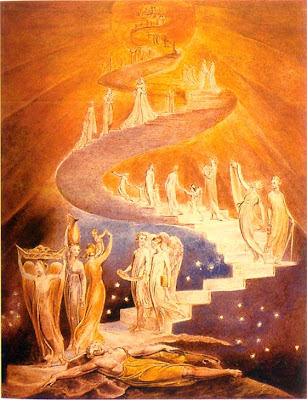
Among those followers was the painter-poet Dante Gabriel Rossetti, who helped see the first biography of Blake into publication in 1863 after the death of the author, Alexander Gilchrist. Since those early efforts, from the Pre-Raphaelites on, each generation has come to Blake and found something that speaks to it. Images such as Blake’s Jacob’s Ladder (above, from 1800) bring the stories of the Bible to life like few others. Blake’s own Christianity was highly unorthodox, which actually adds to the freshness and appeal of his religious works. The PMA owns a wonderful little Nativity scene by Blake in which the Baby Jesus literally flies out of the Virgin Mary’s womb. It used to hang across from J.M.W. Turner’s The Burning of the Houses of Lords and Commons, October 16, 1834, my favorite work in the PMA’s entire collection. I always would make a point of looking at that tiny Blake after getting my full Turner fix. I’m pretty sure that Blake and Turner never met, but I’d love to have sat in on that conversation.

Friday, September 7, 2007

Young at Heart


When arthritis set in and she could no longer do needlework embroidery, Anna Mary Robertson Moses decided to take up painting at the amazing age of 76. Over the next 30 years (yes, 30 years) of her life, the artist better known as Grandma Moses painted over 1,500 works in her own unique style. Born September 7, 1860, months before the election that would choose Abraham Lincoln, Moses lived to see the inauguration of John F. Kennedy as president. On her grave was written, “Her primitive paintings captured the spirit and preserved the scene of a vanishing countryside.” In works such as A Country Wedding (above), from 1951, painted when Grandma was 91 years old, Moses preserves the simpler days of courtship and community that remained in the recesses of her memory.


People always accentuate the primitive in Moses’ work. I’ve always seen it more as a direct translation of her quilting and embroidering days onto canvas. Her figures and perspective sometimes seem awkward, but Edward Hicks and other “primitives” never seem to be held back as much as Grandma for these crimes. I think critics underestimate Moses’ compositional skill, especially in works such as The Quilting Bee (above), from 1950. The painting literally buzzes with activity and the rhythm of figures and color almost approaches that of Piet Mondrian if you look at it as an abstraction rather than purely realistic. It’s fascinating to think just how her art would have developed had she begun earlier or had a different educational background. Of course, taking care of a household and farm while giving birth to ten children (five of whom sadly died in childhood) may have kept her a little too busy to paint. Also, much of the strength of Moses’ work comes from this evocation of memories of a lost age.


Moses’ work once held a mainstream popularity of the Currier and Ives or Hallmark type. Works such as Let Me Help (above), showing people choosing and chopping down their Christmas trees, evoke a warm and fuzzy mythos Americans love to wrap around their holidays, perhaps as an antidote to the increasing commercialism of them. This mythic aspect embroiled Grandma Moses in the Cold War artistic “arms race” waged between the United States and the Soviet Union in the 1950s. Segments of the U.S. Government in the 1950s wanted to promote the Abstract Expressionists, especially Jackson Pollock, as symbolic of American freedom and individuality versus the forced conformity of Communism. More conservative corners of the power elite, including Presidents Harry Truman and Dwight Eisenhower, touted Grandma Moses as the exemplar of America’s goodness through her images of a golden age of innocence and community. Imagining Grandma and “Jack the Dripper” squaring off in battle may induce giggles, but such dichotomies in contemporary art should always be resolvable in some way. Both Moses and Pollock were expressionists—Pollock expressed the now and the self, whereas Moses expressed the past and the community that was so very present to her.

Thursday, August 23, 2007

Horsing Around


Perhaps the greatest painter of the horse ever, George Stubbs was born on August 24, 1724. Stubbs parlayed his lifelong interest in art and anatomy first into a series of medical illustrations for a midwifery text and then into a text on horse anatomy. With his beautifully detailed horse illustrations, Stubbs hit equine gold. Whistlejacket (above), commissioned by the Third Marquess of Rockingham, shows Stubbs amazing ability not only to present horses in all their anatomical wonder but also his ability to capture the sense of personality of these animals that endeared them to their owners. The gratitude of these owners made Stubbs a very, very wealthy artist.


Although Stubbs name is now synonymous with his equine paintings, he also painted other animals, including lions, tigers, giraffes, and even monkeys. Stubbs’ Horse Frightened by a Lion (above) belongs to a series of paintings in which he pitted frightened horses against the king of the jungle. Exotic animals from the jungles of Africa toured England and Europe throughout the 18th century as curiosities and presented Stubbs with an opportunity to expand his repertoire. I’ve always wondered if Eugene Delacroix knew of Stubbs’ paintings of lions and tigers and horses battling. The many late works of Delacroix showing such scenes definitely belong to the fevered Romantic style of his era, but you can also see some early Romantic drama in Stubbs’ blazingly white stallion rearing away from the lion emerging from the darkness.


Despite attempts at pastoral landscapes and history painting, Stubbs fell prey to his own success and never truly escaped the label of the painter of horses. Like Edward Hicks with his Peaceable Kingdom series, Stubbs will always be a one-hit wonder. I like to imagine some frustration on Stubbs’ face in his Self-Portrait from 1781 (above), presenting him as an acclaimed, wealthy, and perhaps bored painter at the age of 57. Other painters have won some glory with paintings of horses (Rosa Bonheur comes to mind) and others have more accurately presented how horses move (such as Thomas Eakins in his A May Morning in the Park [The Fairman Rogers Four-in-Hand]), but perhaps no one else knew the horse from the inside out, from its heart to its soul, the way that Stubbs did.

Thursday, August 16, 2007

South of the Border


Martin Johnson Heade, born on August 11, 1819, suffers from many misconceptions about his work. Critics try to enroll him into the Hudson River School and the Luminist School, but those labels always seem unsatisfactory. Although his landscapes stand as his most enduring works, they comprise less than half of his total output. Most of Heade’s work concerns still lives, portraits (which allowed him to survive financially in the 1850s), and small naturalist works of birds and flowers, such as Orchid and Hummingbird (above) from 1885, after he had moved to Florida in his final years.


Heade defies school labels almost as much as his early teacher, Edward Hicks. The spirituality of Hicks’ Peaceable Kingdom series, if not his technique, shines through much of Heade’s landscapes, such as Twilight Singing Beach (above), which he painted in South America, following the example of his friend Frederic Edwin Church. Whereas Church created huge epic scenes for public consumption, Heade created quieter works for private contemplation. Heade’s landscape of choice was the marsh landscape of the New England coast and later Florida’s coast, a vast departure from the mountain ranges and epic panoramas of the Hudson River School.


Rio de Janeiro Bay (above), painted by Heade in 1864, resembles much of the Luminist school in its presentation of light. His South American coastlines seem to glow even today. Such easily appreciated luminosity and exotic locales won Heade a wide audience in his day. In fact, his buying public grew so widely that many of his works are still discovered today in attics and garage sales, Antique Road Show style. There’s a democratic side to Heade’s work, a simple appeal, that he may also have learned from his mentor Hicks, whose simple folk art was designed for everyone.


The flip side of these vibrant skies is found in Heade’s Approaching Thunder Storm (above), modeled after Narragansett Bay in Rhode Island in 1859. In the threatening skies and inky waters of the bay, Heade may anticipate the oncoming American Civil War. The darkness he paints may be the darkness of the American soul torn apart over the issue of slavery. Heade fled American during the Civil War years to the safety and beauty of South and Central America. This final message left behind stands as just another fascinating facet of this versatile, multidimensional artist who is literally being rediscovered today.

Wednesday, April 4, 2007

The Peaceable Kingdom of Edward Hicks


Edward Hicks, famous for his Peaceable Kingdom paintings, was born on this day in 1788. Sixty-two versions of The Peaceable Kingdom are in existence today. Hicks’ paintings were largely forgotten until the 1920s, when he was re-discovered as an early master of American folk art.

I remember seeing the Hicks exhibit at the PMA in 1999 and coming away with a greater respect for his work. It is easy to dismiss Hicks’ work (and much folk art) as less than truly museum-worthy, especially because of the repetition of his major theme, i.e., illustrating the words of Chapter 11 of the Book of Isiah, “The wolf also shall dwell with the lamb, and the leopard shall lie down with the kid; and the calf and the young lion and the fatling together; and a little child shall lead them." But it is the child-like innocence of his work along with the obsessive nature of his Quaker faith that made his work so striking. It was also enlightening to see paintings of other subjects by him to realize that he really was working in an unique style. (The Wikipedia entry for Hicks shows some of these other paintings.)

Growing up as a Philadelphia kid, I always got a kick out of the little scene of William Penn, founder of Pennsylvania, negotiating with the Lenape Indians in the background of many of Hicks’ versions of The Peaceable Kingdom. It was just another part of what seemed like the quaint Quaker beginnings of a city now drowning in its own violence.

Now that I have a child, I can enjoy Hicks in a whole new way—as part of the educational children’s show Little Einsteins. Each episode of Little Einsteins has four kids go on an adventure featuring a great work of art and a clip of Classical music. In the episode “I Love to Conduct,” the animals in Hicks’ Peaceable Kingdom come to life to help the kids on their mission. Seeing Hicks’ lion move within the scenery was unforgettable. My little boy liked it too, I think.