Showing posts with label Siqueiros (David Alfaro). Show all posts

Thursday, November 17, 2011

Occupy MoMA: Diego Rivera’s Populist Murals Reunited


During his lifetime, Diego Rivera stood as one of the most important and controversial artists in the world. Today, thanks to the international feminist phenomenon of Frida Kahlo (who stood in her husband’s considerable shadow while alive), Rivera finds himself, at best, “Mr. Frida Kahlo” and, at worst, the philandering lout who only added emotional pain to Frida’s physical suffering. Diego Rivera: Murals for The Museum of Modern Art, at the Museum of Modern Art, New York through May 14, 2012, reminds us of the artistic genius and political passion that attracted both Kahlo and patrons to Rivera’s art. As the Occupy Wall Street movement continues to find venues to occupy around the world, it seems only fitting that Rivera’s murals first created for a MoMA retrospective in 1931—as the Mexican Revolution and Great Depression weighed heavily on the world—reunite to inspire a new generation of revolutionaries facing a new time of economic turmoil. Please come over to Picture This at Big Think to read more of "Occupy MoMA: Diego Rivera’s Populist Murals Reunited."

[Image: Diego Rivera. The Uprising. 1931. Fresco on reinforced cement in a galvanized-steel framework, 74 x 94 1/8” (188 x 239 cm). Private collection, Mexico. © 2011 Banco de MĂ©xico Diego Rivera & Frida Kahlo Museums Trust, MĂ©xico, D.F./Artists Rights Society (ARS), New York.]

[Many thanks to the Museum of Modern Art, New York, for providing me with the image above and other press materials for Diego Rivera: Murals for The Museum of Modern Art, which runs through May 14, 2012.]

Wednesday, January 28, 2009

Mythbusters


It’s a great romantic myth that great artists come out of nowhere and develop a truly “new” style that breaks all the rules and announces a brave, new world. When Clement Greenberg hailed Jackson Pollock as the next big thing that would cast off the oppressive chains of the past and lead the way to a whole new way of seeing, he bought into that myth entirely and invited the entire art world to join him. Born January 28, 1912, Pollock owed much of his art to a series of mentors and influences, like pretty much every other major artist in history. As America pulled itself out from under The Great Depression, Pollock worked for the WPA Federal Art Project from 1935 to 1943. Without that financial assistance, Pollock would never have continued as an artist and never painted works such as Moby-Dick (above, from 1943). Moby-Dick not only shows Pollock’s interest in Herman Melville but also the influence of David Alfaro Siqueiros, whom Pollock worked with in the 1930s. Siqueiros’ unique use of the liquid properties of paint as well as his independent spirit helped shape Pollock into the individualist he later became.


Another great influence on the young Pollock was Thomas Hart Benton. It’s hard to see how Benton, the pseudo-realist regionalist, could have influenced works such as Pollock’s Blue Poles (Number 11, 1952) (above, from 1952), but if you dig deeply, you can see the connections. Like Siqueiros, Benton displayed a fierce streak of independence and passed that trait on to his students, including Pollock. But even more importantly, Benton taught Pollock how to compose a painting. Many people who look at Pollock’s paintings deny that there is any structure, but there is, if you look closely. Blue Poles may have the most obvious structure of all. In his study of Pollock’s art, Kirk Varnedoe showed how Blue Poles mimics the compositions of many of Benton’s works, with the blue poles standing in for the figures that would strike poses in Benton’s historical murals. The drip technique certainly doesn’t come from Benton, but the underlying structure does.


Perhaps the most fascinating suggested influence on Pollock for me is that of Claude Monet. Monet’s late Water Lilies paintings, thanks to his severe cataracts, approach abstraction in their color and lines. Before even that late period, Monet’s Cathedral series took the face of a cathedral and almost dissolved it in different light effects. One of Pollock’s earliest drip paintings, titled Cathedral (above, from 1947), may pay homage to Monet in some sense. In Cathedral, Pollock layers paint in a very controlled and deliberate fashion, constructing the “cathedral” of paint with absolute control in a way that denies the myth of “Jack the Dripper” aimlessly flinging paint about and eventually calling it art. Monet’s art is all about the eye taking in light and color. Pollock took that lesson and extended it further, almost obliterating the ostensible subject in the pursuit of pure color and gesture. The wild ride of Abstract Expressionism seems light years away from the serenity of Impressionism, but inquiring minds can find connections in the great web of art history. Freed from the myth of magical individuality, Pollock can finally be seen as a great student of art history who set off on his own only after following the tracks of others.

Tuesday, November 25, 2008

Burning Man


Of the big three of the Golden Age of Mexican Mural Painting—Diego Rivera, David Siqueiros, and Jose Clemente Orozco—Orozco burns with an intensity and singularity of purpose beyond even his intense contemporaries. Born November 23, 1883, Orozco passionately believed in the freedom of the Mexican people but never compromised those ideals in the following of false liberators. As a young man, Orozco lost his right hand and some sight in his right eye in an accident. Taking the surgically removed hand home, Orozco placed it in a container filled with alcohol and set it aflame. Even in his 1940 Self-Portrait (above), Orozco seems to be burning with passion. Perhaps Orozco’s most famous work, the 1939 ceiling mural titled Man of Fire, shows a man literally burning but still walking forward towards his destiny. For Orozco, fire purified by its destructive power, heated the blood to action, and lit the way to a clear path to freedom.


One of the sadder aspects of Rivera and Siqueiros’ lives and art is their continuous falling for false leaders and false hopes that set Mexico back as it strove to move forward. Orozco, however, always viewed potential saviors with a cynical eye. In the painting Zapata (above, from 1930), Orozco shows Emiliano Zapata, leader of the Mexican Revolution. Rather than place Zapata front and center as the central hero, Orozco pushes Zapata to the back of the picture. Peasants and soldiers dominate the front of the image, just as the conflict between the ruthless enemy army and the defenseless Mexican poor caught up in the conflict dominated Orozco’s mind more than the capering of a self-proclaimed hero. The dagger aimed at Zapata’s eye foreshadows his bloody end in which he who lived by the sword, died by it. There’s a great similarity between Orozco’s style and that of the German Expressionists, especially Ernst Ludwig Kirchner. Both artists searched for ways to express the harsh realities around them in a simple, arresting style that all levels of society could rally around.


When Orozco painted murals for the National Preparatory School in Mexico City in the early 1920s, one of the most controversial was his Christ Destroying his Cross (above, a different version from 1943). Orozco returned to this theme over and over, including a version in his largest work, the 24-panel, 3,200-square-foot-long series of murals known as The Epic of American Civilization at Dartmouth University. Instead of painting the meek, suffering servant version of Christ, Orozco paints an axe-wielding Jesus chopping down the cross as a symbol of all forms of authoritarian oppression throughout history. Meek acceptance of anything just wasn’t something Orozco could do, and he could never envision a savior who was less of a warrior than he was. It’s amazing to think that Orozco accomplished such tremendous physical feats of art with a single hand and diminished eyesight, but the fires that burned inside his soul fueled a mighty engine that refused to quit as long as someone, somewhere did not enjoy the light of freedom.

Thursday, March 13, 2008

Demon Child

Girl with a Mask, Juan Soriano (Mexican, 1920 – 2006), 1945. Oil on canvas, 31 5/8 x 39 1/2 inches. Philadelphia Museum of Art, Gift of Mrs. Herbert Cameron Morris, 1947.

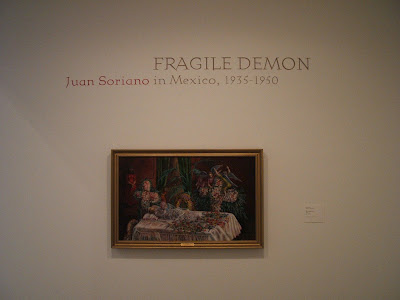
“In 1920 was born this fragile, sickly demon,” the Mexican poet Octavio G. Barreda wrote of the Mexican artist Juan Soriano in 1945. Borrowing that phrase for the title of the first exhibition of Soriano’s work in the United States at the PMA, Edward J. Sullivan’s Fragile Demon: Juan Soriano in Mexico 1935 to 1950 brings this well-known name in his native country out of obscurity for an American audience. In doing so, Sullivan not only presents a unique, multi-dimensional artist, but also a whole new way of looking at the perception of Mexican art as primarily the domain of the grand muralists Diego Rivera, David Alfaro Siqueiros, and Jose Clemente Orozco. The same alternate “reality” found in pseudo-Surreal works such as Girl with a Mask (above) surrounds the story of Soriano—homosexual and conservative—versus the Marxist machismo of the muralists.


The Dead Girl, Juan Soriano (Mexican, 1920 – 2006), 1938. Oil on panel, 18 1/2 x 31 1/2 inches. Philadelphia Museum of Art, Gift of Mr. and Mrs. Henry Clifford, 1947.

Born a sickly child, Soriano’s family encouraged him to paint and draw his fantasies. That encouragement and the imaginative material supplied by the religious processions, home altars, and other sacred rites of his native Guadalajara shaped Soriano’s unique sensibilities. Soriano’s small stature and slight build gave him a child-like air even as an adult. “An eternal child, ageless, bitter, cynical, naĂŻve, malicious, hardened, helpless,” the poet Octavio Paz writes in a 1941 meditation on his friend reproduced by Sullivan in the catalogue. Soriano the demon child finds painting children irresistible. “Soriano’s children are often unruly, misbehaving, fighting, or about to get into some other form of trouble,” Sullivan writes, demonstrating Soriano’s imp of the perverse in multiple works. When Soriano’s children aren’t getting into mischief, they’re dead. The Dead Girl (above) represents just one of many depictions Soriano made of the emotion and spirituality surrounding the death of a child in Mexico. He painted The Dead Girl after seeing a freshly dead girl displayed in the window of a home. A tiny piece of cotton peeks out of her nostril, placed there to hold back post mortem excretions. Disembodied hands hover over the girl, standing in for the devout mourners. Six years later, Soriano titled another painting The Dead Girl, creating a more elaborate setting for the deceased child featuring angels bearing flowered crosses. In such works Soriano taps into the same native spirituality and fascination with death that Frida Kahlo does explicitly in works such as The Dead Dimas and less explicitly in the more macabre elements of her self-portraits. “Death imagery nourished and entertained him,” Sullivan writes of Soriano’s fixation on these dead children, “and he later portrayed death as an amusement, a challenge as well as an inevitability.” Soriano both genuflects and laughs in the graveyard, living up to the collection of contradictions ascribed to him by Paz and others.

Still Life, Juan Soriano (Mexican, 1920 – 2006), 1942. Oil on canvas, 19 5/8 x 27 5/8 inches. Philadelphia Museum of Art, Gift of Mr. and Mrs. Joseph J. Gersten, 1951.

Sullivan excels in presenting Soriano as outside the mainstream of twentieth century Mexican art dominated by Rivera and his brethren, surpassing even Kahlo in straying from that center. While Rivera, Kahlo, and other artists embraced Marxism as Mexico’s best hope, welcoming even Trotsky into their home, Soriano resisted accepting any ideological savior. His political conservatism hurt his chances at obtaining commissions in that politically charged atmosphere. Barreda, the man who called Soriano a “demon” in print, linked Soriano with similar non-political artists who still retained a sense of Mexican-ness in their art. The non-political art of Still Life (above) and other works placed him in a category with Kahlo, whom Soriano loved, in spite of her marriage to Rivera, whom he loathed. “She had a tremendous personality,” Soriano once said of Frida, “like a little child full of life.” Soriano’s homosexuality also marked him as radically different from the macho muralists and mainstream Mexican culture. “Soriano’s frank affirmation of his sexuality in his paintings, drawings, writings, and interviews would remain a hallmark of his personality throughout his life,” Sullivan asserts. Saint Jerome (1942) shows Soriano’s lover, Diego de Mesa, posed nude before a mirror containing a skeleton assuming the same pose as Diego, linking desire and death. Guardian Angel (1941) depicts a falling male nude saved by a winged, male, nude angel in another homoerotic exercise by Soriano. Critic Jose Luis Martinez encapsulated Soriano’s ex-centric (i.e., out of the center) qualities in 1941: “He does not paint, nor does he pretend to illustrate social themes… His painting evidences three themes: eroticism, religiosity, and death, whose expression comes about with the intimate sensibility of the Mexican.” Soriano pushes the envelope of what being “Mexican” could mean in the larger context of the art and society of his time.


Girl with a Bouquet, Juan Soriano (Mexican, 1920 – 2006), 1946. Oil on canvas, 18 1/2 x 23 3/4 inches. Philadelphia Museum of Art, Gift of Mr. and Mrs. Herbert Cameron Morris, 1957.

Soriano’s friendship with Henry Clifford, a long-time curator at the PMA, makes the PMA the idea place for this exhibition. Sullivan credits the 30-year correspondence between Soriano and Clifford archived at the PMA with providing the basis of his research. Clifford and his wife donated the four Soriano paintings that make up the core of the exhibition, which offers a fascinating postscript to the epic Frida Kahlo exhibition also running at the PMA. Sullivan concentrates on the period from Soriano’s arrival in Mexico City in 1934 to his departure for Europe in 1951, when Soriano becomes more “universalist” in his themes, although he always carries his own private Mexico with him in his heart. Soriano’s slipperiness arises from his rejection of all convenient labels, even the tag of Surrealist that he resisted placing on works such as Girl with a Bouquet, arguing that the Surrealists practiced a brand of “self-indulgence” he couldn’t abide. Sullivan agrees with Soriano’s self-assessment, arguing that these works “incorporate dream-like or otherwise surprising elements,” but never fully realize the status of Surrealist art. Despite this absence of handles, Sullivan retains a firm grasp on the elusive demon Soriano and brings him vibrantly back to life for us today. As the novelist Carlos Fuentes says in his essay “The Eye of Dawn: Juan Soriano,“ “Soriano, like all great painters, is present in this present that doesn’t sacrifice its past or its future… Soriano in himself is dawning: a beginning charged with pasts, a daybreak that does not deceive us with the promise of an innocent future.” Fragile Demon: Juan Soriano in Mexico 1935 to 1950 allows Juan Soriano to live again as he once did—fully in the present moment, free of the lies of the past and the false promises of the future.


[Many thanks to the PMA for providing me with a review copy of Edward J. Sullivan’s Fragile Demon: Juan Soriano in Mexico 1935 to 1950 and for the images above from the exhibition.]

Tuesday, February 19, 2008

Face to Face With Frida


Walking through the galleries of the PMA’s Frida Kahlo exhibition at the press preview last Friday, I actually could feel the presence of the artist. Perhaps it was the amazing collection of personal photographs that serve as a powerful prologue to the paintings. Looking at a photo of Diego Rivera and then being able to see the other side, upon which Frida placed a heavily lipsticked kiss, I sensed the more than five decades since her death in 1954 melt away. Of course, looking at the paintings, so many of them self-portraits, such as her masterpiece, The Two Fridas (above, shown in the United States for the very first time), you find it easy to believe that you know the artist like a beloved old friend.


Co-curators Elizabeth Carpenter (above, explaining Kahlo’s Portrait of Luther Burbank) and Hayden Herrera led the tour through the galleries. The PMA’s own modern art curator Michael Taylor introduced the tour by pointing out the choice of wall colors for the exhibition. The early works begin surrounded by blue walls, much like the famous Blue House of Frida’s childhood, featured prominently in several of the paintings. Blue gives way to deep, blood red in the rooms housing the more tortured, intimate works such as The Two Fridas. It’s hard to imagine a more comprehensive collection of Kahlo’s work assembled than this one, which makes it a must-see for anyone interested in her life or the trajectory of modern art, especially the role of women in that history still being written.


The preview provided yet another chance to hear Hayden Herrera (above, with Michael Taylor looking on) speak upon the subject that her biography helped launch into the consciousness of mainstream culture. I found it fascinating that Herrera confessed that she herself had never seen many of the paintings in person until this exhibition. When she mentioned that she had never seen the gouges in the frame of A Few Small Nips, engraved by Frida during a moment of Diego-inspired fury, it heavily impressed on me that even such “well-known” artists as Kahlo remain a never-ending source of revelations even for authorities such as Herrera.


Perhaps the greatest revelation of the exhibition to me was the sheer physicality of the works, or their lack of it. With the exception of The Two Fridas, most of the works are relatively small in size, understandable considering that Kahlo painted many of them while convalescing in bed from injuries or her innumerable surgeries. The tininess of these works draws you in, pulling you into the artist’s embrace. Her choice of materials, such as metal supports to mimic the ex voto of Mexican folk art, becomes clearer through the PMA’s presentation of ex votos in their own collection. An 1803 ex voto of a woman and child surviving a fall from a balcony (above) recreates the context Kahlo worked within wonderfully when hung close by The Suicide of Dorothy Hale, the surreal portrait of the dead actress and perhaps Frida’s most wonderfully bizarre ex voto.


This exhibition showcases the PMA’s special interest in Mexican and Latin American art. All of the signage appears in both English and Spanish in anticipation of a heavy Hispanic audience (such as the text beside The Broken Column above). In support of the exhibition, the PMA created a side show of Frida Kahlo in Context, featuring works by her Mexican contemporaries David Alfaro Siqueiros, Federico Cantu, Dr. Atl, her beloved Diego, and many others. The gift shop offers the obligatory kitsch, but kitsch with a specific flavor. The tiny doll of Frida as seen in The Broken Column and the ready-to-display Frida shrine were personal favorites for their capturing of the baroque nature and black humor of Mexican spirituality. It will be interesting to see just how many people buy into and literally buy the more Frida-esque items versus the safer t-shirts, scarves, and prints.


Another great extra-Frida touch is the Juan Soriano exhibition, Fragile Demon: Juan Soriano in Mexico, 1935 to 1950 (the exhibition title and The Dead Girl [1944] shown above). Soriano knew Kahlo, who was 13 years older. Although they came from slightly different generations, the same Mexican and modernist drives inform their work. The PMA’s exhibition shows Soriano’s work in the United States for the first time, bringing this well-known name in Mexico to an American audience perhaps primed by the Kahlo show for further explorations into Mexican and Latin American art. (I’ll be running a review of the Soriano catalogue soon.)

Although this exhibition previously appeared at the Walker Art Center and will later travel to the SFMoMA, I doubt either can replicate the experience the PMA offers with their own supporting collections (both of the ex votos and pre-Columbian art, which appears often in late works by Kahlo, such as My Nurse and I), the Kahlo in Context gallery, and the Soriano show. Hopefully, people in Philadelphia and even New York and Washington, D.C., will realize the opportunity the PMA is offering and take full advantage of coming face to face with Frida and her world.

[Many thanks to the PMA for inviting me to the Frida Kahlo press preview.]

Monday, January 28, 2008

Composing Chaos


With the possible exception of Frida, Salma Hayek’s film of Frida Kahlo’s life and art, Ed Harris’ Pollock, his interpretation of the life and art of Jackson Pollock, may be the finest biopic of a painter ever done. Born January 28, 1912, Pollock lived the myth of the tortured artist, always playing up to the expectations the public had of the crazy artist dubbed by the press as “Jack the Dripper” for his unique abstract expressionist paintings created by dripping and splashing paint. Behind the wild life story and the caricature of the madman blindly flinging paint onto canvas, there is a core of composure beneath the chaos. In works such as Blue Poles Number 11, 1952 (above, from 1952), Pollock grounded the patterns of dripped color with the rhythmic series of horizontal blue lines (the “poles” of the title) using, as Kirk Varnedoe showed in his book on Pollock, a compositional pattern Pollock learned from the regionalist Thomas Hart Benton. In many ways, Pollock’s life careened out of control, thanks mainly to substance abuse and his unstable emotional life, but his art never was a creation of pure chance.


Like the poles that stabilize Blue Poles, Pollock’s marriage to fellow abstract expressionist Lee Krasner helped stabilize his life and allow him to enjoy some success. Works such as Number 1, 1950 (Lavender Mist) (above, from 1950) show the beautiful effects that Pollock’s technique could achieve. Advances in liquid paint made that technique possible, and Pollock’s time assisting David Alfaro Siqueiros helped open his eyes to that potential. Pollock’s drip paintings made such a paradigmatic leap in modern art that nobody really could follow in the same style. Anything else would be condemned as pure imitation. For a style so deceptively easy to the untrained eye, no school of Pollock formed around him. Such isolation only makes his art and his life more fascinating.


The performance aspect of Pollock’s painting continues to intrigue students of his art. Fortunately, Hans Namuth filmed Pollock at work, including innovative shots such as the one above in which Pollock painted on a sheet of glass as Namuth filmed from below, giving a sense of being within the painting as Pollock worked upon it. Unfortunately, such close scrutiny made the already self-conscious artist even more jittery and upset the delicate balance of his life. During his life, Pollock continually felt torn asunder by demands upon his work. The critic Clement Greenberg championed Pollock as the greatest painter of the age, the heir to the long legacy of Western art. Greenberg’s rival critic Harold Rosenberg, meanwhile, proposed Willem de Kooning as the top artist, attempting to generate a rivalry in the press between the artists that didn’t exist in real life between the two friends. Pollock even became the plaything of the United States government during the Cold War as they held his work up as an example of the freedom of American democracy in contrast to the repression of Russian Communism. All of these strains proved too much for Pollock, who lived too fast and died too young while drunk driving. Like James Dean, another icon of the period, it would be difficult to imagine Jackson Pollock living into old age, but it would have been nice to have had the chance.

Thursday, January 3, 2008

A Fighting Education


"Art must no longer be the expression of individual satisfaction that it is today, but should aim to become a fighting educative art for all," David Alfaro Siqueiros once said, emphasizing the political activism behind so much of his work. Born December 29, 1896, Siqueiros lambasted the rich ruling classes in murals for the masses such as Portrait of the Bourgeoisie (above, from 1939-1940). With fellow muralists Diego Rivera and JosĂ© Clemente Orozco, Siqueiros revitalized the mural as a medium for public political protest. Siqueiros centered much of his imagery on the history of the Mexican Revolution, using that period’s violence and chaos to provide a language through which he could express his ideas of an ideal society, based heavily on his own Marxist ideals. Rivera and Orozco both loved their country passionately, but Siqueiros took that passion to another, perhaps dangerous level.


In The New Democracy (above, from 1944) a woman carrying the torch of freedom explodes from the center of the mural as she shatters the chains of oppression. The idealized classical bodies that Siqueiros depicts lend a timelessness to his message, which is basically the eternal struggle between the powerless many and the powerful few. Siqueiros preached his universal message beyond Mexico, traveling to South America, Europe, Russia, and even America to spread his vision and paint more ideologically charged murals. While in America in the late 1930s, Siqueiros ran a political art workshop attended by many young American artists, including Jackson Pollock, who saw the expressive potential of liquid paint in Siqueiros’ hands and later used that potential to create his own Abstract Expressionist works.


During that period in America, Siqueiros painted many smaller works, including Echo of a Scream (above, from 1937). It’s hard to imagine a more excessively disturbing scene than the bizarre infant of Echo of a Scream. As much as Siqueiros strove to bring light to the workers’ world, he fostered a dark side as well, particularly in his possible involvement in the assassination plot against Leon Trotsky that led to his 1940 exile from Mexico. Fighting against the excesses of capitalism and fascism, which he wed in the imagery of Portrait of the Bourgeoisie that he barely finished before his 1940 exile, Siqueiros fell into an excessiveness of his own. Like many artists of the early twentieth century, Siqueiros looked to Socialism as a solution to the ills of the exploitive capitalism sucking their country dry. Sadly, that promise soon disappeared as Communism became the next incarnation of authoritarianism and oppression. To the end, Siqueiros fiery passion for social justice could never be quenched, and his scream echoes on today.

Wednesday, December 12, 2007

Against the Wall

Few artists aroused such passions during his life as Diego Rivera. Born December 8, 1886, Rivera stirred political passions with his art during his life as well as the amorous passions of many women, including fellow artist Frida Kahlo. Perhaps the highlight (or lowlight, depending on how you look at it) of Rivera’s career was the infamous 1933 episode in which Rivera painted Vladimir Lenin into the mural Nelson Rockefeller commissioned for Rockefeller Center, titled Man at the Crossroads. Rockefeller ordered the fresco destroyed after Rivera, an avid Communist at the time, refused to remove the portrait. A year later, Rivera recreated the mural (above) at the Museo del Palacio de Bellas Arte in Mexico City, renaming it Man, Controller of the Universe. As chaotic as his personal life became, Rivera was always the master of his artistic universe.


Rivera's role in the Mexican Mural Renaissance beside fellow muralists Jose Clemente Orozco and David Alfaro Siqueiros justly takes pride of place in memories of Diego. However, Rivera shouldn’t be labeled as just a muralist or just a Mexican artist. In his travels to Europe before 1920, Rivera saw and embraced Cubism, painting works such as Two Women (above, from 1914), showing that even then he had ladies on his mind. Cezanne’s bright colors and reduction of images to simple shapes inspired Rivera in his later murals. Travels through Italy and first-hand exposure to the great frescoes of the masters certainly provided material for Rivera to digest and transform into his native idiom.


Rivera’s pride in his native Mexico shines through much of his work. Kahlo absorbed much of that pride into her own work and even her personal dress, selecting native Mexican dress to please her Diego. Sadly, Rivera’s philandering brought much pain to Kahlo’s already painful life. Around the same time that Rivera painted Detroit Industry (above, detail of south wall, from 1932 to 1933), Kahlo suffered another miscarriage, which inspired her painting Henry Ford Hospital. After Kahlo’s death, Rivera told others that only then he realized that she had been the love of his life. Judging on appearances alone, Rivera makes for one of the unlikeliest of lotharios, but the passion and charisma of his life and art drew others to him magnetically and continues to inspire Latin American artists today.