Showing posts with label Leger (Fernand). Show all posts

Wednesday, June 17, 2009

Cracking the Code


As the Philadelphia Museum of Art’s exhibition Cezanne and Beyond proved earlier this year, Paul Cezanne sired many artistic “sons,” including equally influential artists such as Henri Matisse and Pablo Picasso. Cezanne’s family tree spreads far and wide and includes many “daughters,” as well, including the Portuguese artist Maria Elena Vieira da Silva. Born June 13, 1908, Vieira da Silva began her studies in Lisbon, Portugal, but by her teens was already in Paris studying with the likes of Fernand Leger, who had his own “Daddy” issues with Cezanne to deal with. Maria soon took the lessons of Cezanne and extended them in her own way, as so many followers of Cezanne have. The atomization of reality that Cezanne approached in his depiction of mountains and still lives becomes almost total in works such as Vieira da Silva’s Dance (above, from 1938). Her approach falls between several different movements while brushing up against them. The approach is Cubist without rendering the subject totally unrecognizable. Cezanne-like colors remain, but the geometry of the shapes predominates over the subject matter itself. Especially in works such as Dance, there’s a sense of movement, yet that movement comes from a geometrical pattern rather than from the near-biological shapes of Futurism, which animated Cubism, which came out of Cezanne. Vieira da Silva mothers this incestuous blending of styles into a style uniquely her own.


The idea of Viera da Silva’s art as a kind of code to be decoded comes across most clearly in The Chess Game (above, from 1943). The checkered pattern of the chessboard extends beyond the table not only to the players themselves but also to the very landscape itself. All of reality becomes a game to be played and comprehended by the intellect and the imagination in tandem. Vieira da Silva would have loved The Matrix films. Surrounded by all the different theories of modern art swirling around Europe in the first half of the twentieth century (half of which Picasso created or improved), Vieira da Silva rose above the individual codes and got metaphysical. Maria’s meta-code of pure plane geometry may be the purest homage to Cezanne himself, who was always wary of theorizing and preferred to view his personal vision as exactly that, a personal vision of the world captured in art. Vieira da Silva resists all these influences without ignoring them in holding onto her own creative personality. She painted The Chess Game not only while these art movements squared off against each other, but also while nations waged the “great game” of World War II for nothing less than world control.


Vieira da Silva spent the war years back in Lisbon, but she returned to her second home of Paris in 1947, living there for the rest of her days. Her Paris (above, from 1951) renders her beloved adopted city as another kind of code. The city itself remained fractured at the time, still rebuilding after the war. The colored windows of the buildings resemble the checkerboard world of The Chess Game. Without the title, it would be impossible to guess what Vieira da Silva is painting here. With that clue, however, our minds search the lines for the edges of buildings and the streets lined with cafes and homes. Vieira da Silva invites us to crack the code she sets up and discover the same Paris she discovered over the course of her life. In 1956, Vieira da Silva became a French citizen. In 1966, the French government awarded her the Grand Prix National des Arts, making her the first female recipient. In 1979, France named her a Chevalier of the Legion of Honor. Step by step, over the years, Vieira da Silva drew herself deeper into the maze of French culture and art, becoming one, if not “The One,” with the puzzle that is Paris.

Tuesday, March 3, 2009

To Impressionism… and Beyond


Paul Cézanne, (French, 1839–1906), Mont Sainte-Victoire, c. 1902. Oil on canvas, 33 x 25 5/8 inches. The Henry and Rose Pearlman Foundation, Inc.; long-term loan to the Princeton University Art Museum.

Father. Protector. Herald. Hero. Even God. Those are just a few of the labels heaped upon Paul Cezanne by those who followed in his wake and who comprise the “beyond” in the Philadelphia Museum of Art’s exhibition Cezanne and Beyond. In the catalogue, edited by PMA curators Joseph J. Rishel and Katherine Sachs, a star-studded cast of critics join forces to paint a broad portrait of the large shadow Cezanne cast over the twentieth century and still casts over our own twenty-first. As Max Beckmann explained in his 1948 “Letters to a Woman Painter,” Cezanne “really became the last old master, or I might better say he became the first ‘new master.’” As Rishel and Sachs explain in the opening essay, titled “The Making of an Exhibition,” the legacy of Cezanne swung between two poles—the “aloof” “Apollonic Cezanne… and a more mortal (but equally protean) creature, animating in very concrete ways artists right up to the present.” Cezanne and Beyond brings Cezanne down from the mountain (perhaps his beloved Mont Sainte-Victoire, above, from 1902) to mingle with his fellow mortals and great artists. From early devotees such as Matisse and Picasso to modern day followers such as Francis Alys and Sherrie Levine, Cezanne and Beyond emphasizes how great artists use other great artists as points of departure towards that undiscovered country of their own vision.

Pablo Picasso, (Spanish, 1881-1973), The Dream (Marie-Thérèse), 1932. Oil on canvas, 51 ¼ x 38 1/8 inches. From the Collection of Steve and Elaine Wynn © 2008 Estate of Pablo Picasso/Artists Rights Society (ARS), New York.

The catalogue features a useful chronology by Adrianne O. Bratis that combines the trajectories of Cezanne’s life and artistic afterlife with that of the other 18 artists discussed. Working through the series of births, deaths, and other landmarks of this cast proves a fitting introduction to the dizzying interplay between these artists, which leaves a tangled web that the essayists do not unweave but rather celebrate. Contributions by Robert Storr and Richard Shiff lay out the competitive landscape these artists faced off on. Addressing the lingering question of “modernism’s paternity” and offering Manet, Courbet, and Goya as candidates, Storr somewhat settles the issue by asserting that “there is no disputing that Cezanne was the quintessential modernist at the advent of its glory days.” Regardless of what we may think today, Cezanne was the man for cutting edge artists in 1907, the year of the grand posthumous exhibition that brought Cezanne’s work to a wider audience. Shiff then picks up the trail, describing Cezanne as “a piece of collective cultural property that successive generations shaped according to their needs, as they wrestled with their doubt.” Picasso sensed early on Cezanne’s powerful doubt but also his eventual self-assurance of vision. “In Cezanne,” Shiff writes, “Picasso perceived a life-anxiety he shared, while he overcame the art-anxiety that accompanied it.” When Picasso paints The Dream (above, from 1932), he “borrows” not only the red armchair of Cezanne’s portraits of Madame Cezanne but also Cezanne’s final arrival at an almost preternatural faith in painting the world as he sees it, regardless of what others think. “What forces our attention is Cezanne’s anxiety,” Picasso later said. “That’s Cezanne’s lesson.” As John Elderfield writes in his essay, “Picasso’s Extreme Cezanne,” Picasso saw “the fervent and troubled Cezanne” where most saw the “classical Cezanne.” Picasso humanizes Cezanne through shared fears then re-elevates him in his conquest of those fears.

Paul Cézanne, (French, 1839–1906), The Large Bathers, 1906. Oil on canvas, 82 7/8 x 98 ¾ inches. Philadelphia Museum of Art; Purchased with the W. P. Wilstach Fund, 1937.

Elderfield sees Picasso’s Les Demoiselles d'Avignon as a specific response to Cezanne’s Large Bathers paintings (the PMA’s 1906 version above). “While capturing and enlarging the element of the grotesque in Cezanne’s figural groupings, [Picasso] also adapted their tone of melancholy introspection to his confrontational sexual display,” Elderfield writes, “infusing the coarse hedonism with a silent, unflinching, seemingly unending disquiet.” Just as Cezanne’s “disquiet” attracted Picasso, it set up Cezanne as a role model for other artists. Georges Braque, as John Golding shows, became a stoic in the vein of Cezanne after suffering wounds in World War I. When Arshile Gorky studied to become an artist with no instructor to guide him, Michael Taylor writes, “He aptly chose Paul Cezanne” as his model for what an artist should be and copied Cezanne’s works just as Cezanne had haunted the Louvre decades before in pursuit of excellence. Marsden Hartley was already an established artist when he made a pilgrimage to the places Cezanne had painted, immersing himself so deeply in Cezanne that he almost drowned his own art, Joseph Rishel explains in his essay. But Cezanne’s disquiet also repulsed at one point or another other artists such as Henri Matisse and Fernand Leger. Yve-Alain Bois dispels the “illusion” that Matisse adopted Cezanne from the very beginning, pointing out that most of Matisse’s adoring comments on Cezanne come in the 1940s and 50s. Even then, Bois writes, “the Cezanne that emerges in these relatively late statements [by Matisse] is one that has been tamed, converted into a coherent entity whose contradictions tend to be underplayed.” Christopher Green follows Leger’s self-deceptive personal timeline of Cezannism, which Leger claims ended in 1914 but Green and others see as extending well into the 1920s, seemingly beyond Leger’s control. The uniqueness of each artist’s response to Cezanne makes for a fascinating crazy quilt of influence that gives a more realistic (but less easily summarized) view of how artistic influence actually works.

Giorgio Morandi (Italian, 1890–1964), Still Life, 1947. Oil on canvas, 8 1/6 x 10 13/16 inches. The Cartin Collection. © 2008 Artists Rights Society (ARS), New York/SIAE, Rome.

Another twist to the tale comes when the “beyond” of Cezanne and Beyond crosses international borders as well as time periods. The works of Liubov Popova serve to represent the influence of Cezanne in Russia, which didn’t begin until 1908 but soon “spread like wildfire in Moscow—faster, indeed, than anywhere else in Europe,” writes Albert Kostenevich. “Having rejected the traditions of the Renaissance, often in favor of a kind of artistic nihilism,” Kostenevich explains, “young Russian artists in the 1910s sought to base their art on the most contemporary foundations possible, and therefore, above all, they turned to Cezanne.” Hartley, Charles Demuth, and other members of the Stieglitz circle bring the gospel of Cezanne to American shores after the tidal wave of modernism of the 1913 Armory Show. In Italy, Cezanne’s influence became a political football of sorts kicked around by modernists such as Umberto Boccioni, Giorgio de Chirico, and Giorgio Morandi (whose Still Life, from 1947, appears above). In her essay, “For the Love, and Fear, of Painting: Cezanne, Morandi, and Italian Modernism,” Jennie Hirsh follows how Cezanne’s style became adopted by Morandi and accepted by Fascists between the wars, a context that led de Chirico to reject Cezanne primarily by association. Cezanne’s pictorial call to order became twisted into the Fascist call to social order, with Morandi’s still lifes standing in for the new political way of life. Again, Cezanne and Beyond takes you beyond the standard studies of Cezanne and his influence, here entering into the political arena.

Paul Cézanne, (French, 1839–1906), Chestnut Trees at Jas de Bouffan, 1885–86. Oil on canvas, 28 x 35 ½ inches. The Minneapolis Institute of the Arts; Purchased with the William Hood Dunwoody Fund.

Perhaps most fascinating of all the individual artist essays are those dealing with the still-living artists Ellsworth Kelly, Jasper Johns, Brice Marden, and Jeff Wall. Each of these artists spoke with their essayists and described their personal relationship with Cezanne first hand. Kelly traced his infatuation with Cezanne back to an illustration of Cezanne’s Chestnut Trees at Jas de Bouffan (above, from 1885-1886) that Kelly pulled from an art history book he had received as a teenager. Cezanne’s painting contained all of the elements—“a tension between foreground and background, surface and depth, positive and negative space,” Kathleen Sachs writes—that would dominate Kelly’s own art. For Johns, “Cezanne’s nearly obsessive repetition of motifs in still lifes, landscapes, and figural scenes provided a significant precedent” for Johns’ maps, flags, and other oft-repeated subjects, Roberta Bernstein relates. For Marden, Cezanne’s motifs fascinate not in their repetition as much as in their disappearance. Both Marden and Cezanne take only the “energy” of the motif, Sachs writes, rather than simply reproduce it, emphasizing that “it is in the process of getting there that all their creativity occurs. They bring life to a painting by capturing the spirit of its making and letting that spirit work with them to complete it.” For Wall, a photographer and perhaps the most off-the-wall member of the Cezanne clan, Cezanne still offers something found nowhere else. Watching Cezanne “transform the legacy of the masters,” Jean-Francois Chevrier writes, Wall learns how “to adapt it to his own ambition” as well, including the legacy of Cezanne.

Jeff Wall (Canadian, b. 1946), Card Players, 2006. Transparency in lightbox, 46 x 50 inches. Private collection.

Seeing Wall’s Card Players (above, from 2006), an homage to Cezanne’s similarly named paintings, in the catalogue (and especially lit up in the exhibition space itself) is a jarring experience. You just don’t expect it. Cezanne and Beyond is all about defying expectations and jarring jaded viewers. Wading through the 500 plus pages of the catalogue is a daunting task but well worth it to get a fuller understanding of how complex Cezanne’s influence has been in the century since his death. I say “fuller” rather than “complete” because the biggest lesson of Cezanne and Beyond is that we are still in that “beyond” stage. “Beware of the influential master!” Cezanne himself warned, and it is this wariness of artists that keeps Cezanne’s influence from descending into copying and derivativeness. The quarrels artists continue to have with Cezanne keep him fresh and alive to today. Cezanne and Beyond maps the location of Cezanne’s (and any great artist’s) fountain of perpetual youth. From that source, Cezanne may truly go “to infinity… and beyond!

[Many thanks to the Philadelphia Museum of Art for providing me with a review copy of the catalogue to the exhibition Cezanne and Beyond and for the images above.]

Friday, October 24, 2008

Late Bloomer


“I was twenty-one before I saw a good picture,” Sir Matthew Smith once said of his insular upbringing in the shadow of his pious, businessman father. Born October 22, 1879, Smith eventually resisted his father’s attempts to place him in the world of business and, despite ill health, willed himself into the world of art. In 1908, Smith traveled to France to study at the Slade, the art school run by Henri Matisse. Although he most likely didn’t study directly with Matisse, Matisse influenced the entire curriculum of the school. Smith’s Dulcie (above, from 1915) shows how he took the style of Matisse in his Fauvist days and adapted it to his own uses. The connection with Matisse opened up doors to Smith that allowed him to exhibit with the likes of Matisse, Kandinsky, Fernand Léger, and Georges Rouault all before World War I erupted and forced Smith to return to England. Because of this influence of Matisse, Smith seemed “more French than English” upon his return, according to one contemporary, in terms of his handling of color to elicit emotion. Smith neatly smuggled Matisse across the Channel and overnight opened the eyes of his countrymen to the next big thing in painting.


Within a few years of returning to England, Smith found himself drafted into the war. He suffered shrapnel wounds in combat that taxed his already frail health, but the experience of war exacted a greater toll on his mind, beginning a cycle of creativity alternating with depression that would plague the rest of his life. Smith eventually established a London studio near that of Walter Sickert, whose (in)famous “Camden Town” nudes set the standard for the nude form in English painting in the early twentieth century. In Model Turning (above, from 1924), Smith slowly turns away from Matisse’s influence and turns toward a style closer to that of Sickert’s. The red skirt and blue and purple cushions hark back to Fauvism, but the instability of the figure itself generated by the roughness of the brushwork is pure Sickert. Actually, Smith exceeds even Sickert’s penchant for molding the figure in color like a sculpture rather than through line.


Smith continued to progress in a more Sickert-esque direction. In one of his many portraits of his friend and fellow painter Augustus John (above, from 1944), Smith handles the subject roughly. John referred to his portrait as “another hemorrhage for Matthew” in acknowledgment of the bloody, gory way Smith painted flesh even in the portraits of friends. As the pace of his cyclical depression increased, Smith’s view of life and humanity seemed to darken considerably. The young Francis Bacon admired Smith’s troubled style and patterned his own work after it. In many ways, Smith is the link between Sickert and Bacon, the two most important painters of the nude in English painting in the twentieth century. Smith’s evolution from Fauvism, one kind of beastliness, to the later brand of beastliness in his final works demonstrates how the late bloomer more than made up for lost time.

Friday, August 8, 2008

Hungry Heart


While working in his Paris studio in 1924, Chaim Soutine hung an actual side of beef as a model for his Carcass of Beef (above, from 1924). Soutine, who died on August 9, 1943, grew up in such poverty in his small Jewish town in Lithuania that we only know he was born sometime in 1894. Accustomed to hunger since childhood, Soutine saw the beef as a beautiful still life rather than a meal. Despite the protests of neighbors, who could smell the rotting meat, Soutine continued to paint, accustomed to hatred directed at him since his earliest years. His devoutly Jewish community condemned any form of art. Soutine actually received beatings at the hands of siblings and neighbors when he tried to draw. When one neighbor family beat Soutine for trying to draw their father, Soutine’s mother sued them for damages. Fittingly, Soutine used the money awarded to enter art school in 1909. After a year of scraping together enough cash to buy a fourth-class ticket, Soutine boarded a train to Paris and a life of more poverty and struggle, but freedom, finally, to pursue his art.


Once in Paris, Soutine soon united with equally poor, equally creative artists such as Amedeo Modigliani, Jacques Lipschitz, Marc Chagall, and Fernand Leger. Soutine and Modigliani shared rooms until Modigliani’s death in 1920, which wounded Soutine deeply. Soutine’s portraits, such as Pastry Cook with Red Handkerchief (above, from 1922-1923), show Modigliani’s influence in how they distort the human figure, but add a whole new level of violence beyond Modigliani’s contortions. Unable to hire models, Soutine painted anyone who would sit for him, including the simple waiters and cooks who lived and worked in his neighborhood. In 1923, Soutine’s ship finally came in in the person of Dr. Albert C. Barnes, who purchased sixty of Soutine’s paintings for his collection that would eventually become the Barnes Foundation. Never again would Soutine need to worry for money.


But new worries came in the form of anti-Semitism and the Fascist Nazi regime when they invaded France during World War II. When the Germans bombed Paris during World War I, Soutine fled to southern France and painted such Van Gogh-inspired, pseudo-Cubist works as Céret Landscape (above, from 1919). Unfortunately, nowhere in France could Soutine find safety from the Nazis. Soutine often slept in forests during rainstorms to elude capture, which exacerbated the stomach ailments he faced his entire life. Just two weeks before the liberation of France by the allies in 1944, Chaim Soutine died during a long-overdue operation on a massive stomach ulcer. From inconceivably humble beginnings, Soutine rose to the heights of the art world, painting an oeuvre that influenced later artists such as Francis Bacon and Lucian Freud and perhaps even the Abstract Expressionists. Ignoring the hunger in his belly, Soutine never failed to feed the hunger in his heart to create images reflecting his inner turmoil.

Wednesday, July 30, 2008

Sibling Rivalry


What must it have been like growing up the brother of Marcel Duchamp? Gaston Duchamp, better known as Jacques Villon, must have felt overshadowed at times by his little brother, twelve years his junior. Born July 31, 1875, Villon took his new name in honor of French poet François Villon and set out to create his own type of poetry separate from that of his famous sibling Marcel and his lesser-known artistic siblings Raymond and Suzanne. In prints such as The Cards (above, from 1903), Villon shows his debt to the works of Henri de Toulouse-Lautrec, whose stunning graphic style swept through Europe and changed the way Villon and other graphic artists who followed went about their work. While Marcel delved into the deep thought experiments of Dada and Surrealism, Villon traveled in Fauvist, Cubist, and Abstract Impressionist circles, slowly moving away from the Post-Impressionism of Toulouse-Lautrec to a more modern look.


Villon excelled at printmaking and etching. The Checker Table (above, from 1920) shows Villon trying his hand at Cubist etching. (I wonder if Villon and Marcel, famous for his love of chess, ever squared off over a board or two.) The board and the table it rests on seem to be disassembling themselves off into space, much like Marcel’s Nude Descending a Staircase, No. 2 painted eight years earlier. Like Marcel and so many other European artists, the 1913 Armory Show served as a coming out party for Villon, introducing his art to an American audience for the first time. While some of those artists met resistance from the American markets, Villon found a second home and acceptance for his more accessible Cubist works such as The Checker Table.


While Marcel always seemed to be an art movement unto himself, always wary of labels and the very nature of institutionalized art itself, Villon seems more at home in groups, helping others find an audience. Although Marcel and Raymond also helped form the Puteaux Group that included Francis Picabia, Robert Delaunay, and Fernand Leger, Villon more than his brothers organized the Section d'Or exhibitions that brought those innovative artists to the public eye. In Villon’s Self-Portrait from the 1950s (above), he seems almost forbidding, perhaps poking fun at his open, inviting character. Marcel always seems to be in exile from himself and art, while Villon always seems secure in his place in the world and art-making. Perhaps the younger brother could have learned a few things from his older brother. Just the choice of the graphic medium, with its easy reproduction and often illustrative nature, speaks of Villon’s greater desire to communicate in contrast to his still-befuddling, often overshadowing younger brother.

Tuesday, February 5, 2008

A Series of Tubes


An artist that should find a place in U.S. Senator Ted Stevensheart, Fernand Leger took the Cubism of Braque and Picasso and rounded it off, creating his own form of Cubism later known as Tubism. (And, no, surfers did not call it “tubular.”) Born February 4, 1881, Leger painted works such as The Card Players (above, from 1914) while still under the influence of Italian Futurism. In The Card Players, Leger creates players more machine than human, consisting of a series of tubes connected together more than anything resembling flesh and blood. A friend of other abstract artists such as Robert Delaunay and Francis Picabia, Leger painted in an increasingly abstract style up to his involvement in World War I, which changed his work immensely as the marriage of man and machine no longer seemed like such a fine idea.


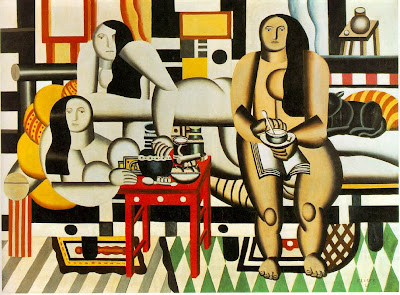
After the war, Leger returned to a more classical style of painting in works such as Three Women (above, from 1921). The rounded forms and cylinders of Tubism remain, but Leger paints here flesh and blood rather than the cold, hard steel of The Card Players. Like many artists between the wars, Leger couldn’t return to a purely abstract style or develop a purely classical one, so he creates hybrids such as Three Women, a unique take on the nude that borrows from everyone from the Greeks up to Cezanne in portraying the nude female body. Whereas some of his abstract brethren, such as Picabia, followed the path of chaos even further after the Great War, Leger stepped back from the precipice and reevaluated his art.


While living in the United States during World War II, Leger became less and less abstract in his style, creating works such as Three Musicians (above, from 1944). Like Picasso’s Three Musicians , Leger takes advantage of the interplay of the three figures and their instruments to create interesting contrasts of color and shape. Unlike Picasso, one of the sources of his early Tubist Cubism, Leger no longer relies on heavy distortion of the human form. Their faces are stylized masks in many ways, but nothing like the excessive primitivism of Picasso’s faces. Near the end of his life, Leger turned to Socialism in hopes of making a better world. His desire to bring a sense of humanity to the often cruel twentieth century succeeded in humanizing his art.