Girl with a Mask, Juan Soriano (Mexican, 1920 – 2006), 1945. Oil on canvas, 31 5/8 x 39 1/2 inches. Philadelphia Museum of Art, Gift of Mrs. Herbert Cameron Morris, 1947.
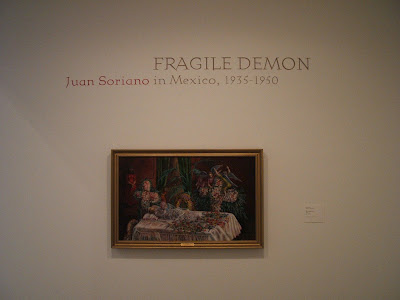
“In 1920 was born this fragile, sickly demon,” the Mexican poet Octavio G. Barreda wrote of the Mexican artist Juan Soriano in 1945. Borrowing that phrase for the title of the first exhibition of Soriano’s work in the United States at the PMA, Edward J. Sullivan’s Fragile Demon: Juan Soriano in Mexico 1935 to 1950 brings this well-known name in his native country out of obscurity for an American audience. In doing so, Sullivan not only presents a unique, multi-dimensional artist, but also a whole new way of looking at the perception of Mexican art as primarily the domain of the grand muralists Diego Rivera, David Alfaro Siqueiros, and Jose Clemente Orozco. The same alternate “reality” found in pseudo-Surreal works such as Girl with a Mask (above) surrounds the story of Soriano—homosexual and conservative—versus the Marxist machismo of the muralists.
 The Dead Girl, Juan Soriano (Mexican, 1920 – 2006), 1938. Oil on panel, 18 1/2 x 31 1/2 inches. Philadelphia Museum of Art, Gift of Mr. and Mrs. Henry Clifford, 1947.
Born a sickly child, Soriano’s family encouraged him to paint and draw his fantasies. That encouragement and the imaginative material supplied by the religious processions, home altars, and other sacred rites of his native Guadalajara shaped Soriano’s unique sensibilities. Soriano’s small stature and slight build gave him a child-like air even as an adult. “An eternal child, ageless, bitter, cynical, naïve, malicious, hardened, helpless,” the poet Octavio Paz writes in a 1941 meditation on his friend reproduced by Sullivan in the catalogue. Soriano the demon child finds painting children irresistible. “Soriano’s children are often unruly, misbehaving, fighting, or about to get into some other form of trouble,” Sullivan writes, demonstrating Soriano’s imp of the perverse in multiple works. When Soriano’s children aren’t getting into mischief, they’re dead. The Dead Girl (above) represents just one of many depictions Soriano made of the emotion and spirituality surrounding the death of a child in Mexico. He painted The Dead Girl after seeing a freshly dead girl displayed in the window of a home. A tiny piece of cotton peeks out of her nostril, placed there to hold back post mortem excretions. Disembodied hands hover over the girl, standing in for the devout mourners. Six years later, Soriano titled another painting The Dead Girl, creating a more elaborate setting for the deceased child featuring angels bearing flowered crosses. In such works Soriano taps into the same native spirituality and fascination with death that Frida Kahlo does explicitly in works such as The Dead Dimas and less explicitly in the more macabre elements of her self-portraits. “Death imagery nourished and entertained him,” Sullivan writes of Soriano’s fixation on these dead children, “and he later portrayed death as an amusement, a challenge as well as an inevitability.” Soriano both genuflects and laughs in the graveyard, living up to the collection of contradictions ascribed to him by Paz and others.
 Still Life, Juan Soriano (Mexican, 1920 – 2006), 1942. Oil on canvas, 19 5/8 x 27 5/8 inches. Philadelphia Museum of Art, Gift of Mr. and Mrs. Joseph J. Gersten, 1951.
Sullivan excels in presenting Soriano as outside the mainstream of twentieth century Mexican art dominated by Rivera and his brethren, surpassing even Kahlo in straying from that center. While Rivera, Kahlo, and other artists embraced Marxism as Mexico’s best hope, welcoming even Trotsky into their home, Soriano resisted accepting any ideological savior. His political conservatism hurt his chances at obtaining commissions in that politically charged atmosphere. Barreda, the man who called Soriano a “demon” in print, linked Soriano with similar non-political artists who still retained a sense of Mexican-ness in their art. The non-political art of Still Life (above) and other works placed him in a category with Kahlo, whom Soriano loved, in spite of her marriage to Rivera, whom he loathed. “She had a tremendous personality,” Soriano once said of Frida, “like a little child full of life.” Soriano’s homosexuality also marked him as radically different from the macho muralists and mainstream Mexican culture. “Soriano’s frank affirmation of his sexuality in his paintings, drawings, writings, and interviews would remain a hallmark of his personality throughout his life,” Sullivan asserts. Saint Jerome (1942) shows Soriano’s lover, Diego de Mesa, posed nude before a mirror containing a skeleton assuming the same pose as Diego, linking desire and death. Guardian Angel (1941) depicts a falling male nude saved by a winged, male, nude angel in another homoerotic exercise by Soriano. Critic Jose Luis Martinez encapsulated Soriano’s ex-centric (i.e., out of the center) qualities in 1941: “He does not paint, nor does he pretend to illustrate social themes… His painting evidences three themes: eroticism, religiosity, and death, whose expression comes about with the intimate sensibility of the Mexican.” Soriano pushes the envelope of what being “Mexican” could mean in the larger context of the art and society of his time.
 Girl with a Bouquet, Juan Soriano (Mexican, 1920 – 2006), 1946. Oil on canvas, 18 1/2 x 23 3/4 inches. Philadelphia Museum of Art, Gift of Mr. and Mrs. Herbert Cameron Morris, 1957.
Soriano’s friendship with Henry Clifford, a long-time curator at the PMA, makes the PMA the idea place for this exhibition. Sullivan credits the 30-year correspondence between Soriano and Clifford archived at the PMA with providing the basis of his research. Clifford and his wife donated the four Soriano paintings that make up the core of the exhibition, which offers a fascinating postscript to the epic Frida Kahlo exhibition also running at the PMA. Sullivan concentrates on the period from Soriano’s arrival in Mexico City in 1934 to his departure for Europe in 1951, when Soriano becomes more “universalist” in his themes, although he always carries his own private Mexico with him in his heart. Soriano’s slipperiness arises from his rejection of all convenient labels, even the tag of Surrealist that he resisted placing on works such as Girl with a Bouquet, arguing that the Surrealists practiced a brand of “self-indulgence” he couldn’t abide. Sullivan agrees with Soriano’s self-assessment, arguing that these works “incorporate dream-like or otherwise surprising elements,” but never fully realize the status of Surrealist art. Despite this absence of handles, Sullivan retains a firm grasp on the elusive demon Soriano and brings him vibrantly back to life for us today. As the novelist Carlos Fuentes says in his essay “The Eye of Dawn: Juan Soriano,“ “Soriano, like all great painters, is present in this present that doesn’t sacrifice its past or its future… Soriano in himself is dawning: a beginning charged with pasts, a daybreak that does not deceive us with the promise of an innocent future.” Fragile Demon: Juan Soriano in Mexico 1935 to 1950 allows Juan Soriano to live again as he once did—fully in the present moment, free of the lies of the past and the false promises of the future.
[Many thanks to the PMA for providing me with a review copy of Edward J. Sullivan’s Fragile Demon: Juan Soriano in Mexico 1935 to 1950 and for the images above from the exhibition.]