Showing posts with label Nolde (Emil). Show all posts
Showing posts with label Nolde (Emil). Show all posts
Tuesday, March 25, 2014
The Sad, Strange History of “Degenerate Art”
“Crazy at any price!” read a sign above the modern art masterpieces at the Nazi-sponsored Entartete Kunst (“Degenerate Art ,” in English) exhibition in Munich, Germany, in 1937. The fevered brainchild of art-obsessed Adolf Hitler, Entartete Kunst
aimed at showing not only what “Jewish” and “Bolshevik” art looked
like, but also arguing how the degeneracy of those artists and their
work threatened the spiritual health of the German people, the “master
race” Hitler believed would rule the world, with him as their leader.
The Neue Galerie in New York City revisits that sad moment in modern art history with the exhibition Degenerate Art: The Attack on Modern Art in Nazi Germany, 1937,
which runs through June 30, 2014. The exhibition gathers together many
of the “crazy” works labeled as degenerate, holds them up against
examples of the Hitler-approved German art, and takes us down the long,
strange road that led up to that Munich show. The result is a sad,
strange history that will leave you shaking your head at the past, but
will also make you wonder if it could happen, again, here and now. Please come over to Picture This at Big Think to read more of "The Sad, Strange History of 'Degenerate Art.'"


Thursday, October 25, 2012
Did the Nazis Inadvertently Globalize Modern Art?

[Image: Nazi Reich Minister of Propaganda Joseph Goebbels views the Degenerate Art exhibition in Munich, Germany, in 1937. Image source.]
Thursday, May 28, 2009
Passion Play

Working as a teenager as apprentice to a glass painter and restorer, Georges Rouault came face to face daily with beautiful stained glass windows showing scenes of the life of Christ. Born May 27, 1871 to a poor, pious Parisian family, Rouault’s faith was always strong, but it was his friendship with the philosopher Jacques Maritain that drove Rouault to commit himself to painting primarily religious subjects. Rouault’s The Flagellation (above, from 1915) shows the lingering influence of stained glass window design in the cloisonnist dark lines separating the fields of color. Christ stands at the pillory in the center of the work to take the blows of the soldiers. World War I raged as Rouault painted this scene of suffering, which may allude to Europe’s self-flagellation in the name of nationalism. It is interesting that Rouault’s works concentrate almost exclusively on the passion and death of Christ, with no images that I know of depicting the triumph of the Resurrection. Rouault identified with agony more than ecstacy, saying once, “The conscience of an artist worthy of the name is like an incurable disease which causes him endless torment but occasionally fills him with silent joy.” Perhaps Rouault allowed himself a moment of “silent joy” upon completing The Flagellation, but the emphasis was definitely on the silence.
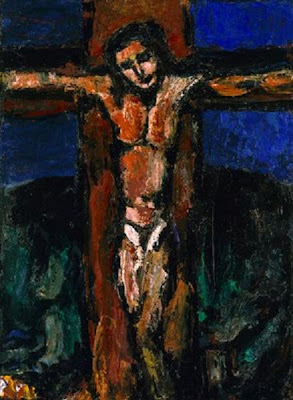
In 1920, Rouault painted The Crucifixion (above) in the same stained-glass style with the same contorted limbs. The Fauves claim Rouault as one of their own for his bold use of color. The Expressionists count him among their ranks for Rouault’s tortured rendition of the human body, usually Christ’s. Certainly Emil Nolde’s 1912 Prophet equals the religious fervor and Expressionist angst of Rouault’s religious works. I find it fascinating that Rouault paints Jesus in The Crucifixion without a beard, whereas other works show the familiar bearded face. Michelangelo chose to paint the Savior of The Last Judgment as a beardless youth to allude to the Greek ideal, casting Christ as a new Apollo bringing light into the world. I’m not sure that Rouault shared Michelangelo’s same faith in humanism, especially in 1920, when the aftershocks of the Great War continued to be felt throughout Europe. Maybe Rouault paints Jesus here as the beardless youth to stand for the whole generation of beardless European youth that met their end in the trenches and fields of wartime folly.

Before Rouault turned his attention to Christ-centered paintings, he painted series of works showing clowns, kings, and prostitutes as a way of commenting on the sad state of modern society. In Christ Mocked by Soldiers (above, from 1932) Rouault shows Jesus at the moment he is forced to play the clown king for the amusement of the soldiers, who crown him with thorns and place a reed “scepter” in his hands. In Christ Mocked by Soldiers, Rouault mocks the world itself, which he sees as prostituting itself for material things at the expense of its soul. “The richness of the world, all artificial pleasures,” Rouault lamented, “have the taste of sickness and give off a smell of death in the face of certain spiritual possessions.” By 1932, Rouault may have recognized, as did many others, the degenerating situation in the world that would eventually lead up to World War II. Rouault returns to the image of the bearded Christ here to emphasize the weariness of age rather than the innocence of youth of The Crucifixion. In his sixties himself, Rouault grew weary of the world and its self-destructive ways. Shortly before his death in 1958, Rouault destroyed three hundred of his own paintings, which would be worth a fortune today, as if to place them on his own funeral pyre and out of the reach of the materialists who valued them in currency instead of, as he did, in Christianity.
Friday, May 1, 2009
Flower Power

For the April Art Poll By Bob, in honor of the the U.S.’s tax return deadline on April 15th, I asked the following question, “Which of these following money- or tax-related works brings you the most to account?” The returns are in and say the following: Quentin Matsys' The Moneylender and his Wife (1514) won with 9 votes over Hieronymus Bosch's Death and the Miser (1490s) with 8. Caravaggio's The Calling of Saint Matthew (1599-1600), Albrecht Dürer's (attributed) Of Usury, from Brant's Stultifera Navis (the Ship of Fools) (1494), John Leech's Ebenezer Scrooge and the Last of the Spirits from Charles Dickens's A Christmas Carol (1843), and Paul Vos' The Tax Collector (1543) all tied for third place with 4 votes each. Lucas Cranach the Elder's Christ Drives the Usurers out of the Temple (1517) and Rembrandt's Christ Driving the Moneychangers from the Temple (1626) tied with 2 votes each and Niels Larsen Stevns' Zacchaeus (1913) and Thomas Sully's Shylock and Portia from Shakespeare's The Merchant of Venice (1835) brought up the rear with a single vote each.
Thanks to everyone who chimed in and voted. I wish I could say a refund check is in the mail, but I can’t.
For the May Art Poll By Bob, I’ve decided to go floral in honor of those great May flowers allegedly brought by all those relentless April showers and ask, “Which of these beautiful bouquets would you pick for your garden of earthly delights?”:
 Eugène Delacroix. Bouquet of Flowers (1849-1850).
 Paul Gauguin. Sunflowers (1901).
 Frida Kahlo. Flower of Life (1944).
 Paul Klee. Heroic Roses (1938).
 Gustav Klimt. Country Garden with Sunflowers (1905-1906).
 Claude Monet. Monet's Garden, the Irises (1900).
 Emil Nolde. Flower Garden (1908).
 Pierre-Auguste Renoir. Roses (1890).
 Vincent van Gogh. Irises, Sait-Rémy (1889).
Maybe all this flower power will help usher in a new age of peace, love, and understanding like back in 1967 when Bernie Boston snapped his famous Flower Power photo (top of post) showing Vietnam War protestors sticking flowers into the rifles barrels of National Guardsmen. Stop, smell the roses, tune in, tune out, and vote, but not necessarily in that order.
Tuesday, April 28, 2009
Bridge Over Troubled Waters
 Erich Heckel (1883-1970). Landscape in Dresden (Landschaft bei Dresden), 1910. Oil in canvas, 66.5 x 78.5 cm (26 1/8 x 30 7/8 in.). Staatliche Museen zu Berlin, Neue Nationalgalerie
“What is great in man is this: that he is a bridge and not an end,” wrote Friedrich Nietzsche in Thus Spoke Zarathustra in 1885. Two decades later, on June 7th, 1905, four young architecture students in Dresden, Germany, may have had those words in mind when they founded the artists group known as Die Brucke, or “The Bridge.” Ernst Ludwig Kirchner, Karl Schmidt-Rottluff, Erich Heckel, and Fritz Bleyl thus began an artistic movement that would stage more than seventy exhibitions before their disbanding in 1913, with twenty-seven happening in 1907 alone. “By joining together into a small, cohesive community with common goals, the Brucke artists hoped to stand up to [the] putatively fragmenting, debilitating effects of modern urban life,” writes Reinhold Heller in his essay “Brucke in Dresden and Berlin, 1905-1913” in Brucke: The Birth of Expressionism in Dresden and Berlin, 1905-1913, the catalogue to the current exhibition at the Neue Galerie in New York City. This exhibition, the first major exhibition of the Brucke in the United States, resituates these artists at the very beginning of the modern, international art world as they reached beyond Germany’s borders and invited the likes of Norwegian Edvard Munch (unsuccessfully) to join their band. “By reaching out, whether successfully or not, to such revolutionary painters,” Heller continues, “the Brucke established a network of communication with Europe’s most progressive artists and art institutions.” Dresden, known as “Florence on the Elbe” and famous for its many bridges (one of which is captured in Erich Heckel’s Landscape in Dresden, above, from 1910), thus became the starting point for the bridge-building across borders and between individual artists that the modern art world has become today.
 Erich Heckel (1883-1970). Studio Scene (Atelierszene), 1910-11. Oil on canvas, 70 x 48 cm (27 1/2 x 18 7/8 in.). Nachlass Erich Heckel, Gaienhofen.
In addition to their unsuccessful wooing of Munch, the Brucke successfully brought other artists, such as Emil Nolde and Max Pechstein into their fold. Staging group exhibitions and developing a signature style for their promotional material, the Brucke artists created a template for later artistic groups to follow. In all things, however, the Brucke set out to stand apart from the flow of contemporary, mainstream German life. They embraced “primitive” Indian, Oceanic, and African art, following in the footsteps of heroes such as Van Gogh and Gauguin and their search for primal forces untainted by modernity’s touch. This primitive approach, especially to the human figure, appears throughout their work, including Heckel’s Studio Scene (above), which also accurately depicts the everyday existence of the Brucke. For the Brucke artists, work and life were inseparable and models became friends and, sometimes, lovers. The artists even provided a “ruheraum” or “room of rest” for the models away from the labor of modeling. The German government’s crackdown on erotic images made the nude images of the Brucke artists all the more daring and avant-garde. In a musty old world suddenly thrown into an industrial age, the Brucke artists painted themselves as outlaws belonging to neither, but rather inhabitants of their own bohemian sphere of equality, fraternity, and, above all, beauty.

Ernst Ludwig Kirchner (1880-1938). Marzella (Fränzi), 1909-10. Oil on canvas, 76 x 60 cm (29 7/8 x 23 5/8 in.). Moderna Museet, Stockholm.
In the midst of this cultural separation, however, the Brucke longed to reconnect with what they saw as the essence of German art. Surrounded by the medieval art treasures of Dresden, the Brucke artists embraced forefathers such as Albrecht Dürer, Matthias Grünewald, and Lucas Cranach the Elder. Kirchner fashions himself as a modern Durer, who becomes “
 Ernst Ludwig Kirchner (1880-1938). Berlin Street Scene (Berliner Strassenszene), 1913-14. Oil on canvas, 121 cm x 95 cm (47 5/8 x 37 3/8 in.). Neue Galerie New York and Private Collection, New York.
Despite this German self-identification, the Brucke continually looked beyond national borders. Jill Lloyd’s “Brucke: National Identity and International Style” examines the tension between these nationalist and internationalist impulses. Dresden exhibitions of Van Gogh’s work in 1905 and Munch’s work in 1906 bring the cutting edge of art right to the Brucke’s doorstep. (The Neue Galerie’s Van Gogh and Expressionism exhibition in 2007 [my review here] covered that link extensively.) Lloyd sees the Brucke’s taking in of these influences not as “slavish dependence” but rather as “transformation[s].” Comparing the Brucke with their contemporaries, the Fauves, Lloyd writes, “Whereas the French artists worked within an established national tradition, the Germans pursued a self-conscious internationalism that went beyond the formulation of a new expressive style.” Criticism of the Brucke for not being “German” enough drove them in 1911 from Dresden to the more international city of Berlin. Berlin was the hub of the international art market at the time and provided easier access to the rest of the art world. In Berlin, Lloyd writes, the Brucke could “build more consciously on the elements of ‘Germanic’ or ‘Gothic’ style that had always co-existed with their modernism.” Kirchner’s Berlin Street Scene (above, from 1913-1914) shows how he adapted to his new, more cosmopolitan surroundings.
 Karl Schmidt-Rottluff (1884-1976). Corner of a Park (Parkecke), 1910. Oil on canvas, 83.5 x 75.5 cm (32 7/8 x 29 3/4 in.). Pinakothek der Moderne, Munich.
By 1911, however, the Brucke artists were beginning to grow apart. When Kirchner writes his chronicle of the movement and casts himself as the leader, Schmidt-Rottluff (whose Corner of a Park appears above, from 1910) and others take offense and finally disband in 1913. As Rose-Carol Washton Long explains in her essay, “Brucke and German Expressionism: Reception Reconsidered,” the Brucke soon drifted to the margins of art history for being not “modern” enough or not “political” enough. Only in the last twenty years, when “modernism” has been redefined as “one of the conflicting products of change in an industrial society,” Long writes, have the Brucke been rediscovered as an essential step in the progress of modern art. Brucke: The Birth of Expressionism in Dresden and Berlin, 1905-1913, the catalogue and exhibition, not only brings this neglected school to American shores for the first time, but also allows them to resurface from the depths of art history obscurity. Rather than being just a poor relation to Der Blaue Reiter, Die Brucke helped shape the international art world as we know it today in all its jet-setting internationalism. Able to embrace both their own national heritage and those of other civilizations, the Brucke artists set an example that artists continue to follow today, even if they don’t know where, how, or why it began. The Neue Galerie’s exhibition will answer all those questions, and more.
[Many thanks to the Neue Galerie for providing me with a review copy of Brucke: The Birth of Expressionism in Dresden and Berlin, 1905-1913 and for the images above from the exhibition.]
Tuesday, April 14, 2009
Grand Entrance

Meet James Ensor
Belgium's famous painter
Dig him up and shake his hand
Appreciate the man
Before there were junk stores
Before there was junk
He lived with his mother and the torments of Christ
The world was transformed
A crowd gathered round
Pressed against his window so they could be the first
To meet James Ensor
Belgium's famous painter
Raise a glass and sit and stare
Understand the man
He lost all his friends
He didn't need his friends
He lived with his mother and repeated himself
The world has forgotten
The world moved along
The crowd at his window went back to their homes
Meet James Ensor
Meet James Ensor
Belgium's famous painter
Dig him up and shake his hand
Appreciate the man
—“Meet James Ensor” by They Might Be Giants
Introducing a trend towards unconventional depictions of Jesus Christ in late nineteenth century European art, James Ensor’s Christ's Entry into Brussels (above, from 1888) might be the strangest of all. Born April 13, 1860, Ensor struggled with his religious faith for much of his life. Resolving the message of Christ with the modern way of life seemed impossible to him. In Christ’s Entry into Brussels, Ensor depicts just how incongruous Christ would be walking the streets of Brussels, circa 1888. Most of the people flooding the street wear masks, an obsession of Ensor’s and his shorthand way of painting the issues of identity he saw as at the heart of modern alienation. You have to search long and hard to find Christ in the picture. Look for the disc of Christ’s nimbus about his head at the center of the painting, just below the banner stretched across the top. That banner reads “Vive la Sociale” or “Long Live Welfare,” just one of the many texts appearing in the painting, including an advertisement for “Colman's Mustard,” that add a subtext of the political manipulations and commercialism plaguing society. The mayor of the town presides over the parade from a reviewing stand like a modern Pharisee. Such a bizarre image of Christianity hit home later with the German Expressionists and Surrealists who would consider Ensor a father figure.

Ensor suffered from horrible ulcers. Life certainly seemed bleak to him, but he managed to keep a sense of humor about things. Christ’s Entry into Brussels is a bizarre and bleak view of society, but it’s also hysterically funny when seen from a certain perspective. The same perspective allows us to see Ensor’s Skeletons Fighting Over a Smoked Herring (above, from 1891) as a macabre joke. If Christ’s Entry into Brussels serves as a prototype for the Christ-haunted works of German Expressionists such as Emil Nolde (who visited Ensor in 1911), then Skeletons Fighting Over a Smoked Herring looks forward to the skewed humor of Surrealists such as Salvador Dali. The title alone seems like something thought up by the Monty Python troupe. Ensor whistles through the graveyard and plays with the bones with little concern for conventional propriety. That disregard for mainstream mores more than anything else set up Ensor as a hero for later artists of different nations looking for an example to follow.

Ensor had his share of demons. Just look at his Self-Portrait With Demons (above, from 1898). That colored lithograph, almost cartoonish in style, helped open the eyes of other artists to the possibilities of printmaking to capture the devilish pictures dancing in their heads. Alfred Kubin owned several prints by Ensor. Leon Spilliaert, a fellow Belgian, felt the lasting influence of Ensor. Along with Odilon Redon, Ensor set the stage for imaginative art that took advantage of the new field of psychology. Demons no longer were seen as the products of a diseased mind but rather as the consequences of natural psychological reactions to the world. Ensor lived on to a ripe, old age, but he never recaptured the strange elegance of his most fruitful period between 1880 and 1900. I’m not sure it’s possible to sustain such close contact with the darkest corners of one’s mind without losing contact with reality entirely. Ensor stayed tethered to reality and the art world through his admirers, who watched his grand entrance and followed in his footsteps.
Tuesday, February 24, 2009
Garden Party

The story of Nils Büttner’s The History of Gardens in Painting is essentially the story of the garden in human history itself—a wish to return to paradise physically, spiritually, or both. Using the usual Abbeville Press style of lavish illustration, Büttner works his way through the beginnings of art history to the present day, hitting upon the usual suspects such as Claude Monet and the Impressionists (above, Monet’s Iris Bed in Monet’s Garden, from 1900) but also calling forth artists less well known for their natural touch, bringing both those artists and their periods into fresh perspective. Büttner’s text strikes at the heart of the human fascination with green oases and how the philosophy underpinning that fascination has changed in tandem with Western civilization’s evolving relationship with the earth. “[E]ven illustrations of actual gardens intended as topographical records are often echoes of human hopes or longings or projections of symbolic meanings,” Büttner writes. From the ancient Romans to the most modern of modern artists, the garden has held a unique place in the creative mind of mankind and reflected many of the central concerns of each age.

Büttner begins with the Romans and “the ideal of the Roman villa, which over time had come to epitomize otium, that exquisite calm, far from the hectic bustle of city life, universally considered necessary for any kind of intellectual activity.” The Romans actually borrowed this garden ideal from the Greeks and Egyptians, from whom they borrowed almost everything else. When living gardens were impractical, painted ones sufficed. A garden landscape of the Villa of Livia (above) created a grotto-like effect in a windowless, underground room. Büttner easily transitions from this Roman contemplative use of the painted garden to the religious contemplative use of the early Christians, who linked Christ with the lost paradise of Eden. Without getting bogged down in detail, Büttner explains how flower symbolism developed around figures such as Christ and the Virgin Mary into a full-grown visual garden of salvation for believers. Büttner shows how even the garden of courtly love, a parallel development to the Christian painted garden, bought into the idea of garden as the means of salvation. “Nothing that conflicts with the ethic of courtly love is admitted into the garden,” Büttner writes, “wickedness, hate, greed, envy, and miserliness are banished from it as surely as are old age and poverty.” Sacred and profane love follow the same program of green power.

When Büttner reaches the Renaissance and Baroque periods, we truly get a sense of how the garden became an ideological battleground in art. In addition to presenting familiar names such as Fra Angelico, Botticelli, and Andrea Mantegna, Büttner pulls out fascinating artists from the shadows of art history such as Jacob Cornelisz van Oostsanen. Van Oostanen’s Christ as Gardener (above, from 1507) depicts Christ as literally a gardener, with spade in hand, but “the garden here tended by Christ,” Büttner writes, “is to be perceived topologically as a symbol of the human soul.” Diving deep into the vast seas of religious images of these periods, Büttner always manages to resurface with a precisely apt picture to get his point across. Similarly, Lucas Cranach the Younger’s 1569 painting The Lord’s Vinyard shows a figure tending the garden of the human soul, but Martin Luther rather than Christ, who has been betrayed by the poor stewards of the Catholic church, according to the Reformation. The ancient Roman’s idea of the garden as philosophical facilitator gives way to a free-for-all atmosphere in such works in which the physical garden itself is reduced to nothing but a stage prop for propaganda.

As the power of the church began to fade and secular power took command, the garden as ideological battleground changed from a spiritual landscape to a landscape of social and political standing. Kings began to surround their palaces with elaborately structured gardens, such as the Gardens of Versailles. “Both the elaborate garden structures and the floral splendor displayed were luxuries reserved for the upper classes,” Büttner explains, “and thus clear evidence of social distinction.” When Rubens paints his self-portrait titled Peter Paul Rubens with Helene Fourment and Nicolas Rubens in the Garden in 1630, he shows himself as the owner of an elaborate garden to flash his “credentials” as a member of the elites in one single image. Romantic artists such as Caspar David Friedrich resisted Rubens identification. In The Garden Terrace (above, from 1811-1812), Friedrich shows a seemingly simple image of a young woman reading in the garden. However, Büttner deconstructs this painting to show how Friedrich disdains the young woman reading and ignoring the natural beauty around her, preferring instead the sublime wilderness beyond. “Perceived as the symbol of rationalism, the French garden is here contrasted with religious faith, a specifically German virtue,” Büttner explains. Suddenly, a garden scene not only depicts a philosophical distinction but also a nationalistic one, concisely capturing the convoluted web of ideas that underlie much of the garden imagery of the early nineteenth century before the Impressionists.

When the Impressionists and post-Impressionists arrive on the scene, Büttner’s narrative picks up speed and falls in line with the standard story of modern art. “The pure artistry in Monet’s pictures and those of the Impressionists developed a dynamic of its own,” Büttner writes, “one that caused objectivity to retreat into the background in favor of a total focus on artistic subjectivity.” Van Gogh takes this a step further and, in Büttner’s eyes, helps originate “the notion, commonly held to this day, that the artist as a creative subject, working for himself without commissions, adds new images to the reality of his time that must be engaged.” Later, German Expressionists such as Emil Nolde engage artistically with Van Gogh’s work in paintings such as Nolde’s Trolhoi’s Garden (above, from 1907). Büttner’s text helps restore the centrality of the garden and nature itself in the evolution of modern art—specifically as the origin of the vibrant colors that inspired the Impressionists and every movement on down to the Abstract Expressionists. Taking examples from artists not normally associated with garden scenes, such as Gustav Klimt and Edvard Munch, Büttner proves that the garden motif belonged not just to nature lovers but also to anyone addressing the course of modern art.

Paul Klee believed that the artist must hold “conversations with nature.” Klee’s Rose Garden (above, from 1920) is just one example of the many wonderful individual conversations within the larger dialogue of Western art with the idea of the garden found in Nils Büttner’s The History of Gardens in Painting. The garden may seem absent from the world of contemporary art, but Büttner believes that “[t]he garden painting fell into disrepute only when it degenerated into kitsch,” citing Bob Ross’ “happy little trees” and Thomas Kinkade’s sappy cottage gardens. Today’s focus on ecology will help reenergize the garden as a fruitful site of artistic exploration. If I have one complaint with Büttner’s text it is his laser-like focus on Western art to the exclusion of other traditions. A complete world history would be a tall order, but some inclusion of the garden in Chinese history (Craig Clunas’ Fruitful Sites: Garden Culture in Ming Dynasty China would be a great source) or the influence of Japanese garden painting on the West via Japonisme, a huge factor in the development of Van Gogh and others, would certainly add another dimension to Büttner’s argument. However, The History of Gardens in Painting remains a valuable compendium of how artists have lost themselves in gardens over time in the never-ending pursuit of paradise.
[Many thanks to Abbeville Press for providing me with a review copy of Nils Büttner’s The History of Gardens in Painting and for the images from the book shown above.]
Subscribe to:
Posts (Atom)