Modernism first moved on May 29, 1913. That’s century-old hyperbole, of
course, but if any date achieves day of infamy status for modern art in the 20th
century, it’s the day that Russian composer Igor
Stravinsky teamed up with Russian ballet impresario Sergei
Diaghilev and his Ballets Russes company to stage Le Sacre du printemps,
or, in English, The Rite of Spring. Diaghilev
and the Ballets Russes, 1909–1929: When Art Danced with Music, now at the National
Gallery of Art, Washington, DC, returns to that cataclysmic moment when
modernism became an unavoidable reality for the mainstream public, which had
done its level best to ignore it previously. Multimedia in its combination of
music, dance, and artistic design, The Rite of Spring and other
productions by the Ballet Russes helped modernism move beyond the fringe to the
center of Western culture ever since. Please come over to Picture This at Big Think to read more of "When Modernism First Moved."
[Many thanks to the National Gallery of Art, Washington, DC, for the
image above and other press materials related to Diaghilev
and the Ballets Russes, 1909–1929: When Art Danced with Music, which
runs through September 2, 2013.]
Showing posts with label Rouault (Georges). Show all posts
Showing posts with label Rouault (Georges). Show all posts
Tuesday, May 21, 2013


Wednesday, August 25, 2010
Thumbs Up: Reconsidering Jean-Léon Gérôme

If you think that a thumbs up in ancient Rome meant that the beaten gladiator would live and that a thumbs down meant death, you can thank Jean-Léon Gérôme’s 1872 painting Pollice Verso (shown above) for that. In reality, thumbs down meant “stick your sword in the ground” and no kill. Thumbs up meant “stick the sword in his neck.” It’s amazing to think of how a single work could generate such a widespread idea, but Gérôme enjoyed that kind of influence in the nineteenth century thanks to hi show-stopping scenes of the ancient world and exotic east. As tastes shifted towards modernism with the turn of the twentieth century, Gérôme slid into obscurity. Reconsidering Gérôme, edited by Scott Allan and Mary Morton, accompanies The Getty Center’s exhibition, The Spectacular Art of Gérôme, in trying to restore Gérôme’s good name in today’s art world. Their efforts amount to one big thumbs up for an artist whose old-fashioned realism masks modernist impulses that make Gérôme’s art relevant today. Please come over to Picture This at Big Think to read more of "Thumbs Up."
[Image: Jean-Léon Gérôme. Pollice Verso, 1872. Oil on canvas, 39.5 x 58.6 cm (15.5 x 23 in.). Phoenix Art Museum. Museum purchase.]
Thursday, May 28, 2009
Passion Play

Working as a teenager as apprentice to a glass painter and restorer, Georges Rouault came face to face daily with beautiful stained glass windows showing scenes of the life of Christ. Born May 27, 1871 to a poor, pious Parisian family, Rouault’s faith was always strong, but it was his friendship with the philosopher Jacques Maritain that drove Rouault to commit himself to painting primarily religious subjects. Rouault’s The Flagellation (above, from 1915) shows the lingering influence of stained glass window design in the cloisonnist dark lines separating the fields of color. Christ stands at the pillory in the center of the work to take the blows of the soldiers. World War I raged as Rouault painted this scene of suffering, which may allude to Europe’s self-flagellation in the name of nationalism. It is interesting that Rouault’s works concentrate almost exclusively on the passion and death of Christ, with no images that I know of depicting the triumph of the Resurrection. Rouault identified with agony more than ecstacy, saying once, “The conscience of an artist worthy of the name is like an incurable disease which causes him endless torment but occasionally fills him with silent joy.” Perhaps Rouault allowed himself a moment of “silent joy” upon completing The Flagellation, but the emphasis was definitely on the silence.
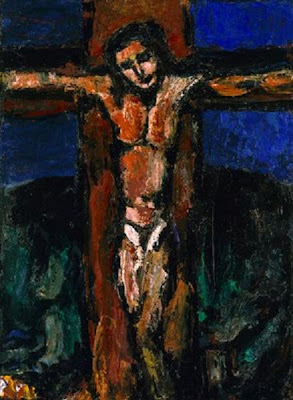
In 1920, Rouault painted The Crucifixion (above) in the same stained-glass style with the same contorted limbs. The Fauves claim Rouault as one of their own for his bold use of color. The Expressionists count him among their ranks for Rouault’s tortured rendition of the human body, usually Christ’s. Certainly Emil Nolde’s 1912 Prophet equals the religious fervor and Expressionist angst of Rouault’s religious works. I find it fascinating that Rouault paints Jesus in The Crucifixion without a beard, whereas other works show the familiar bearded face. Michelangelo chose to paint the Savior of The Last Judgment as a beardless youth to allude to the Greek ideal, casting Christ as a new Apollo bringing light into the world. I’m not sure that Rouault shared Michelangelo’s same faith in humanism, especially in 1920, when the aftershocks of the Great War continued to be felt throughout Europe. Maybe Rouault paints Jesus here as the beardless youth to stand for the whole generation of beardless European youth that met their end in the trenches and fields of wartime folly.

Before Rouault turned his attention to Christ-centered paintings, he painted series of works showing clowns, kings, and prostitutes as a way of commenting on the sad state of modern society. In Christ Mocked by Soldiers (above, from 1932) Rouault shows Jesus at the moment he is forced to play the clown king for the amusement of the soldiers, who crown him with thorns and place a reed “scepter” in his hands. In Christ Mocked by Soldiers, Rouault mocks the world itself, which he sees as prostituting itself for material things at the expense of its soul. “The richness of the world, all artificial pleasures,” Rouault lamented, “have the taste of sickness and give off a smell of death in the face of certain spiritual possessions.” By 1932, Rouault may have recognized, as did many others, the degenerating situation in the world that would eventually lead up to World War II. Rouault returns to the image of the bearded Christ here to emphasize the weariness of age rather than the innocence of youth of The Crucifixion. In his sixties himself, Rouault grew weary of the world and its self-destructive ways. Shortly before his death in 1958, Rouault destroyed three hundred of his own paintings, which would be worth a fortune today, as if to place them on his own funeral pyre and out of the reach of the materialists who valued them in currency instead of, as he did, in Christianity.
Friday, October 24, 2008
Late Bloomer

“I was twenty-one before I saw a good picture,” Sir Matthew Smith once said of his insular upbringing in the shadow of his pious, businessman father. Born October 22, 1879, Smith eventually resisted his father’s attempts to place him in the world of business and, despite ill health, willed himself into the world of art. In 1908, Smith traveled to France to study at the Slade, the art school run by Henri Matisse. Although he most likely didn’t study directly with Matisse, Matisse influenced the entire curriculum of the school. Smith’s Dulcie (above, from 1915) shows how he took the style of Matisse in his Fauvist days and adapted it to his own uses. The connection with Matisse opened up doors to Smith that allowed him to exhibit with the likes of Matisse, Kandinsky, Fernand Léger, and Georges Rouault all before World War I erupted and forced Smith to return to England. Because of this influence of Matisse, Smith seemed “more French than English” upon his return, according to one contemporary, in terms of his handling of color to elicit emotion. Smith neatly smuggled Matisse across the Channel and overnight opened the eyes of his countrymen to the next big thing in painting.

Within a few years of returning to England, Smith found himself drafted into the war. He suffered shrapnel wounds in combat that taxed his already frail health, but the experience of war exacted a greater toll on his mind, beginning a cycle of creativity alternating with depression that would plague the rest of his life. Smith eventually established a London studio near that of Walter Sickert, whose (in)famous “Camden Town” nudes set the standard for the nude form in English painting in the early twentieth century. In Model Turning (above, from 1924), Smith slowly turns away from Matisse’s influence and turns toward a style closer to that of Sickert’s. The red skirt and blue and purple cushions hark back to Fauvism, but the instability of the figure itself generated by the roughness of the brushwork is pure Sickert. Actually, Smith exceeds even Sickert’s penchant for molding the figure in color like a sculpture rather than through line.

Smith continued to progress in a more Sickert-esque direction. In one of his many portraits of his friend and fellow painter Augustus John (above, from 1944), Smith handles the subject roughly. John referred to his portrait as “another hemorrhage for Matthew” in acknowledgment of the bloody, gory way Smith painted flesh even in the portraits of friends. As the pace of his cyclical depression increased, Smith’s view of life and humanity seemed to darken considerably. The young Francis Bacon admired Smith’s troubled style and patterned his own work after it. In many ways, Smith is the link between Sickert and Bacon, the two most important painters of the nude in English painting in the twentieth century. Smith’s evolution from Fauvism, one kind of beastliness, to the later brand of beastliness in his final works demonstrates how the late bloomer more than made up for lost time.
Wednesday, April 9, 2008
Fighting the Muse

The Spring 2008 issue of Nineteenth-Century Art Worldwide: A Journal of Nineteenth-Century Visual Culture contains a fascinating article by Scott C. Allan titled Interrogating Gustave Moreau’s Sphinx: Myth as Artistic Metaphor in the 1864 Salon. Born April 6, 1826, Gustave Moreau long enjoyed the status of a pioneering Symbolist artist but more recently, as Allan puts it, “has been firmly situated in his generational context as an aspiring history painter who came of age in the Salons of the Second Empire (1851–1870).” I’m not sure I agree entirely, but I found his reading of Moreau’s Oedipus and the Sphinx (above, from 1864) interesting in showing a different side of Moreau. Pointing towards Moreau’s self-identification in correspondence, etc., as “a harried defender of idealist values,” Allan sees Moreau’s depiction of the Sphinx as “read[able] not only as the materialist enemy which the artist was set on confronting and defeating (the dominant understanding of his composition), but also as a chimerical poetic and artistic ideal to which, for better or worse, he was fatally attached.” In other words, the Symbolist muse so commonly linked with Moreau was actually his enemy, both the antithesis of his idealism and a temptation he couldn’t resist.

Extending Allan’s theory, we can see Moreau’s Orpheus (above, from 1865) as a depiction of the same siren song of materialist decadence. Moreau was a deeply, if unconventionally spiritual man, as shown by especial affection for his student, Georges Rouault, himself a deeply religious painter albeit in a modern idiom. Moreau chose Rouault to look after his home after his death and oversee its transition to a museum. It’s interesting how closely Oedipus and the Sphinx and Orpheus follow the same composition. In both, a standing figure gazes into the eyes of a magical creature, unable to look away, giving credence to Allan’s idea of Moreau’s conflicted relationship to his proto-Symbolist works.
 I’d like to believe that Moreau found peace with his muse in later years, as shown in Hesiod and the Muse (above, 1891). No longer are the two figures locking stares, literally facing off against one another. Instead, the muse stands behind Hesiod, pointing the way for him instead of standing in his way. Allan’s article does a great job in showing a different facet of Moreau. I admit that I like to cling to the idea of Moreau as the great French father of Symbolism, mainly because of my affection for that brand of painting, so full of mystery and the fantastic. Knowing now that Moreau’s original impulse was to be a history painter, painting straightforward scenes of history and mythology to help ward off what he saw as the decadent path French painting was taking, makes the spiritual component of his art all the more alluring—something even the artist himself couldn’t resist.
Tuesday, September 25, 2007
Tragedy, Ecstasy, Doom, and So On
+1956.jpg)
“[I’m] only in expressing basic human emotions—tragedy, ecstasy, doom, and so on,” Mark Rothko once wrote. “And the fact that a lot of people break down and cry when confronted with my pictures shows that I can communicate those basic human emotions . . . The people who weep before my pictures are having the same religious experience I had when I painted them. And if you, as you say, are moved only by their color relationship, then you miss the point.” Born Marcus Rothkowitz on September 25, 1903 in Latvia, Rothko created works such as Untitled (Orange and Yellow) (above, from 1956) that reach directly into your heart, emotionally and aesthetically. Rothko’s multiform pictures, large unframed canvases full of giant bodies of color bleeding into one another, command and envelop a room. Many people see only an emptiness in these blocks of color, or just interesting composition. For those who allow their minds and hearts to ponder the range of feeling within them, Rothko becomes a religious experience.

The struggles that play out on Rothko’s multiforms mirror the struggles of his life. After suffering through the Russian pograms of his youth, his family moved to America in 1913. Mastering his new language of English (his fourth), Rothko excelled at school and earned a scholarship to Yale, leaving after one year. Rothko felt drawn to spiritual artists such as Paul Klee, Georges Rouault, and the German Expressionists before meeting fellow philosophical artist Barnett Newman in the 1930s. Through his conversations with Newman and his readings of Freud, Jung, Nietsche, and J.G. Frazer, Rothko developed an idiosyncratic view of myth and symbolism that he expressed in works such as The Omen of the Eagle (above), from 1942. But even those ancient symbols seemed unsatisfying in his mission to express those elusive “basic human emotions.”

Simon Schama’s episode on Rothko in The Power of Art series focuses on his 1958 Seagram Murals at the Tate Museum (one of which appears above). In these murals and other late works, such as those which eventually became the Rothko Chapel, Rothko achieved a nearly transcendent use of color and form approximating pure emotion and, perhaps, religious epiphany. Applying the paint to these images became such a demanding experience for Rothko that many of his later works were actually painted by assistants under his direction as his health began to fail. This intensity of his art may have contributed to his suicide in 1970. Schama’s treatment of Rothko presented his works in this cosmic intensity, pulling away from the murals and melding them into a vision of the starry heavens, as if they were doorways to another dimension. The Seagram Murals, with their square frame motifs, open the door to Rothko’s mind and philosophy and call us to join him in a voyage of self-discovery like few other artists can.
Friday, May 25, 2007
Through a Glass Darkly

Taking what he learned from his apprenticeship as a glass painter and restorer, Georges Rouault, born on May 27, 1871, painted beautiful works of great emotion and spirituality that deserve far greater acclaim than they currently receive. Old King, shown above, demonstrates this unique approach to line and color that later influenced the German Expressionists, especially in the field of the woodcut.
Rouault studied under Gustave Moreau and shared a common interest with his teacher in the mystical and spiritual and how to portray such ephemeral concepts in art. Whereas Moreau created proto-Surreal, symbolist works that portray realistic scenes with fantastic overtones, Rouault used the framework of the stained glass window to capture the inner light he saw in life. The power of his lines to express emotion has few rivals. The color in his paintings represents some of the best of the Fauvist movement. Rouault knew Henri Matisse personally and shared his passion for color. Van Gogh’s ability to use color to express passionate emotion also influenced Rouault.
Rouault studied under Gustave Moreau and shared a common interest with his teacher in the mystical and spiritual and how to portray such ephemeral concepts in art. Whereas Moreau created proto-Surreal, symbolist works that portray realistic scenes with fantastic overtones, Rouault used the framework of the stained glass window to capture the inner light he saw in life. The power of his lines to express emotion has few rivals. The color in his paintings represents some of the best of the Fauvist movement. Rouault knew Henri Matisse personally and shared his passion for color. Van Gogh’s ability to use color to express passionate emotion also influenced Rouault.

I have always been drawn to Rouault’s religious works, such as his Crucifixion above. Coming from an Irish Catholic background, the stark, primitive emotion as well as the effusive color pull at my heart like the finest stained glass windows I’ve seen in the old cathedrals of Europe. Even more impressive may be Rouault’s Miserere et Guerre series of black and gray aquatints. (The full series can be seen here.) Jesus Reviled, one of the series’ most touching images, appears below. In the Miserere et Guerre series Rouault displays a depth of tone in the simple and black as well as a richness of line and gesture that belies the often “primitive” appearance of his works.

Unfortunately, Rouault never received his fair share of accolades during his lifetime. Near the end of his life, he burned three hundred of his paintings in despair. Fortunately, the wealth of his emotional and spiritual life still shines brightly through all his work, from the hopeful, colorful celebrations of life to the somber, grey meditations on suffering and death.
UPDATE: For those in the New York area, you can go see Georges Rouault: Judges, Clowns and Whores through June 9 at Mitchell-Innes & Nash. A New York Times review is here.
Subscribe to:
Posts (Atom)