Showing posts with label Feiffer (Jules). Show all posts

Sunday, February 20, 2011

Room for Hope: The Art of G.B. Trudeau’s Doonesbury


“Satire works by inference,” cartoonist G.B. Trudeau says in Brian Walker’s new book Doonesbury and the Art of G.B. Trudeau. “What you condemn should reveal what you value, what you stand for. That’s why I don’t like categoric, 360-degree attacks. Scorched-earth artists leave no room for hope.” Since its debut on October 26, 1970, Doonesbury has attracted devotees as well as devoted critics with Trudeau’s heart-on-his-sleeve liberalism. Walker walks through the evolution of the Doonesbury, which began in 28 newspapers and now boasts 100 million daily readers, and gives not a biography of Trudeau but rather a biography of the life of the strip itself. Despite all the wars—cultural and shooting—of the past four decades, Trudeau never forgot to leave room for hope, and Walker’s affectionate tribute reminds us of that crowning achievement of his art. Please come over to Picture This at Big Think to read more of "Room for Hope."

[Many thanks to Yale University Press for providing me with a review copy of Doonesbury and the Art of G.B. Trudeau by Brian Walker.]

Tuesday, October 7, 2008

Behind Enemy Lines


In a little under a month from now, Americans will decide who will be making the big decisions for the next four years. The recent flap over Barry Blitt’s satiric cover of the July 21, 2008 issue of The New Yorker, titled “The Politics of Fear,” featuring Senator Barack Obama and his wife Michelle in poses straight from a paranoid conservative’s nightmares reminded many Americans of the power of political cartoons to inflame and, perhaps, even enlighten. Donald Dewey’s The Art of Ill Will: The Story of American Political Cartoons traces the history of American political cartooning back to the very beginning—Benjamin Franklin’s Join, or Die (above, from 1754), which he actually printed in response to colonial infighting over supporting England in the French and Indian War but was later repurposed for unity in opposing England during the American Revolution. Franklin’s crude illustration reflects the crude beginnings of political cartooning in America, which developed along with the nation into a golden age of the second half of the nineteenth century only to lapse into a slow and excruciating long decline that reaches to our very time. Dewey presents the good, bad, and the ugly of political cartooning and provides an overarching narrative that puts all the different images so heavily tied to their time and place into a coherent, troubling narrative.


Dewey allows no illusions about the role of political cartooning in American politics. “Originality, outlandishness, and impact had always been at the service of a periodical seeking more circulation and advertising, a political party seeking to score points against an opponent, or some other interest seeking to ensure one of both objectives,” Dewey explains with clear eyes. Amidst a sea of cynical opportunism reaching from the very beginnings of the nation and the infamous Jefferson—Adams election of 1800 to the corrupt spoils system of the post-Civil War period, Thomas Nast rises above the waters and provides Dewey with his first hero of the drawing board. In images such as The Tammany Tiger Loose (above, from 1871), Nast waged war on Boss Tweed's Tammany Hall political machine through scathing symbolism that spoke to the illiterate immigrants hit hardest by Tweed’s machinations. As The Tammany Tiger rends another innocent taxpayer limb from limb, the Nero-esque Tweed looks on approvingly, even daring the masses to do something about it. Nast, indeed, did something about it, inundating the public imagination with pictures of Tweed’s criminality more than fifty times in the second half of 1871 alone. Tweed even tried to bribe Nast with $100,000 to go to Europe to “study art” and leave him alone. Tweed lost power in 1871 and found himself in jail in 1872, thanks in some part to Nast’s efforts. “Nast… refused to draw anything he didn’t believe in,” Dewey writes, “leading him to disappear from Harper’s for months at a time because of the weekly’s support of Rutherford B. Hayes and his own disdain for the president.” Such a principled stand makes Nast one of the few untarnished heroes of this period, more remarkable for perpetuating power and racist stereotypes than for standing up for the little guy.


“Give me a good cartoonist, and I can throw out half the editorial staff,” Dewey quotes H.L. Mencken saying. This power of the single image proved a valuable tool—one that the authorities often looked to control. Abraham Lincoln and Ulysses S. Grant both acknowledged the role of Nast’s cartoons in the Civil War and Reconstruction, years before Nast took on Tweed. However, government more often sought to suppress the power of political cartoonists, especially in the twentieth century, when Socialism and its pacifist creed challenged America’s moral authority in going to war. Robert Minor’s Army Medical Examiner (above, from 1916) questioned Woodrow Wilson’s plea to enter the United States into World War I by creating the “perfect soldier”—namely, one with no head to think and disagree. Publications such as The Masses provided an outlet for such cartooning outside of the mainstream newspapers tied up by corporate interests themselves tied to government—the very beginnings of the American military-industrial complex. By 1918, government repression forced The Masses to end publication as some cartoonists found themselves in jail for protesting American involvement in the war and refusing to personally join the cause. Another outstanding cartoonist of this period, Homer Davenport, satirized William McKinley and his stage-manager Mark Hanna, the Karl Rove of his day, for William Randolph Hearst’s chain of newspapers, working within the establishment media to undermine the establishment.


The history of American political cartooning often takes the form of their targets—from the hatchet-faced Andrew Jackson to an almost bestial Abraham Lincoln to the mustache and glasses of Theodore Roosevelt to the chin and cigarette holder of Franklin Roosevelt. Although symbols such as Uncle Sam and John Q. Public sprang from cartoonists’ brains, they could never match up to the real thing. And few victims of cartoonists’ pens ever had as much to complain about as Richard Milhous Nixon, perhaps the most caricatured face in American political history. Rick Perlstein’s Nixonland: The Rise of a President and the Fracturing of America cites Herblock’s 1954 cartoon, Here He Comes Now, as a prescient depiction of Nixon’s willingness to play gutter and even sewer politics. “Nixon was to cartooning what Marilyn Monroe was to sex,” cartoonist Doug Marlette once said. “Nixon looked like his policies. His nose told you he was going to bomb Cambodia.” Along with Bill Mauldin and Paul Conrad, Herblock instituted a brief renaissance in American political cartooning in the mainstream media that died as quickly as it began. “Except for the Herblocks, Mauldins, and a few others,” Dewey laments, “cartoonists over the years have generally done what they have been told to do or anticipated being told to do, or they have not had the imagination to improve on what it had been a bad idea to do. One reason [such names] have stood out is that they have been exceptions.” Dewey often strikes the note of fear that such exceptional figures may no longer find a place in mainstream media.
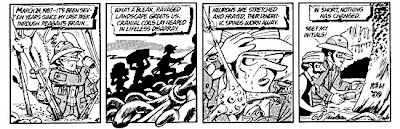


The strongest part of Dewey’s argument for the decline of American political cartooning comes through in his analysis of the ever-increasing connection between politics and entertainment. Gary Trudeau’s Doonesbury strip (shown above searching for Ronald Reagan’s brain in 1987), although highly praised and awarded, contributes to the blurring of the line between government figures and celebrity by bringing serious issues to the “funny pages.” On the other side of the political spectrum, conservative strips such as Mallard Fillmore further muddies the water by making political ideology itself speak through cartoon mouthpieces. “When a real politician becomes a stock character in a fictional scenario,” Dewey cautions, “no matter how critically he is treated, he enters a protective zone that has little in common with the goals of a potent editorial cartoon.” Doonesbury and its children literally take more of the bite out of the already toothless modern American political cartoon by prioritizing laughs over social commentary. Dewey’s pessimistic view of the history of the American political cartoon leads him to question whether such images have always been just entertainment, “with congressmen and presidents taking the role of mothers-in-law for the joke telling?”


The maverick world of underground cartooning, pioneered by artists such as Jules Feiffer at The Village Voice in the 1950s, still struggles for space in the collective American consciousness today. Too often, that space comes only when highly controversial strips such as Ted Rall’s Terror Widows (above, from 2002) hit hot button issues such as the September 11th attacks. The wide-open world of the internet allows underground comic artists to poke and prod at the establishment façade, yet resistance seems futile in the face of monolithic media conglomerates and the fast-approaching demise of the daily newspaper as cable television news takes its place. Such abrasiveness as Rall demonstrates may the last hope for cracking open the mind of America. Herblock knew his Mr. Atom character, created to represent the dangers of atomic warfare, had lost his punch when someone described it as “cute.” Cute no longer cuts it when the stakes are this high for the American civilization.


Perhaps the greatest revelation of The Art of Ill Will is just how American political cartooning has reflected the racist nature of America itself. Even Theodore Geisel, the future Dr. Seuss, could indulge in World War II-era anti-Asian stereotypes in a 1942 cartoon titled Waiting for the Signal from Home (above), which shows Asian-Americans looking to Japan for a signal to sabotage the American war effort. Just hours after Geisel’s cartoon ran, the order for the internment of Japanese-Americans passed. Anyone looking for a valentine to the ideals of American democracy shouldn’t open The Art of Ill Will. If you’re looking for a thought-provoking history of how popular images have shaped and been shaped by the course of American history, however, The Art of Ill Will may make you a little ill at first but should inoculate you to even the strongest strains of partisan fever.


[Many thanks to New York University Press for providing me with a review copy of Donald Dewey’s The Art of Ill Will: The Story of American Political Cartoons.]

Tuesday, July 8, 2008

Voice From the Past


When George Carlin died recently, I thought back to how I felt when Kurt Vonnegut died. Both men developed their critical, humane, humorous voices during the Eisenhower years of the 1950s and helped shape the direction that the tumultuous 1960s would take. After reading Jules Feiffer’s Explainers: The Complete Village Voice Strips (1956-66), I nominate the ground-breaking cartoonist, still very much alive, for that short, distinguished list. After apprenticing under comics pioneer Will Eisner from 1946 through 1952, Feiffer looked for a new outlet for his talents and views. “Feiffer wanted to use comics to stir things up and to get into the thick of the fray,” Gary Groth writes in his introduction to Explainers, “but there wasn’t much of a fray to be in the thick of in the mid-‘50s.” When The Village Voice began publishing on October 25, 1955, Feiffer found his home. Given “basically… carte blanche on the spot to do whatever he wanted” when hired by the Voice in October 1956, Feiffer went on to create over 2,000 socially conscious cartoons for the next 44 years. This volume, the first of four covering Feiffer’s full career at the Voice, presents “practically an encyclopedia of issues preoccupying the public intellectual from 1956 to 1966.” Feiffer took the ideas of contemporary thinkers such as I.F. Stone, Murray Kempton, Eric Fromm, Lewis Mumford, and others and made them accessible through an endless pantheon of characters such as the prone man immobilized by doubt, young couples talking over drinks, and his most memorable figure—the Dancer. In a strip from December 2, 1959 (above), the Dancer offers “A Dance to the Loss of Innocence” that rails against “The disappointment of friends—the inadequacy of lovers—the failure of gods.” Reading through Feiffer’s cartoons from 1956 through 1966 we relive in “real time” a generation’s loss of innocence, rising to the peak of the Kennedy years before descending to the nadir of Vietnam.


For those who know the 1960s only from history books or popular culture, Feiffer brings it all to life with honesty and nuance. Looking back at the 1960 Presidential Debates between JFK and Nixon, Feiffer writes: “Those who like Nixon think he won. Those who like Kennedy think he won. Those who think both men are inadequate thought both men were inadequate.” As Groth points out, “Feiffer considered himself a radical in contradistinction to liberalism, which he felt was insufficiently principled.” Feiffer’s radicalism allows him to poke fun at both sides. As Feiffer writes in a May 24, 1962 strip, “The mark of a mediocre man is a mediocre ideal.” Feiffer never allows himself mediocre ideals, waiting instead for a brass ring to reach for. After the Kennedy assassination, Feiffer didn’t fall for the Camelot-laden mythology but did credit Kennedy for effecting a change in the American discourse. On January 2, 1964, Feiffer responded to the assassination with a strip featuring a child reading a fairy tale of a fallen prince (above), but not the standard tale issued. “Kennedy woke us up,” Feiffer says. “The Prince kissed Sleeping Beauty, she came awake again but instead of living happily ever after, we started quarreling over all those issues we long suppressed.” Civil rights, the military-industrial complex, and sexuality—issues dormant during the 1950s—all moved to center stage in the 1960s, refusing to be silenced again until the “princes”—JFK, RFK, MLK–slept in the earth.


It is impossible to read Explainers and not draw parallels between that era and today. A strip such as Feiffer’s March 30, 1961 caustic piece on the “free” press (above) could easily have been written today. “For diverting trivia we have a free press,” the man shown says. “The function of a free press is to publish free press releases.” In today’s world of the media “echo chamber,” in which “embedded” journalists lose all independence and fall into government-approved stenography, Feiffer’s words seem both prescient and disturbing—proof that the media’s current state existed nearly half a century ago and seems to have only gotten worse. “Free press?” the man asks. “We’re a nation of trade journals.” The corporate consolidation of media, now possible on an unprecedented scale thanks to the removal of most monopoly protections, makes Feiffer’s accusation of “trade journals” seem even more stinging. “Much of what I was going after was what government did with language—the double-speak that Orwell wrote about so brilliantly in 1984,” Feiffer says. Only a complicit media can make the “double-speak” stick and the “memory hole” permanent.


“The trouble with you critics, fear artists, and prophets of doom is that you never offer an alternative,” says the talking head of the establishment to the talking head of dissent in Feiffer’s landmark strip of November 10, 1966 (above), drawn during the heat of the Vietnam War escalation. The dissenter offers alternative after alternative until the establishment voice offers a final solution—suppress dissent. Feiffer fights censorship in all its forms, however tranquil. “If suppression can not disarm criticism,” Feiffer writes on May 4, 1961, “amiable acceptance can.” This “amiable acceptance” most often takes the form of “The Radical Middle,” whose lukewarm panacea for 1963 is “Bold times call for bold answers. Within reason. In a manner of speaking. More or less.” This “Radical Middle” approves of “free elections just so long as there continue to be no real differences between the parties.” Feiffer’s writing, however embittered it may seem, remains a bracing tonic for those looking for change at the ballot box. The timing of the republishing of these works couldn’t be better for an American audience.


By the end of the first volume of Explainers, Feiffer seemingly loses all hope. “For me, getting out of bed in the morning is an act of false confidence,” Feiffer writes in 1963. By the end of 1966, even that false confidence is gone. In a December 15, 1960 strip riffing on Samuel Beckett’s Waiting for Godot, one character remarks, “There seems to be a direct line between waiting and disappointment.” The long wait takes it’s toll on Feiffer, as shown in the April 21, 1966 strip in which the Dancer looks to embrace Spring in all its hopefulness only to have a gun literally flower from the earth and kill her, as more guns appear poised to rise behind it. “The old fogey in me doesn’t expect much,” Feiffer says today, “but the boy-cartoonist in me remains foolishly idealistic as ever, but not foolish enough to involve myself directly or politically again.” “Scratch a cynic,” George Carlin once said, “and you’ll find a disappointed idealist.” Feiffer’s past disappointment demonstrated in these pages serves as a cautionary tale for both idealists and cynics today. Step into the time machine that is Jules Feiffer’s Explainers, relive the days of hope and the days of disillusionment, and come to understand the full meaning of the label “cynic” as both an earned badge of honor and an unwelcome curse.

[Many thanks to Fantagraphics Books for providing me with a review copy of Jules Feiffer’s Explainers: The Complete Village Voice Strips (1956-66) and for the images above.]

Tuesday, June 17, 2008

Gross Anatomy


Few people make the argument for comics as art as entertainingly or eruditely as Craig Yoe, king and head jester of the Arf Lovers court. Following the success of Arf Forum, Arf Museum, and Modern Arf, Yoe now offers Comic Arf: The Unholy Marriage of Art and Comics—Gross National Product as his latest piece of evidence that comics can be both fun and stimulating, both intellectually and, uh, otherwise. Yoe mines the rich ore of comics lore to recover lost masters such as Milt Gross, whose 1930 A Guide to Useful American Citizens (above) seems startlingly relevant today. Unwashed masses (labeled as “The Right Kind of Immigrants”) enter a meat grinder turned by Uncle Sam himself and emerge transformed into “Useful American Citizens,” embodied by a crowd of classic comics characters, including The Yellow Kid, Popeye, Krazy Kat, Barney Google, and many others. Gross encapsulates the entire emotional immigration debate in one humorous image without leaving out any of the political satire. Yoe’s encyclopedic knowledge of comics history allows him not only to find such lost gems but to pick just the right jewels to catch the modern eye today—the litmus test of continued relevance that makes all great art great.


The Arf Lovers series connects the past with the present by having the artists of today engage in an active dialogue with the artists that influenced them. Taking Gross’ 1920s series, “Draw Your Own Conclusions,” in which Gross would leave the final panel of a 4-panel strip blank for people to fill in their own ending and, perhaps, claim a money prize, Yoe challenges a who’s who of modern cartoonists to try their hand at Gross’ game. The SimpsonsMatt Groening’s attempt (above) gives you a glimpse of the idiosyncratic spin other artists such as Robert Crumb, Mort Walker, Art Spiegelman, Bil Keane, Jules Feiffer, Al Jaffee, Jaime Hernandez, Sergio Aragones, and others put on the punchlines. These responses capture the spirit of Gross’ art, which Yoe describes as “Messy, full of surprises, rule-breaking, stimulating, electrifying, daring, dangerous, and not for the faint of art. Definitely for the screwed, stewed, and tattooed crowd.” For the most part, Yoe allows the art to speak for itself, filling page after page with vintage work often drawn from his personal collection, adding only enough text to guide the reader to the next treasure before stepping aside.


Paging through these Arf Lovers books will make you long for the golden age of newspaper comics. Comic Arf brings back to life in large format the “Right Around Home” series of Dudley Fisher, which Yoe calls “a tour de force in draftsmanship seen from above.” In “Right Around Home,” Fisher would take his cast of characters to a familiar scene, such as the art museum (above), and let them and his imagination run free in a kinetic dervish. Another side of Walt Kelly, famous for his Pogo strip, comes through in the moralizing yet surreal “Contrary Mary and the Angel.” Similarly, Yoe recovers the work of Arch Dale, whose characters “The Doo Dads” may have served as a prototype for “The Smurfs” and may even have inspired the work of Theodore Geisel, aka Dr. Seuss. Such energy and inventiveness flow through Yoe’s own cartooning, a sample of which (“X-Dream It Up”) appears in the final pages of the book. You’ll never accuse Yoe’s work of dry academicism, which is why he brings these classic comics back to life with such full color and fun.


“I owe it all, gentlemen, to the little woman!” announces the artist in Gardner Rea’s Successful Modernist (above), pointing to his Cubist–ly contorted consort as she stands before walls covered with her surprisingly accurate likeness. Looking at Rea, you see the influence of Aubrey Beardsley’s stong line. As Yoe points out, Rea’s gift for placing a single, stunning, centering black (here on the woman’s dress) makes the entire picture—a gift that Beardsley himself shared. The artist’s strangely shaped wife belongs to the tame end of the spectrum of how women appear in many of these comics. Yoe collects the bawdy efforts of cartoonists known better for family-oriented work in Clean Cartoonists’ Dirty Drawings, but gives a taste of that in the work of Argentinian Guillermo Divito, whose curvy pinups with impossibly narrow waists must have seemed more shocking decades ago than they do today. Yoe represents the other side comics lurid coin—horror—with Bob Powell’s “Pit of the Damned,” a Dali-inspired tale pulled from the pre-Comics Code crypt of EC Comics. Looking at such tales today makes you wonder how anyone could imagine they’d corrupt innocent youth rather than spur their imagination on to wilder and more wonderful things.

Yoe titles his last illustration in Comic Arf, “Mental Block Party,” which sounds like a great title for his entire comic history—art history oeuvre. All the comic greats—famous, infamous, and neglected—from yesterday and today get to mingle together and enjoy each other’s company, sharing every gag and the great idea, as we get to eavesdrop on the proceedings. The very serious business of having fun through drawings has no greater champion than Craig Yoe, chief organizer of this never-ending party.

[Many thanks to Fantagraphics Books for providing me with a review copy of Craig Yoe’s Comic Arf: The Unholy Marriage of Art and Comics—Gross National Product and for the images above.]