Showing posts with label Beardsley (Aubrey). Show all posts

Monday, December 12, 2011

How Howard Pyle Gave Our Heroes a Face


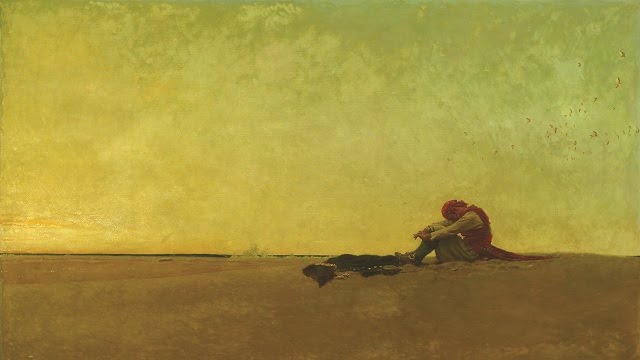
Peer into any young American boy’s imagination, and you’ll likely find knights, soldiers, and pirates roaming about. That fact is a true today as it was a century ago. One big reason for the enduring appeal of those figures is the art of Howard Pyle, the undisputed king of the Golden Age of American Illustration between the 1880s and the end of World War I. Marking the centennial of Pyle’s death, Howard Pyle: American Master Rediscovered at the Delaware Art Museum through March 4, 2012 will enlighten everyone who just asked “Howard who?” From American history books to Pirates of the Caribbean, the work of Howard Pyle continues to captivate us, despite his relatively forgotten place in American art history. Like pirates unearthing buried treasure, the organizers of Howard Pyle: American Master Rediscovered dig up the roots of American visual culture and recover Pyle’s power for a new generation. Please come over to Picture This at Big Think to read more of "How Howard Pyle Gave Our Heroes a Face."

[Many thanks to the Delaware Art Museum for the image above and other press materials for Howard Pyle: American Master Rediscovered, which runs through March 4, 2012. Many thanks to the University of Pennsylvania Press for providing me with a review copy of the exhibition catalog. Special thanks to Margaretta S. Frederick, Chief Curator and Curator of the Samuel and Mary R. Bancroft Memorial Collection at the Delaware Art Museum, for showing me the exhibition and patiently answering my questions.]

[Image: Marooned, 1909. Howard Pyle (1853–1911). Oil on canvas, 40 x 60 inches. Delaware Art Museum, Museum Purchase, 1912.]

Monday, August 25, 2008

Showtime


Around Christmastime 1894, Alfons Mucha dropped into a Parisian print shop and found his life changed forever. Someone from the Theatre de la Renaissance confronted the print shop owner with a sudden demand for an advertising poster for the new play Gismonda starring famed actress Sarah Bernhardt. Mucha, seeing the opportunity of a lifetime, interjected that he could deliver the poster in two weeks. Two weeks later, Mucha poster of Sarah Bernhardt as Gismonda (above, from 1894) announced to the world his jaw-dropping talent. Born August 24, 1860, Mucha had lingered in relative obscurity since moving to Paris in 1887 from his native Morovia (now the Czech Republic), but the Gismonda poster soon became the toast of the city. Rivaling graphic artists such as Henri de Toulouse-Lautrec, Mucha soon became one of the most in-demand artists for advertising and caught the eye of the actress herself, who thereafter requested that her image be shaped by Mucha’s eye.


Every year, I buy for Annie calendars of the art of Mucha and John Singer Sargent, two of her favorite artists whom she never tires of seeing grace her office walls. Mucha brings an organic life and explosively blooming color to the style known as Art Nouveau. Aubrey Beardsley helped imagine the Art Nouveau line that makes that style so distinctive, but Mucha brought it to the public’s attention and made it the style of choice like no other artist. Mucha helped sell everything from perfume to chocolates with his images, usually of dreamily beautiful women looking wistfully off into the distance. Mucha’s poster for an event in honor of Sarah Bernhardt (above, from 1896) shows how he could make even hair come alive into a vast swarm of tendrils. I find Mucha’s work so infectiously engaging because of his endless ability to make even the most mundane detail pop with abundance.


Mucha’s work followed Bernhadt as she tore through the classic works of Shakespeare, including Hamlet (above, from 1899), in which she herself played the troubled prince. Although so much of Mucha’s work speaks of beauty and joy, he never lost that Slavic sense of national struggle and pride in that struggle. When his native Czechoslovakia won independence after World War I, Mucha designed the stamps, currency, and government documents for the new nation. Mucha later painted twenty mammoth canvases following the history of the Czech and Slavic people, which he called The Slav Epic and donated to the people of Prague in 1928. Sadly, the same pride that made Mucha literally the painter of his people, made him a target when the Nazis invaded in 1939 and took the aging artist into custody. The shock of the experience quickly led to Mucha’s death. Despite the Nazis’ ban on a state funeral, the Czech people staged a grand farewell to Mucha, a final curtain call for an artist who starred on both the small and the grand stages of history.

Tuesday, June 17, 2008

Gross Anatomy


Few people make the argument for comics as art as entertainingly or eruditely as Craig Yoe, king and head jester of the Arf Lovers court. Following the success of Arf Forum, Arf Museum, and Modern Arf, Yoe now offers Comic Arf: The Unholy Marriage of Art and Comics—Gross National Product as his latest piece of evidence that comics can be both fun and stimulating, both intellectually and, uh, otherwise. Yoe mines the rich ore of comics lore to recover lost masters such as Milt Gross, whose 1930 A Guide to Useful American Citizens (above) seems startlingly relevant today. Unwashed masses (labeled as “The Right Kind of Immigrants”) enter a meat grinder turned by Uncle Sam himself and emerge transformed into “Useful American Citizens,” embodied by a crowd of classic comics characters, including The Yellow Kid, Popeye, Krazy Kat, Barney Google, and many others. Gross encapsulates the entire emotional immigration debate in one humorous image without leaving out any of the political satire. Yoe’s encyclopedic knowledge of comics history allows him not only to find such lost gems but to pick just the right jewels to catch the modern eye today—the litmus test of continued relevance that makes all great art great.


The Arf Lovers series connects the past with the present by having the artists of today engage in an active dialogue with the artists that influenced them. Taking Gross’ 1920s series, “Draw Your Own Conclusions,” in which Gross would leave the final panel of a 4-panel strip blank for people to fill in their own ending and, perhaps, claim a money prize, Yoe challenges a who’s who of modern cartoonists to try their hand at Gross’ game. The SimpsonsMatt Groening’s attempt (above) gives you a glimpse of the idiosyncratic spin other artists such as Robert Crumb, Mort Walker, Art Spiegelman, Bil Keane, Jules Feiffer, Al Jaffee, Jaime Hernandez, Sergio Aragones, and others put on the punchlines. These responses capture the spirit of Gross’ art, which Yoe describes as “Messy, full of surprises, rule-breaking, stimulating, electrifying, daring, dangerous, and not for the faint of art. Definitely for the screwed, stewed, and tattooed crowd.” For the most part, Yoe allows the art to speak for itself, filling page after page with vintage work often drawn from his personal collection, adding only enough text to guide the reader to the next treasure before stepping aside.


Paging through these Arf Lovers books will make you long for the golden age of newspaper comics. Comic Arf brings back to life in large format the “Right Around Home” series of Dudley Fisher, which Yoe calls “a tour de force in draftsmanship seen from above.” In “Right Around Home,” Fisher would take his cast of characters to a familiar scene, such as the art museum (above), and let them and his imagination run free in a kinetic dervish. Another side of Walt Kelly, famous for his Pogo strip, comes through in the moralizing yet surreal “Contrary Mary and the Angel.” Similarly, Yoe recovers the work of Arch Dale, whose characters “The Doo Dads” may have served as a prototype for “The Smurfs” and may even have inspired the work of Theodore Geisel, aka Dr. Seuss. Such energy and inventiveness flow through Yoe’s own cartooning, a sample of which (“X-Dream It Up”) appears in the final pages of the book. You’ll never accuse Yoe’s work of dry academicism, which is why he brings these classic comics back to life with such full color and fun.


“I owe it all, gentlemen, to the little woman!” announces the artist in Gardner Rea’s Successful Modernist (above), pointing to his Cubist–ly contorted consort as she stands before walls covered with her surprisingly accurate likeness. Looking at Rea, you see the influence of Aubrey Beardsley’s stong line. As Yoe points out, Rea’s gift for placing a single, stunning, centering black (here on the woman’s dress) makes the entire picture—a gift that Beardsley himself shared. The artist’s strangely shaped wife belongs to the tame end of the spectrum of how women appear in many of these comics. Yoe collects the bawdy efforts of cartoonists known better for family-oriented work in Clean Cartoonists’ Dirty Drawings, but gives a taste of that in the work of Argentinian Guillermo Divito, whose curvy pinups with impossibly narrow waists must have seemed more shocking decades ago than they do today. Yoe represents the other side comics lurid coin—horror—with Bob Powell’s “Pit of the Damned,” a Dali-inspired tale pulled from the pre-Comics Code crypt of EC Comics. Looking at such tales today makes you wonder how anyone could imagine they’d corrupt innocent youth rather than spur their imagination on to wilder and more wonderful things.

Yoe titles his last illustration in Comic Arf, “Mental Block Party,” which sounds like a great title for his entire comic history—art history oeuvre. All the comic greats—famous, infamous, and neglected—from yesterday and today get to mingle together and enjoy each other’s company, sharing every gag and the great idea, as we get to eavesdrop on the proceedings. The very serious business of having fun through drawings has no greater champion than Craig Yoe, chief organizer of this never-ending party.

[Many thanks to Fantagraphics Books for providing me with a review copy of Craig Yoe’s Comic Arf: The Unholy Marriage of Art and Comics—Gross National Product and for the images above.]

Tuesday, January 22, 2008

Following in Line

Aubrey Beardsley, The Peacock Skirt, 1894, Line block proof on Japanese vellum, Collection of Dr. Michael Richard Barclay

When Aubrey Beardsley, decadent bad boy of British illustration, died after a scant quarter century on this earth in 1898, he left a body of work that sent shock waves throughout the world of illustration. You either embraced or rejected Beardsley, but you could never ignore the boundless talent that created works such as The Peacock Skirt (above). The Peacock Skirt came to symbolize the abundantly overflowing skill of Beardsley and was quoted in the works of those who followed many times over. Rodney Engen’s The Age of Enchantment: Beardsley, Dulac and their Contemporaries 1890-1930, the catalogue to the exhibition at the Dulwich Picture Gallery, recreates this golden age of illustration that began with Beardsley in many ways but never ended in any real sense. Engen ties together many of the prevailing forces on artists of that era and highlights the art and personal lives of these great, often forgotten masters of illustration.


Edmund Dulac, Sinbad the Sailor entertains Sinbad the Landsman [from Stories from the Arabian Nights], 1914, Kendra and Allan Daniel Collection

The same Orientalism that flavored many of Beardsley’s works appears clearly in the illustrations of Edmund Dulac, the French-born Art Deco artist who took his love of the East and Far East further than any Western illustrator had done before. In his illustrations of the Stories from the Arabian Nights (an example above), Dulac created “a more refined world of orientalising, which greatly appealed to a younger audience tired of gloomy historicism,” Engen writes. Dulac’s close study of Persian miniatures, one of his many passions in collecting, provided a living sense of detail that comes across in his work. A friend of the W.B. Yeats, Dulac shared the poet’s love of the Japanese Noh drama, another aspect of the Orient that Dulac lived rather than copied in his drawings. A dramatic figure to the end, Dulac died in 1953, at 70 years of age, from a heart attack after dancing the flamenco.


Jessie M. King, The Sea Voices [from Seven Happy Days], 1914, pen and ink, watercolour, and sivler on vellum, Victoria and Albert Museum

Beardsley’s love of Arthurian legends continued on in the works of many artists, including Jessie Marion King. The Pre-Raphaelite Brotherhood and their love of medievalism created a lasting impression on all British art of the period, but perhaps left their most lasting imprint on children’s illustration. One of the Pre-Raphaelites, Edward Burne-Jones, actually served as a mentor to Beardsley during his work illustrating Le Morte Darthur. After Beardsley’s death, however, the dark aspects of medievalism gave way to “a healthier, less dark and more wholesome love of fantasy,” as can be seen in such works as King’s The Sea Voices (above). King loved the folk ballads of her native Scotland and even designed her own mock medieval dresses to wear as an outward sign of her love of the Arthurian and the fantastic. The gentle washes of color add a softer feel to King’s art that the stark black and white of Beardsley lacked. After World War I, a rage for color eclipsed the days of pure black and white line illustration and further challenged artists.


Edward Detmold, Tiger, Butterflies and Fan Palms, colour etching, Private Collection

“With the rise of the wealthy Edwardian middle classes,” Engen writes, “came a yearning for escape from the horrors of industrialization and the urban sprawl that accompanied it.” Epitomizing this “new rural religion” is the work of Edward and Maurice Detmold, twin brothers who collaborated on works stunning in their naturalistic detail that drew comparisons to Durer while they were still teenagers. “The Detmolds were, for a generation of enthusiasts, the supreme masters of nature in art,” Engen claims, backing it such claims with works such as Edward’s Tiger, Butterflies and Fan Palms (above), painted after his brother’s tragic suicide in 1908.

The story of the Detmolds is just one of the many fascinating tales of these forgotten artists. Sidney Sime, who scratched imps and devils onto the walls of the coal mines he worked in as a child, rose from poverty to become a revolutionary figure in terms of technique and imagination, creating images as disturbing as any by Odilon Redon. When asked to explain his hesitancy over illustrating the works of Edgar Allan Poe, Sime responded, “You see, I am looking forward to meeting Poe in Hell and I am loathe to do anything that would embarrass the encounter.” Arthur Rackham created 3,000 illustrations and 150 books over a 40-year career dominated by Germanic influences such as Durer, Bosch, and Grunewald. His nephew called him “the only truly happy man I have come across” thanks to his ability to escape into his work regardless of wars and even air raids. Perhaps the most quizzical figure of this group, Alastair, drew fantastic, unreal images that echoed Beardsley at his most decadent and perhaps even surpassed the master. Engen calls Alastair “an enigmatic puzzle, a curious mixture of petulance, childishness and anger, who refused to be pinned down and was always on the move.” Engen gives each of these shadowed figures another day in the sun, spotlighting the immense talent behind these striking personalities.


Kay Nielsen, The Faun, watercolour and bodycolour, Kendra and Allan Daniel Collection

For me, the most fascinating of these forgotten artists remains Kay Nielsen, the Danish artist who took his love for folklore and married it to his encyclopedic grasp of multiple artistic cultures. “Nielsen’s winning formula was derived largely from his beloved folkloric background,” Engen argues, “he also borrowed from a love of early Italian painting, from the delicate Persian miniatures and Indian and Chinese landscapes which he mixed and borrowed in a process he called ‘artistic wandering.’” Such “wandering” led Nielsen to a successful career in illustration through works such as The Faun (above) and later brought him to America and Hollywood to work on Walt Disney’s Fantasia, specifically the “Bald Mountain” and “Ave Maria” sections. Many of the works by Nielsen come from the Kendra and Allen Daniel Collection, which was on display in 2007 at the Brandywine River Museum in the Flights Into Fantasy exhibition (reviewed here). The inclusion of Nielsen in this international exhibition will hopefully raise his profile within the art world as well as establish this era of illustration as more than just kids’ stuff.


Aubrey Beardsley, Sir Launcelot and the Witch Hellawes [full-page illustration for Le Morte Darthur]. 1893-4. Private Collection

Engen chooses 1930 as the cutoff date for this exhibition with a degree of sadness. Although the taste for Beardsley-inspired art (including Le Morte Darthur, above) faded, the artists themselves remained to “live out their careers in disappointment, anger and soul-destroying neglect,” Engen laments. “As they watched the century progress and its poor standards of artistic taste surround them, it was for many too much to bear.” Edward Detmold continued working after his brother’s death, eventually becoming a hermit, until despairing over fading sales and taking his own life in 1956. Kay Nielsen died a broken and forgotten man in 1957. Many others simply faded into the shadows of art history, waiting to be rediscovered. Fortunately, the boldness and brightness of the work itself lives on in this catalogue and exhibition, perhaps finally reaching that hour when their lives, which Nielsen once said were “devoted to the lyrical and the poetic,” no longer seem lived in vain.


[Many thanks to the Dulwich Picture Gallery for providing me with a review copy of the catalogue to The Age of Enchantment: Beardsley, Dulac and their Contemporaries 1890-1930 and for the images above from the exhibition.]