Showing posts with label Marden (Brice). Show all posts

Saturday, July 31, 2010

Close Examination: A Chuck Close Portrait on Film


“Chucky Fat Face,” artist Chuck Close admits to being called by fellow artist Richard Serra during their graduate school days together at Yale early on in the film Chuck Close, Marion Cajori’s lauded documentary now available on DVD for the first time from New Video. In Cajori’s film, we see Close full face—both while painting one of his signature self-portraits and through the eyes of his fellow artists and his family. It is this combination of intimate close examination and wide-angle perspective that makes Chuck Close not only an unforgettable study of an individual artist, but also a thought-provoking examination of twentieth-century art and how modern artists mentally approach their art. Please come over to Picture This at Big Think to read more of "Close Examination."


[Many thanks to New Video for providing me with a review copy of Chuck Close.]

Tuesday, October 16, 2007

Painting Impossibilities


“Mr. Marden may have been able to evade Modernism’s breakthrough requirement because he made his entrance at a time when painting as a whole had supposedly ground to a halt,” wrote Roberta Smith of Brice Marden in her New York Times review of Marden’s 2006 MOMA retrospective. “This was the late 1960’s, when painting was being forced through the eye of the Minimal-Conceptual needle and proving a trifle bulky and balky. It was having a near-death experience.” Marden, born October 15, 1938, survived that near-death experience by painting works such as The Dylan Painting (above, from 1966), an homage to the protean musician Bob Dylan as well as a Jasper Johns-influenced attempt to paint the textures and nuances of life after painting had seemingly ceased to exist. Like Dylan, Marden saw the world around him and re-envisioned his art form, stripping away everything until he found a core upon which to build.


Marden’s philosophical approach owes much to his 1963 MFA from Yale University’s School of Art and Architecture. Like his classmates Richard Serra and Chuck Close, Marden struck out a new path in art, seeking out different cultural viewpoints, falling eventually under the influence of Chinese art and calligraphy. As Francoise Jullien argues in his The Impossible Nude: Chinese Art and Western Aesthetics (reviewed by me here), Chinese art concentrates on process, such as the endless workings of nature and the spirit of dao within nature, rather than on the individual figure and any idea of individual essence. Similarly, in works such as Post Calligraphic Drawing (above, from 1998), Marden removes the figure and revels in pure process, in this case pure line flowing and sometimes sputtering across a page in pure, egoless dao. To answer all questions of painting’s demise, Marden changes the topic of discussion from the individual to painting itself, bringing Eastern philosophy into play over the domineering Western aesthetic.


In recent years, Marden had brought a greater sense of color to his work, as in The Propitious Garden of Plane Image, Second Version (above, from 2000-2006). Marden continues his exploration of the calligraphic line as an egoless solution to painting’s ego-driven excesses while adding bold color to please the eye. Whereas Jackson Pollock’s personality flowed all over his Abstract Expressionist canvases, there is no Brice Marden shouting from these images. Marden comfortably stands behind his works rather than in front of them, achieving a connection with the viewer some thought impossible after the meteoric rise and flameout of painting in the late twentieth century.

Wednesday, April 25, 2007

Memento Mori


I just got a chance to go through the companion book to the Annie Leibovitz: A Photographer’s Life 1990-2005 exhibit that appeared earlier this year at the Brooklyn Museum. For those who know her only for the shallow celebrity work she’s done for Rolling Stone, this collection will surprise.

Leibovitz’s shallow celebrities are there, of course. Scarlet Johansson, Brad Pitt, Leonardo DiCaprio, and Nicole Kidman seem even more plastic in well-lit, well-composed, still photography than they do in motion pictures. But there are some intriguing celebrity photos as well. Sylvester Stallone’s torso (circa 1993) in all its grotesque muscularity and popping veins almost doubles for antique statuary. A young, topless Cindy Crawford entices as a believable Eve, complete with snake. Chris Rock turns the racial tables by appearing in whiteface. Even the notorious pregnant Demi Moore nude for the cover of Vanity Fair seems now more like a modern madonna (no, not that Madonna).

However, all these images pale before the photographs of Susan Sontag, Leibovitz’s companion during the span covered by the book until Sontag’s death in December 2004 (a photo of Sontag by Leibovitz is above). Photo series of Sontag sitting in a car, laying on a bed, nude in a tub, and dwarfed by the rocky entranceway to Petra give way over time to her battle with cancer, culminating in series of images of her laying in a hospital bed and finally in her open casket. Sontag’s trademark white streak in her raven hair grows to envelop all of her hair as her cancer takes hold. Leibovitz beautifully documents Sontag’s struggle with an undying love and unerring eye. Perhaps the most poignant images of Sontag are those showing only the notes on her desk for The Volcano Lover, a precursor to the absence that would be felt after her wonderful, opinionated voice went silent.

Leibovitz also captures the spirit of some of her fellow artists: Cindy Sherman, Chuck Close, Brice Marden, Matthew Barney, Julian Schnabel, and even photographs the shadow of Jasper Johns. Her photos of the Guggenheim Museum in Bilbao, Spain follow each maddening, shimmering curve of Frank Gehry's design. Leibovitz even photographs herself in a mirror nude and pregnant.

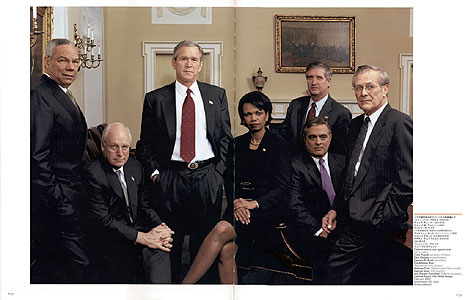
The imagination can’t help but be pulled in by Leibovitz’s often stirring photographs. A Nighthawk stealth fighter seems to pass by a church steeple, both solid black silhouettes against a slate grey sky, swift movement echoing stationary stone. A golden panorama of the Nile River celebrates Sontag’s 60th birthday. A bicycle fallen to the ground in Sarajevo in 1994 acts like punctuation at the end of long bloody swirls, asking where the rider has gone (image here, scroll down). A disturbing unsmiling portrait of the Bush cabinet from December 2001, with only Cheney and Powell even coming close to a sneer and Bush himself suppressing a smirk, recalls the days shortly after September 11th and emblemizes the days since.

Leibovitz’s body of work deserves a new appraisal if for nothing else than her devotion to Susan Sontag and the honesty of how she presents Sontag’s final battle, a love story to the end.