Showing posts with label Kirchner (Ernst). Show all posts
Showing posts with label Kirchner (Ernst). Show all posts
Tuesday, March 25, 2014
The Sad, Strange History of “Degenerate Art”
“Crazy at any price!” read a sign above the modern art masterpieces at the Nazi-sponsored Entartete Kunst (“Degenerate Art ,” in English) exhibition in Munich, Germany, in 1937. The fevered brainchild of art-obsessed Adolf Hitler, Entartete Kunst
aimed at showing not only what “Jewish” and “Bolshevik” art looked
like, but also arguing how the degeneracy of those artists and their
work threatened the spiritual health of the German people, the “master
race” Hitler believed would rule the world, with him as their leader.
The Neue Galerie in New York City revisits that sad moment in modern art history with the exhibition Degenerate Art: The Attack on Modern Art in Nazi Germany, 1937,
which runs through June 30, 2014. The exhibition gathers together many
of the “crazy” works labeled as degenerate, holds them up against
examples of the Hitler-approved German art, and takes us down the long,
strange road that led up to that Munich show. The result is a sad,
strange history that will leave you shaking your head at the past, but
will also make you wonder if it could happen, again, here and now. Please come over to Picture This at Big Think to read more of "The Sad, Strange History of 'Degenerate Art.'"


Wednesday, December 5, 2012
Is the Future of Graphic Design in its Past?
If Brad Pitt and Angelina Jolie reign as
the premier power couple of Hollywood, then Seymour
Chwast and Paula Scher
deserve credit as the “Brangelina”
of the world of graphic design and
illustration for the last half century. In Double Portrait: Paula
Scher and Seymour Chwast, Graphic Designers, which runs at the Philadelphia Museum of Art through April
14, 2013, the work of “Schwast” (“Chwer”?) appears together for the first time
in an unruly retrospective that, like all retrospectives, points back, but also
points forward to where the world of illustration and graphic design might go
in the technology-laden future. Please come over to Picture This at Big Think to read more of "Is the Future of Graphic Design in its Past?"
[Image: (Left) End Bad Breath, 1967. Seymour Chwast, American, b. 1931.
Poster, offset lithograph, 37 x 24 inches; (Right) 1995-96 Season campaign poster
for The Public Theater, 1995, by Paula Scher/ Pentagram.] [Many thanks to the Philadelphia Museum of Art for the image above, an invitation to the press preview for, and other materials related to Double Portrait: Paula Scher and Seymour Chwast, Graphic Designers, which runs through April 14, 2013. Many thanks also to Bloomsbury USA for providing me with review copies of Seymour Chwast’s The Odyssey and The Canterbury Tales. Very special thanks to Mr. Chwast for indulging a long-time fan by autographing my copy of The Canterbury Tales.]
Wednesday, November 10, 2010
Out of the Ashes: Art Stolen by Nazis Rediscovered

It’s a sad fact of human history that the leadership regime most obsessed with art belonged to that of the Nazis. From Adolf Hitler the frustrated painter to obsessive collectors such as Herman Goering and Joseph Goebbels (who knew enough to step aside when Hitler lusted after an object), the Nazi power circles thought about art and its effect on their country’s culture continually, more often to art’s detriment than to its benefit. Exhibit A of the detrimental effects of that cultural concern is that dark episode in modern art history—the infamous Entartete Kunst (“Degenerate Art”) exhibition of 1937 that defined for Germans what was and what wasn’t acceptable art. Some of those “degenerate” works and the artists that made them escaped Nazi clutches, while much of that condemned art seemed lost to posterity in the same conflagration that consumed the Nazis themselves. A recent discovery, however, adds a small, but happy coda to the tragic symphony of the Nazis destructive love of art. Please come over to Picture This at Big Think to read more of "Out of the Ashes."
Thursday, May 21, 2009
Superstar

The long and often tragic history of Germany is tied up in large part with an identity complex. Like many European countries, the idea of Germany as a country with clear borders is a relatively modern one. Wars and kingships have moved borders back and forth so often that what was German land and what wasn’t remained an enduring question. In the late nineteenth century, Germany tried to fill this identity void by creating truly Germanic heroes. In the world of art, Albrecht Durer was crowned the first and truest German superstar. Born May 21, 1471, Durer brought the Italian Renaissance north, where it became the Northern Renaissance. Yet, just as Germany itself was a work in progress, Durer had to grow into his superstardom. The Self-Portrait of 1493 (above) shows the 22-year-old Durer at the beginning of his career, just starting to travel across Europe to accrue the mixture of influences that would inspire his mature work. Durer painted this self-portrait in Basel and shipped it back to his intended back in Nurermberg, writing “Things with me fare as ordained from above” at the top of the picture. From the very beginning, Durer sensed his fate was in God’s hands.

Just five years after painting the awkward Self-Portrait of 1493, Durer paints the self-assured Self-Portrait of 1498. Durer now sits up straighter than before. Whereas the 1493 portrait is isolated, the 1498 portrait includes a window onto the world. Durer had just returned from Venice with the Italian Renaissance still fresh in his mind. The world had literally broken wide open for Durer in the span of just five years. Legend has it that Durer’s dog barked and wagged his tail upon seeing the 1498 portrait for the first time, fooled into thinking it was actually his master. The realism of this portrait as well as the opulence of the clothing Durer wears show that Durer had mastered the techniques of the Renaissance masters and was turning a fine profit for himself. Yet, Durer remains turned slightly away, as if he can’t yet bring himself to face the viewer full on. His mission was not yet complete.

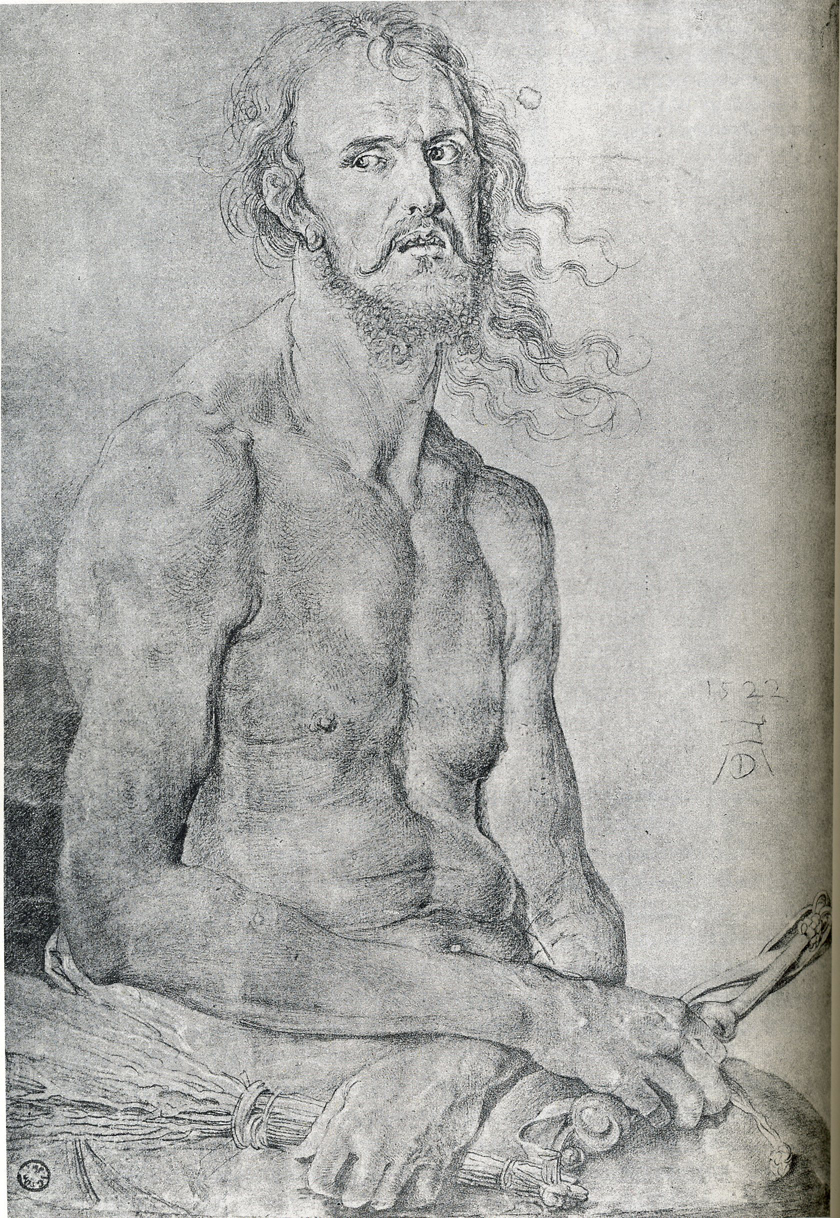
In the final painted Self-Portrait of 1500 (above), Durer faces the viewer directly in total confidence of his powers. He wears kingly clothing and his hair cascades down like a lion’s mane, proclaiming him the king of the German cultural jungle. Durer assumes visually the mantle of the King of Kings, Christ himself, in this final self-portrait not out of blasphemous braggadocio but instead to illustrate how the artist imitates God himself in the creative act. If imitation is the sincerest flattery, Durer imitates Christ to praise him as the source of all artistic and creative power. In a 1522 drawing, Durer lent his features to Christ again, but this time as the Man of Sorrows instead of Christ triumphant. As age began to take its toll on Durer, he identified increasingly with the Suffering Servant side of Christ’s story, recognizing that his ascension to the rank of creator had ended. Of all the artists in different media adopted by the Nazis at the apex of German nationalism, Durer and perhaps Beethoven seem to be the two left untainted by that association. As the German Expressionists recognized (especially Ernst Ludwig Kirchner, who fashioned himself a modern-day Durer through his own self-portraiture), the stellar light of a superstar such as Durer can never be tarnished by mere mortals.
Thursday, May 7, 2009
Man on the Street

Life in the big cities of Germany inspired Ernst Ludwig Kirchner like no other artist of his time. Born May 6, 1880, Kirchner helped found Die Brücke in 1905 along with three other students in Dresden. Kirchner painted Street, Dresden (above) initially in 1908, when Brucke was at its height, but continued to return to make changes up to 1919, long after Brucke had moved on to Berlin in 1911 and even after Brucke disbanded in 1913. Kirchner’s style exemplifies German Expressionism for me, taking the facts of a simple street scene and imposing the vision of the artist upon it. Whenever you see well-dressed women in a Kirchner streetscape, you’re most likely safe in assuming they are prostitutes hawking their wares. The way Kirchner outlines the orange hat of the woman in the foreground with even brighter orange highlights makes me think of a neon sign in its garish, commercial advertising feel. The formless faces in Street, Dresden resemble those of Edvard Munch’s 1892 painting, Evening on Karl Johan Street. Kirchner and the other Brucke artists idolized Munch and even unsuccessfully invited him to join their group. In Street, Dresden, Kirchner captures much of the Munchian sense of alientation and unease.

By the time that Kirchner had painted Friedrichstrasse (above, from 1914), Brucke was over and he was ensconced in Berlin, a city much more international and cosmopolitan than the still-medieval looking Dresden. Kirchner paints Friedrichstrasse in a series of slashing lines, conveying a sense of endless movement similar to the Italian Futurists painting at the same time. The women, again, are most likely prostitutes. The pattern I’ve noticed in Kirchner’s art is that the naked figures are usually young and innocent, whereas the older, fashionably dressed women are far from innocent. Kirchner sets up that opposition to dramatize what he saw as the deadening and corrupting effect of modern civilization. Like Gauguin, Kirchner saw a simplicity and honesty in the art and lifestyle of Oceanic cultures and mimics their art in the angularity of his own. But even that angularity falls into two categories in Kirchner’s world—youthful innocence is simplified into flat planes and colors, rejecting all painterly illusion, whereas aged corruption becomes sinister in the sharp lines of faces and bodies that threaten to cut you like a knife.
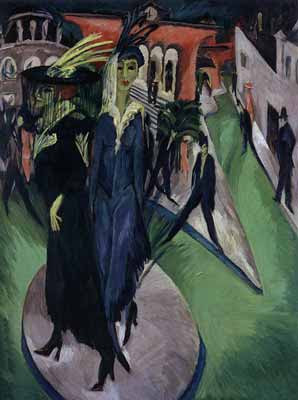
In Potsdamer Platz (above, from 1914), Kirchner merges his Munch-like instincts with his primitivism (although the two are certainly not mutually exclusive). The bodies and faces scream Munch, but the harsh angles of Kirchner’s later development appear. The street itself, however, now seems to shift and move, devolving into a nightmare landscape. World War I loomed on the horizon, and Kirchner volunteered to serve at its beginning. By 1915, a total breakdown left him unfit to fight. Kirchner channeled his anguish into even greater Expressionist works. He came to see himself as the heir to the mantle of greatest German artist, following in the footsteps of Albrecht Dürer and Lucas Cranach the Elder. Sadly, the Nazis in their rise to power redefined what constituted German-ness. Kirchner, the self-styled most German of artists, found himself and his work excluded from German museums and collections as part of the “Degenerate Art” declamation. After watching much of his art either destroyed or sold away, Kirchner took his own life in 1938. If Kirchner had been French, he would have been called a flaneur, a connoisseur of street life mingling among the people and diagnosing the ills of society. But, alas, Kirchner’s German roots not only provided his richest material but ultimately spelled his doom.
Tuesday, April 28, 2009
Bridge Over Troubled Waters
 Erich Heckel (1883-1970). Landscape in Dresden (Landschaft bei Dresden), 1910. Oil in canvas, 66.5 x 78.5 cm (26 1/8 x 30 7/8 in.). Staatliche Museen zu Berlin, Neue Nationalgalerie
“What is great in man is this: that he is a bridge and not an end,” wrote Friedrich Nietzsche in Thus Spoke Zarathustra in 1885. Two decades later, on June 7th, 1905, four young architecture students in Dresden, Germany, may have had those words in mind when they founded the artists group known as Die Brucke, or “The Bridge.” Ernst Ludwig Kirchner, Karl Schmidt-Rottluff, Erich Heckel, and Fritz Bleyl thus began an artistic movement that would stage more than seventy exhibitions before their disbanding in 1913, with twenty-seven happening in 1907 alone. “By joining together into a small, cohesive community with common goals, the Brucke artists hoped to stand up to [the] putatively fragmenting, debilitating effects of modern urban life,” writes Reinhold Heller in his essay “Brucke in Dresden and Berlin, 1905-1913” in Brucke: The Birth of Expressionism in Dresden and Berlin, 1905-1913, the catalogue to the current exhibition at the Neue Galerie in New York City. This exhibition, the first major exhibition of the Brucke in the United States, resituates these artists at the very beginning of the modern, international art world as they reached beyond Germany’s borders and invited the likes of Norwegian Edvard Munch (unsuccessfully) to join their band. “By reaching out, whether successfully or not, to such revolutionary painters,” Heller continues, “the Brucke established a network of communication with Europe’s most progressive artists and art institutions.” Dresden, known as “Florence on the Elbe” and famous for its many bridges (one of which is captured in Erich Heckel’s Landscape in Dresden, above, from 1910), thus became the starting point for the bridge-building across borders and between individual artists that the modern art world has become today.
 Erich Heckel (1883-1970). Studio Scene (Atelierszene), 1910-11. Oil on canvas, 70 x 48 cm (27 1/2 x 18 7/8 in.). Nachlass Erich Heckel, Gaienhofen.
In addition to their unsuccessful wooing of Munch, the Brucke successfully brought other artists, such as Emil Nolde and Max Pechstein into their fold. Staging group exhibitions and developing a signature style for their promotional material, the Brucke artists created a template for later artistic groups to follow. In all things, however, the Brucke set out to stand apart from the flow of contemporary, mainstream German life. They embraced “primitive” Indian, Oceanic, and African art, following in the footsteps of heroes such as Van Gogh and Gauguin and their search for primal forces untainted by modernity’s touch. This primitive approach, especially to the human figure, appears throughout their work, including Heckel’s Studio Scene (above), which also accurately depicts the everyday existence of the Brucke. For the Brucke artists, work and life were inseparable and models became friends and, sometimes, lovers. The artists even provided a “ruheraum” or “room of rest” for the models away from the labor of modeling. The German government’s crackdown on erotic images made the nude images of the Brucke artists all the more daring and avant-garde. In a musty old world suddenly thrown into an industrial age, the Brucke artists painted themselves as outlaws belonging to neither, but rather inhabitants of their own bohemian sphere of equality, fraternity, and, above all, beauty.

Ernst Ludwig Kirchner (1880-1938). Marzella (Fränzi), 1909-10. Oil on canvas, 76 x 60 cm (29 7/8 x 23 5/8 in.). Moderna Museet, Stockholm.
In the midst of this cultural separation, however, the Brucke longed to reconnect with what they saw as the essence of German art. Surrounded by the medieval art treasures of Dresden, the Brucke artists embraced forefathers such as Albrecht Dürer, Matthias Grünewald, and Lucas Cranach the Elder. Kirchner fashions himself as a modern Durer, who becomes “
 Ernst Ludwig Kirchner (1880-1938). Berlin Street Scene (Berliner Strassenszene), 1913-14. Oil on canvas, 121 cm x 95 cm (47 5/8 x 37 3/8 in.). Neue Galerie New York and Private Collection, New York.
Despite this German self-identification, the Brucke continually looked beyond national borders. Jill Lloyd’s “Brucke: National Identity and International Style” examines the tension between these nationalist and internationalist impulses. Dresden exhibitions of Van Gogh’s work in 1905 and Munch’s work in 1906 bring the cutting edge of art right to the Brucke’s doorstep. (The Neue Galerie’s Van Gogh and Expressionism exhibition in 2007 [my review here] covered that link extensively.) Lloyd sees the Brucke’s taking in of these influences not as “slavish dependence” but rather as “transformation[s].” Comparing the Brucke with their contemporaries, the Fauves, Lloyd writes, “Whereas the French artists worked within an established national tradition, the Germans pursued a self-conscious internationalism that went beyond the formulation of a new expressive style.” Criticism of the Brucke for not being “German” enough drove them in 1911 from Dresden to the more international city of Berlin. Berlin was the hub of the international art market at the time and provided easier access to the rest of the art world. In Berlin, Lloyd writes, the Brucke could “build more consciously on the elements of ‘Germanic’ or ‘Gothic’ style that had always co-existed with their modernism.” Kirchner’s Berlin Street Scene (above, from 1913-1914) shows how he adapted to his new, more cosmopolitan surroundings.
 Karl Schmidt-Rottluff (1884-1976). Corner of a Park (Parkecke), 1910. Oil on canvas, 83.5 x 75.5 cm (32 7/8 x 29 3/4 in.). Pinakothek der Moderne, Munich.
By 1911, however, the Brucke artists were beginning to grow apart. When Kirchner writes his chronicle of the movement and casts himself as the leader, Schmidt-Rottluff (whose Corner of a Park appears above, from 1910) and others take offense and finally disband in 1913. As Rose-Carol Washton Long explains in her essay, “Brucke and German Expressionism: Reception Reconsidered,” the Brucke soon drifted to the margins of art history for being not “modern” enough or not “political” enough. Only in the last twenty years, when “modernism” has been redefined as “one of the conflicting products of change in an industrial society,” Long writes, have the Brucke been rediscovered as an essential step in the progress of modern art. Brucke: The Birth of Expressionism in Dresden and Berlin, 1905-1913, the catalogue and exhibition, not only brings this neglected school to American shores for the first time, but also allows them to resurface from the depths of art history obscurity. Rather than being just a poor relation to Der Blaue Reiter, Die Brucke helped shape the international art world as we know it today in all its jet-setting internationalism. Able to embrace both their own national heritage and those of other civilizations, the Brucke artists set an example that artists continue to follow today, even if they don’t know where, how, or why it began. The Neue Galerie’s exhibition will answer all those questions, and more.
[Many thanks to the Neue Galerie for providing me with a review copy of Brucke: The Birth of Expressionism in Dresden and Berlin, 1905-1913 and for the images above from the exhibition.]
Tuesday, November 25, 2008
Burning Man

Of the big three of the Golden Age of Mexican Mural Painting—Diego Rivera, David Siqueiros, and Jose Clemente Orozco—Orozco burns with an intensity and singularity of purpose beyond even his intense contemporaries. Born November 23, 1883, Orozco passionately believed in the freedom of the Mexican people but never compromised those ideals in the following of false liberators. As a young man, Orozco lost his right hand and some sight in his right eye in an accident. Taking the surgically removed hand home, Orozco placed it in a container filled with alcohol and set it aflame. Even in his 1940 Self-Portrait (above), Orozco seems to be burning with passion. Perhaps Orozco’s most famous work, the 1939 ceiling mural titled Man of Fire, shows a man literally burning but still walking forward towards his destiny. For Orozco, fire purified by its destructive power, heated the blood to action, and lit the way to a clear path to freedom.

One of the sadder aspects of Rivera and Siqueiros’ lives and art is their continuous falling for false leaders and false hopes that set Mexico back as it strove to move forward. Orozco, however, always viewed potential saviors with a cynical eye. In the painting Zapata (above, from 1930), Orozco shows Emiliano Zapata, leader of the Mexican Revolution. Rather than place Zapata front and center as the central hero, Orozco pushes Zapata to the back of the picture. Peasants and soldiers dominate the front of the image, just as the conflict between the ruthless enemy army and the defenseless Mexican poor caught up in the conflict dominated Orozco’s mind more than the capering of a self-proclaimed hero. The dagger aimed at Zapata’s eye foreshadows his bloody end in which he who lived by the sword, died by it. There’s a great similarity between Orozco’s style and that of the German Expressionists, especially Ernst Ludwig Kirchner. Both artists searched for ways to express the harsh realities around them in a simple, arresting style that all levels of society could rally around.

When Orozco painted murals for the National Preparatory School in Mexico City in the early 1920s, one of the most controversial was his Christ Destroying his Cross (above, a different version from 1943). Orozco returned to this theme over and over, including a version in his largest work, the 24-panel, 3,200-square-foot-long series of murals known as The Epic of American Civilization at Dartmouth University. Instead of painting the meek, suffering servant version of Christ, Orozco paints an axe-wielding Jesus chopping down the cross as a symbol of all forms of authoritarian oppression throughout history. Meek acceptance of anything just wasn’t something Orozco could do, and he could never envision a savior who was less of a warrior than he was. It’s amazing to think that Orozco accomplished such tremendous physical feats of art with a single hand and diminished eyesight, but the fires that burned inside his soul fueled a mighty engine that refused to quit as long as someone, somewhere did not enjoy the light of freedom.
Friday, September 5, 2008
In Black and White

When Vincent Van Gogh looked for sources of inspiration, he turned East and joined in the Japonisme craze that captured the imagination of many European artists in the late nineteenth century. In 1921, Japanese artist Shiko Munakata reversed the line of influence when he saw Van Gogh’s art and tried to incorporate it into his woodcuts. Despite emulating Van Gogh’s frenetic draftsmanship, Munakata always maintained a sense of the Zen Buddhism he so deeply believed in, primarily through depictions of Buddha as in Gautama and Bodhisattvas (above, from 1958). Buddha, whose family name was Gautama, sits with the Bodhisattvas or spiritual beings who linger on earth to help others reach enlightenment. Born September 5, 1903, Munakata enlightened viewers with his revitalization of the ancient Japanese woodcut through infusions of Western art ideas. “I make black and white prints because I want to go back to the beginning,” Munakata once said, humbly downplaying the sophistication behind his simple, black and white designs.
+1950.jpg)
Munakata brought a unique vision to the woodcut. In works such as Fugen (Samantabhadra Riding on an Elephant) (above, from 1950), Munakata colored the image on the front of the thin translucent paper by painting watercolor to the back of the sheet, which bled through to the front. It’s interesting to see how Munakata’s adaptation of Van Gogh in his woodcuts diverges from the German Expressionists’ adaptation of Van Gogh’s art. Whereas German artists such as Ernst Ludwig Kirchner, Karl Schmidt-Rottluff, and Emil Nolde emphasized Van Gogh’s angst, Munakata instead, perhaps thanks to his Zen Buddhism, saw Van Gogh’s more joyous embrace of nature’s harmony. The vibrancy of a Van Gogh landscape spoke to Munakata, who adapted that energy to the Buddhist belief in the unity of all being as embodied in mythic figures such as Samantabhadra riding an elephant. Munakata carved with great speed, working on the woodblock with no preparatory drawings and allowing the spirit of the work to guide his hand. Never losing faith in the process itself, Munakata accepted accidents and errors graciously as the price for “riding the elephant” he called art. For him, each painting stood as just another manifestation of the greater scheme of nature and beyond human judgment.
+1956.jpg)
Munakata carved series of woodcuts based not only on disciples of Buddha, but also created a calendar of the months featuring different flowers and natural features. The print for February showing an Orchid (Nigatsu—Ranjo no saku) (above, from 1956) shows just how inventive Munakata could be with a basic black framework into which he introduces passionate color. Van Gogh’s flower studies formed the earliest influence on Munakata, and still influenced him in this image more than 30 years later. The accessibility of Munakata’s prints made him a popular figure in Japan and helped him rise to the status of a national treasure. Cursed with poor eyesight, Munakata often carved his woodcuts with his face inches away from the wood, his Mr. Magoo glasses nearly touching the surface. Like Van Gogh, Munakata’s simple ways often earned him the label of primitive or worse, but also allowed him to strip his art to its barest essence and rebuild it in his own unique vision.
Wednesday, July 2, 2008
Self Exile

Compared with his old friends—Egon Schiele and Oskar Kokoschka–Max Oppenheimer’s name has faded from the memory of all but specialists in German Expressionism. Born July 1, 1885 in Vienna, Oppenheimer, who later called himself “Mopp,” bounced around Europe, moving from Vienna to Prague to Zurich and finally fleeing from the Nazis to the safety of America. Schiele admired Oppenheimer’s work enough to paint a portrait of the artist in his signature skeletal style. Oppenheimer returned the favor, in a way, in his gallery poster (above, from 1912) borrowing from Schiele’s tortured take on the human figure while also fleshing out the depiction with some Kokoschka touches on the side. Like many other German Expressionists, such as Emil Nolde and Ernst Ludwig Kirchner, Oppenheimer created many graphic works, such as this advertisement for a larger exhibition of his work. Oppenheimer’s work may lack originality, but it does reflect the same raw, primitive quality of the Expressionist school.

Despite showing some talent, Oppenheimer matched his geographic rootlessness with a stylistic nomadic streak. It seems as if Oppenheimer tried out every style that came his way as easily as trying on a new hat, discarding each new fashion as quickly as he put it on. Before Schiele even died, Oppenheimer had moved on to Futurism in works such as The Klinger Quartet (above, from 1916), which does make innovative work of trying to link the worlds of music and painting. Reducing the musicians to a swirling vortex of hands and instruments, Oppenheimer’s painting seems like one of Picasso’s Cubist guitars caught in a blender. But Oppenheimer arrested even this promising development when he moved to Zurich and fell in with the Dada crowd, adopting the “Mopp” moniker probably just to fit in.

Because of his Jewish background, Oppenheimer fled from the Nazis in the early 1930s and moved to America, where he lived out his days in seclusion until 1954. In New York at Night (above, from 1951), Oppenheimer returns to his graphic arts roots but no longer in the Expressionist style. Instead, he works in a cleaner, almost Vorticist style of blacks and whites arranged in contrasting planes. After donning so many styles, Oppenheimer seems to want to leave all of them behind along with all his other unpleasant memories of Europe. Like so many European exiles of World War II, Oppenheimer idealized his adopted country, depicting a purer, cleaner, and more hopeful ideal rather than the everyday reality. In his final years, Oppenheimer allegedly tried his hand at the newfangled Abstract Expressionist style, reverting back to old form but in a whole new world.
Wednesday, May 7, 2008
Fallen Bridges

When the Post-Impressionist work of Van Gogh and Gauguin raged across Germany in the early twentieth century, young artists such as Ernst Ludwig Kirchner lapped up the primitivism and expressive color of those artists, helping make Germany the center for Expressionism up through the end of World War I. Born May 6, 1880, Kirchner literally copies Gauguin in works such as his Bathers at Mortizburg (above, from 1909), which lifts Gauguin’s native Tahitians and resets them in a European environment. Along with Fritz Bleyl, Karl Schmidt-Rottluff, and Erich Heckel, Kirchner founded Die Brücke or "The Bridge," which pledged to build a bridge from the past in art to the present by introducing a whole new way of expressing the soul through art. Sadly, like so much else of European culture, the Great War shattered the bridgemakers’ dream.

Kirchner volunteered for the German Army in 1914. By 1915, the stress of combat broke him psychologically and he was discharged. Kirchner’s Artillerymen (above), painted in his discharge year of 1915, shows another scene of bathers, but here in the context of men united in a struggle they themselves struggled to understand. The nakedness of the bathers, free of the uniforms that would clearly identify them as artillerymen, symbolizes the psychological nakedness Kirchner himself felt as the conflict laid his mind bare. While recovering in sanitariums in Switzerland, Kirchner found a group of aspiring artists gathering around him as their leader. The “Red-Blue” group propagated many of Kirchner’s ideas about painting and sculpture and helped expand the scope of Expressionism beyond Germany.

Kirchner’s international profile as an artist expanded between the wars. Unfortunately, when the Nazis rose to power in 1933, they labeled Kirchner, along with many others, a "degenerate artist" and banned him from many arts organizations in Germany. Kirchner’s 1928 Self-Portrait (above) shows the artist at the peak of his powers and reputation, yet still a disjointed, conflicted personality. In 1937, the Nazis removed most of Kirchner’s works from German museums, destroying many others. Kirchner himself destroyed unknown numbers of his own sculptures and paintings in his despair. As the Nazi war machine approached his home in 1938, Kirchner took his own life rather than fall into their hands. The man who dreamed of bridging the gap between Old Masters such as Albrecht Dürer and Matthias Grünewald and modern masters such as Van Gogh and Gauguin became an early victim of the mayhem that was World War II. For all the power of his works, Kirchner himself remained a sensitive soul, crushed by the violent world he tried to depict.
Thursday, December 13, 2007
A Warning from History
 Potsdamer Platz, the heart of Berlin, seen from the renowned Café Josty. The famed traffic light is in the middle, and all around is the hustle and bustle of modern urban life—cars, streetcars, trucks, and pushcarts, and everywhere people walking, talking, and watching. SV-Bilderdienst/Scherl.
“Life was a complicated thing, threatened by the pulls of desire and death. Order and stability were ephemeral achievements,” Eric D. Weitz writes of Thomas Mann’s 1925 novel The Magic Mountain in his new study of the period, Weimar Germany: Promise and Tragedy. That description neatly encapsulates Weitz’s take on all the Weimar Republic, so full of hopeful promise after the deprivations of World War I and yet so divided by internal fissures that any permanent foundation could never be built. Weitz provides a panoramic view of Weimar, from the political intrigue in circles of power to the everyday life of men and women in the street (such as the Potsdamer Platz, above) to the lives and works of the artists hoping to bridge the gaps between those worlds and hold that common dream together.
 A Berlin street scene 1926: the new woman out and about.
Using the writings of contemporary authors such as Mann, Joseph Roth, Christopher Isherwood, and Franz Hessel, Weitz leads us on a tour of Weimar Berlin, bringing all the sounds and sights of the streets back to life. “Just follow the unplanned adventure that happens to capture the eye,” Weitz quotes from Hessel. Electrical light brings a modern vibrancy to the city, even as the wounded veterans of The Great War haunt the shadows. Strikingly modern advertising, much of it either targeting the “new woman” or playing off her newfound allure, appears everywhere. “The streets did not thunder, they played music, a love song to the women of Berlin,” one contemporary author wrote. This “new woman” (examples of which appear above) emerges everywhere in German society, “an image of elegance and refinement, of activity and athleticism, and one that flowed from its bourgeois origins to working women, from the capital city to the provinces,” Weitz writes. The “new woman” also provides a very clear target for conservatives who see modern Berlin as “artificial” and even “parasitical,” literally draining the resources of the country in its pursuit of pleasure.
After setting the stage in terms of the social network and politics of the period (which shifted from a period of Left-Center control from 1918 through 1923 to Center-Right from 1924 to 1929 and, finally, authoritarian Right from 1930 to 1933, when the Nazis assumed full control), Weitz weaves into his narrative the impact of the arts on society. He sees George Grosz’s satiric art as indicative of how “the savagery of total war undermined deference toward authority,” leading to the disobedience and disrespect of the German people that undermined much of the Weimar reforms. In contrast, Weitz resurrects the Crystal Chain artists, a group whose letters to one another reflect German Expressionism’s forgotten “utopian tenor, a bold imagining of a harmonious and beautiful future.” “Where are you, prophets?—the heralds of the new life, telling of the new suns—moons—and stars! The millions await you!” one Crystal Chain artist breathlessly expounded. Although most exhibits today examine the angst-ridden side of German Expressionism, this strain of the movement that hoped to transform all of society through art equally captured contemporary artists’ imaginations. Later, the New Objectivity movement, led by Grosz, Otto Dix, Christian Schad, and others, picks up some of this hopeful thread during the stable middle period of Weimar, but replacing, at least in the works of Schad, the breathless fervor with “modulated tones and clean lines.”
 Erich Mendelsohn, Einstein Tower, built 1920–24. Mendelsohn was one of Weimar Germany's most prominent and successful architects. The Tower was built as a laboratory and observatory in which Einstein's theories would be tested. Mendelsohn sought to capture in form the essence of relativity theory. He might not have succeeded in that venture, but the smooth exterior, recessed windows, absence of ornamentation, and overall beauty mark the building as a strikingly original example of modern architecture. On his first visit, Einstein reputedly said in admiration, “Organic!” Here the building is shown following an extensive, very successful renovation in the 1990s. Author’s photograph.
Architecture offers the most concrete means of transforming society. Architects such as Walter Gropius, Bruno Taut, and Erich Mendelsohn design new buildings for the new German to live, shop, work, and study in that contrast starkly with their older surroundings. Mendelsohn’s Einstein Tower (above), his first building, housed an observatory and laboratory to test Albert Einstein’s theories by researching the sun’s light. “Organic!” Einstein himself gushed upon seeing it for the first time, struck by how seamlessly the building harmonized with its natural surroundings. As with the bright side of Expressionism, Weitz goes boldly beyond the familiar Bauhaus to present the intersection and interaction of art and society. Few periods in modern history offer such a rich opportunity to connect contemporary art and society.
 Hans Surén, German Gymnastics. A wide variety of individuals and groups advocated nudity as the path to wholeness and, for those on the Right, the revival of the German spirit. Exercises in the nude, bathed in sunlight, would restore the individual and collective body and soul weakened by the corrupting influences of modern society. Surén’s book, Man and Sun, was wildly successful. G. Riebicke, Galerie Bodo Niemann, Berlin.
Even the human body became a work of art, as figures such as Hans Suren cultivated a cult of the body (above), hoping to transform society through the perfection of the individual physically. Sex takes center stage more openly than ever before in German culture. “Germans would leave behind the stuffy, rigid, and authoritarian society of imperial Germany… and a constrained and hypocritical sexual morality,” Weitz shows. “To be modern meant to be democratic, and it also meant a freer, more open attitude toward bodies and sex.” In this new openness, Hannah Hoch, through her striking photomontages, examines the place of the “new woman” in this freer sexual environment. Weitz wonderfully positions Hoch’s work within the conflicting themes of the era, which both celebrated and exploited women and their sexuality. “The panopoly of images” in Hoch’s work, Weitz concludes, “is a controlled chaos, that of modernity itself.”
From an art history perspective, Weitz offers many fascinating takes on the social-cultural interchange of the period. Just by highlighting the hopeful side of Expressionism and raising the profiles of Mendelsohn and Hoch, he adds depth and fullness to the familiar caricature of Weimar. However, I found myself often longing for more. I imagined a discussion of Ernst Ludwig Kirchner’s Berlin Street Scene (recently exhibited at the Neue Galerie; my review here) adding nuance to Weitz’s virtual “stroll” through Berlin’s streets, especially in the context of the “new woman.” A brief extrapolation into the Nazis’ contrasting vision of architecture as capable of transforming society versus the plans of Mendelsohn et al would have been exciting. The picture of the nearly nude men exercising looks so much like a still from one of Leni Riefenstahl’s films that I can’t believe that Weitz resisted the urge to telescope his vision a little further (or even look back to the art of Hans Thoma for the roots of this body cult in German art and society).
 The Tiller Girls, one of a number of very popular female dance revues, renowned for their precision movements and high kicks.
Ultimately, of course, Weitz is a historian, and he excels at tying together so much of the multiverse of Weimar that it seems unfair to complain of what he doesn’t do when he accomplishes so much. With the precision of the dancing Tiller Girls (above), Weitz never missteps in showing the roots and consequences of the Weimar years. Most importantly, like any good historian, Weitz writes with an eye not just on the past but on how the past speaks to the future. “Weimar Germany still speaks to us,” Weitz says at both the beginning and end of the book, “perhaps most often as a warning sign.” Weitz overturns the conventional narrative that Nazism inevitably followed Weimar. “Weimar did not just collapse,” he writes. “It was pushed over the precipice by a combination of the established Right, hostile to the republic from its very founding, and the newer extreme Right.” Arguing that the Nazis never won more than a third of the votes in any free election, Weitz confronts the idea that the German people wanted Nazi rule. Instead, Weitz reveals the nexus of common interests between groups in power that conspired through a chain of events to launch Adolf Hitler and his followers into leadership roles, always believing that their extremism could somehow be "contained."
But how does that speak to today? “Weimar… demonstrates the limits of elections as a criterion for democracy,” Weitz writes. “Democracy needs democratic convictions and a democratic culture that ripple through all the institutions of society, not just the formal political ones.” When the churches, army, and courts all hold views opposite to those held by the majority, they add up to a recipe for disaster, regardless of how votes are tallied. The Nazis stepped into the breach of German disequilibrium when no other group could muster the energy to fill that vacuum. Naomi Klein’s recent book The Shock Doctrine calls this phenomenon “disaster capitalism,” borrowing from the ideas of economist Milton Friedman of how broad changes in governmental policy can only be done in times of social chaos, such as the challenges to civil liberty after September 11th, the free market experimentation in Iraq after the American victory, and the remaking of New Orleans minus the displaced poor after Hurricane Katrina. Weitz never explicitly connects the events of Weimar with those of recent American history, but the implication is crystal clear. One of my favorite documentaries on the Nazi period is the 1998 BBC documentary The Nazis—A Warning from History. Eric D. Weitz’s Weimar Republic: Promise and Tragedy offers a similar warning from history as well as the hopeful argument that even the most seemingly powerful and inevitable political movements are not destined to happen but only require that good people do nothing to stop them.
[Many thanks to Princeton University Press for providing me with a review copy of this book as well as the images from the book.]
Monday, December 3, 2007
Bridging the Gap

Looking for a new direction in German art, Karl Schmidt-Rottluff joined forces with friends and fellow artists Ernst Ludwig Kirchner, Fritz Bleyl, and Erich Heckel to form Die Brucke in 1905. Die Brucke (or “The Bridge” in English) looked to bridge the gap between modern life and artistic expression and represented the first stirrings of Expressionism in Germany . Born on December 1, 1884, Schmidt-Rottluff in his Self-Portrait (above, from 1906) shows the strong influence of Van Gogh on him and his fellow German Expressionists, which the recent Neue Galerie exhibition and publication Van Gogh and Expressionism (which I reviewed here) examined in depth. These young artists took the lessons of Van Gogh’s art and memorable life story and followed his example in expressing their own feelings in pre-World War I Germany.

Following the example of Emil Nolde, an “honorary” member of Die Brucke, Schmidt-Rottluff revived the woodcut as a means of artistic expression. Like Nolde, Schmidt-Rottluff found the crude lines of the woodcut capable of great feeling, especially in the depiction of religious subjects. In his Christ and Judas (above, from 1918), the faces of the savior and his betrayer, at the intimate moment of the betrayal with a kiss, Schmidt-Rottluff captures all the pathos of that scene. In 1918, as World War I began to come to its sad conclusion for Germany and the punitive measures of the Treaty of Versailles loomed, Schmidt-Rottluff may be commenting on the betrayal of Germany itself by those who had led the nation into war with grand promises of victory.

In the Twilight (above, from 1912) shows the influence of Edvard Munch on Schmidt-Rottluff. Amazingly, both Munch and Van Gogh found their first popular audience in Germany (Munch while alive and Van Gogh posthumously), thanks in large part to the championing of Die Brucke and like-minded artists. Although Die Brucke dissolved in 1913, its influence carried on in German art for decades, bringing the best of modern art to that culture even before the native cultures accepted it. Sadly, with the rise of the Nazis, Schmidt-Rottluff and Die Brucke fell under the banner of “Degenerate Art” and momentarily lost their place in German society and art. The same insight that allowed them to see the merits of Van Gogh and Munch so early later cost them as the Nazis swept away all art they felt was foreign and, therefore, decadent. In truth, Schmidt-Rottluff and Die Brucke represented all that was truly great about early modern German art in its versatility and endless acceptance of all methods of expression.
Thursday, September 20, 2007
Street Walkers

To celebrate the Neue Galerie’s recent acquisition and exhibition of Ernst Ludwig Kirchner’s Berlin Street Scene (above), painted in 1913-1914, the Neue Galerie published a companion book by Pamela Kort tracing the significance and following the long journey of the painting from Kirchner’s studio to their gallery in New York. With this publication, the Neue Galerie puts Berlin Street Scene prominently on the art world map and simultaneously reevaluates the reputation of Kirchner, helping elevate him to the highest echelon of German art.

Kirchner saw Berlin Street Scene as “authentic German drawing,” later commenting that, through “the rhombus of the heads that is twice repeated… life and movement arise from a basic geometric form.” Kort breaks down Kirchner’s painting using Kirchner’s own words to show how this attention to geometry and form, arising perhaps from his early architectural training, allowed Kirchner to create a whole new language of drawing. “Kirchner was eager to find a way of drawing that would register the essentials of reality without duplicating it,” Kort argues. This sense of essentials without complete verisimilitude appears in other works such as the colored woodcut of a café above. The bold lines and bolder red coloration recreate the bustle and sexual energy of the cafe more truly than any realistic representation.

Kirchner’s relationship with the Schilling sisters, Erna and Gerda, becomes central to Kort’s analysis of the painting. Writing of the Schillings, who became both his models and lovers, Kirchner says, “In thousands of drawings, prints, and paintings these bodies shaped my sense of beauty in creating the physically beautiful woman of our time.” (A nude study of one of the sisters appears above.) Kort shows how Kirchner used these two women as the launching point for a bold exploration of reality, a process of “synkrisis” involving “Kirchner’s mixing of different levels of reality.” Because of the pre-World War I crackdown on prostitution in Germany, prostitutes had to dress respectably and use subtle cues to hawk their wares—so subtle that well-to-do women were often confused for prostitutes (and vice versa). Kort shows how Kirchner takes advantage of this confusion to create multiple layers of identity for his female figures. “Social reality is not rendered here,” Kort writes, “It is aestheticized—even eroticized—as part of Kirchner’s pursuit to put down in paint the relational tensions of figures in the streets.”

Kort places Berlin Street Scene within the context of other street scenes painted by Kirchner between 1913 and 1915 and demonstrates how Kirchner increasingly became aware “the selling of the feminine mystique as a painted consumer item.” Like prostitution, modern art fell victim to increased official censorship in the run-up to World War I, linking the two in Kirchner’s mind. As female sexuality became more of a commercial enterprise, Kirchner increasingly saw the link between art and commerce. Other works such as Russian Dancer (above) show how the female figure had been reduced to a commodity, marketed and displayed like any other good for sale. In other works such as his Judgment of Paris, mimicking that of Lucas Cranach the Elder, Kirchner examines the dynamic of how women “asked to be looked at” and how men make the choices, just as the man in Berlin Street Scene chooses between the two women and Kirchner finally chose stable Erna (dressed in Berlin Street Scene in blue as “a kind of de-eroticized Madonna”) over the lusty Gerda (shown in Berlin Street Scene “swathed in red,… a dangerous siren”).
Kort follows with the sad dénouement of Kirchner’s life, starting with his embrace of National Socialism in the early 1930s stemming from his sense of German nationalism. “Interestingly,” Kort writes, “the more it became clear to him the extent to which his work was being driven to the perimeters of the German art scene, the more he underscored himself as a German artist.” By 1937, the Nazis had removed Kirchner’s works from German museums and included him in the "Degenerate Art" exhibit. Kirchner took his own life in 1938, leaving behind a final self portrait hidden behind another work that remained hidden until 1970. This final portrait leaves a haunting final image of this great artist.
Kort concludes the book with a brief history of the painting’s provenance from Kirchner’s hands to the Neue Galerie’s doorstep. It reads like a brief history of the tragic tale of art during Europe’s cataclysmal 20th century. The story of Berlin Street Scene’s improbably survival through two wars and restitution to the heirs of the rightful owners in 2004 reads like adventure fiction, except that you know it was too terribly real.
Although a slender volume, Ernst Ludwig Kirchner: Berlin Street Scene boasts many beautiful color reproductions and a plethora of photos of Kirchner and his circle as well as of the Berlin streets of the time. The electric blue endpapers featuring street maps and street scenes of Berlin circa 1914 first caught my eye and raised my expectations for greater things inside. I wasn’t disappointed. Pamela Kort takes Berlin Street Scene apart brick by brick and rebuilds it in our imagination just as Ernst Ludwig Kirchner rebuilt and reshaped it in his own.
[Many thanks to the Neue Galerie for providing me with a review copy of this book as well as the images above from the exhibition.]
Subscribe to:
Posts (Atom)