Showing posts with label Daumier (Honore). Show all posts

Thursday, November 13, 2008

The Archaeology of Knowledge

Francis Bacon, Triptych Inspired by T.S. Eliot's 'Sweeney Agonistes' (1967). Oil on canvas, 198 x 147.5 cm each. Courtesy Hirshhorn Museum and Sculpture Garden, Smithsonian Institution, Washington DC, Gift of the Joseph H. Hirshhorn Foundation, 1972. © Estate of Francis Bacon. All Rights Reserved, DACS 2008.

As much as one wonders at the paintings reproduced in Francis Bacon (edited by Matthew Gale and Chris Stephens), the catalogue to the Tate Britain exhibition celebrating the centennial of the birth of the painter Francis Bacon, perhaps even more fascinating are the photographs of Bacon’s studio, which has become as much a shrine as an archaeological dig site for fans and scholars since the artist’s death in 1992. “The veil of myth has become attached to the discarded photographs, loose leaves and books, boxes and scraps of clothing,” Gale and Stephens write in their essay, “On the Margin of the Impossible,” of what they call a “composting of detritus.” In many ways, Bacon’s studio served as a physical analogue for the workings of his mind, which could pull together disparate elements across different fields and arrive at works such as Triptych Inspired by T.S. Eliot's “Sweeney Agonistes” (above, from 1967). In this catalogue, Gale and Stephens gather together essays that pick up “these fragments” Bacon “shored against” his “ruins,” to borrow a phrase from Eliot’s The Waste Land, and try to piece together into understandable form an artist always greater than the sum of his parts. “I would like my pictures to look as if a human being had passed between them,” Bacon once famously said, “like a snail, leaving a trail of human presence and memory trace of past events, as the snail leaves its slime.” This catalogue and exhibition follow hot on the trail of Bacon’s humanity—the sublime, the tragic, and, yes, the sometimes slimy.


Francis Bacon, Study from the Human Body (1949). Oil on canvas, 147.0 x 134.2 cm. National Gallery of Victoria, Melbourne, Australia. Purchased 1953. © Estate of Francis Bacon. All Rights Reserved, DACS 2008.

Martin Harrison tackles the issue of Bacon’s take on art history in his essay, “Bacon’s Paintings.” “Francis Bacon’s relationship with art of the past was dynamic, if complicated,” Harrison writes with great understatement. Bacon openly admired works by Honore Daumier, El Greco, and a host of others. Not only did Bacon lean heavily upon Diego Velázquez’s Portrait of Innocent X in creating Study after Velázquez's Portrait of Pope Innocent X (1953), but he also saw Velázquez’s Rokeby Venus as instrumental in his development. “If you don’t understand the Rokeby Venus you won’t understand my paintings,” Bacon claimed, thinking perhaps of works such as Study from the Human Body (above, from 1949). As Harrison points out, Bacon embraced the old masters more as he gained fame and actually distanced himself from more modern influences he once praised, such as Henri Matisse and Chaim Soutine. Bacon consciously scripted how art history would see him. “Bacon professed to be indifferent to the interpretations attached to his paintings,” Harrison asserts, “yet he suppressed texts of which he disapproved.” As Victoria Walsh writes in her essay, “Real Imagination Is Technical Imagination,” “Bacon created his own translator in David Sylvester,” the British art critic who eventually became Bacon’s confidant and semi-official critical outlet. The 16 years that now stretch between today and Bacon’s death provide the necessary space for these critics to step away from Bacon’s looming presence in the art world in life to more clearly see his work in death.


Francis Bacon, Three Studies for Figures at the Base of a Crucifixion (1944). Oil on board, 95 x 73.5 each. © Tate.

Although critics early on recognized Bacon’s debt to the movies in his works, that connection remains a fascinating source of new insights on the artist. David Alan Mellor’s “Film, Fantasy, History in Francis Bacon” traces Bacon’s love of film back to the very beginning of the modern cinema, when the 13-year-old Bacon saw D.W. Griffith’s Intolerance (1916) in 1922. Bacon studied the work of all the great early directors, including Abel Gance, Fritz Lang, and Sergei Eisenstein. The artistry of these directors challenged the other visual arts to keep up. “Film had stolen something of the vitality and the powers of disclosure of painting,” Mellor writes, “it could transcribe history.” Bacon looked to steal back the magic of painting from film. Mellor connects many of Bacon’s works to specific film moments. Critics have long analyzed Bacon’s repeated use of the “screaming nurse” from the Odessa Steps sequence of Eisenstein’s Battleship Potemkin, but Mellor points out the connection between the triptych technique of Three Studies for Figures at the Base of a Crucifixion (above, from 1944) and the cinematic triptych technique used by Abel Gance in the climax of his 1927 masterpiece, Napoléon. Bacon clearly internalized many of the images he saw flicker before him over the years, and Mellor digs into that past to resurrect lost influences such as Gance, one of the many great silent film directors who have nearly disappeared thanks to the physical disappearance of their films.


Francis Bacon, Triptych—In Memory of George Dyer (1971). Oil on canvas support, each: 1980 x 1475 mm painting. Fondation Beyeler, Basel. © Estate of Francis Bacon. All Rights Reserved, DACS 2008

In his essay “Comparative Strangers,” Simon Ofield touches upon the issue of Bacon’s homosexuality and his art. Researching the men’s magazines and bodybuilding magazines that Bacon mined for visual inspiration, Ofield sees these magazines as “making connections between photographic images and certain (and uncertain) knowledges of social, sexual and aesthetic practices and pleasures.” Such publications served as “places where desire took shape—sites of production and seduction,” Ofield writes. Bacon allegedly indulged in the bad-boy fantasy, most famously in his tragic relationship with petty criminal George Dyer, subject of Triptych—In Memory of George Dyer (above, 1971), painted after Dyer’s suicide. Dyer’s tribute goes beyond pure homosexual love and incorporates Bacon’s interest in painting from photography, as he had used snapshots of his former lover in painting the piece. Bacon saw the world through photos, Gale and Stephens suggest, “as if, by viewing photographs, one inevitably reviewed reality more intensely.” The blurring of candid snapshots caused by motion also involved Bacon’s beloved idea of chance. In the Dyer triptych above and many other works, Bacon “harness[es] chance gestures,” believing that “chance is not simply an artistic strategy but a fundamental part of an attitude to life,” Gale and Stephens write. Placing faith in chance rather than some idea of god, Bacon “sought to express what it was to live in a world without God, a state of existence that was merely transitory without reason or afterlife.” Stealing a page from Nietzsche, Bacon found a way to be an optimist in a world constantly aware of its own death.

Francis Bacon, Study of a Nude (1952-1953). Oil on canvas, 61 x 51 cm. Robert and Lisa Sainsbury Collection, University of East Anglia. © Estate of Francis Bacon. All Rights Reserved, DACS 2008.

Bacon once called the sum of his work, “The History of Europe in My Lifetime.” The twentieth century’s long parade of inhumanity that marched past Bacon’s view fed his visual imagination as it shaped his soul (if he acknowledged the existence of one). “I think of myself as a kind of pulverizing machine into which everything I look at and feel is fed,” Bacon once revealed. This wide-ranging catalogue and exhibition de-pulverize much of what Bacon digested and recreate the artist as a young man, before fame formed the brand name of “Francis Bacon” and he began to shape his own legacy by force of sheer will. Bacon’s style, sexuality, and subject matter will certainly dissuade and attract viewers, but the reality of his work demands some response from each of us who know that the history of his lifetime found in his works is the history of our own, or at least the history of what shapes our world today. Like a fine team of archaeologists, Gale and Stephens dug deep into the subject of Francis Bacon and exhumed not only the artist but the man and mind behind the art.

[Many thanks to Tate Britain for providing me with a review copy of Francis Bacon (edited by Matthew Gale and Chris Stephens) and for the images above from the exhibition.]

Tuesday, July 15, 2008

Technical Knock Out

George Bellows. Introducing Georges Carpentier, July 1921. Crayon with touches of pale brown wash on smooth, dark cream, wove one ply card stock. Wiggin Collection, Boston Public Library.

On July 2, 1921, French boxing champion and World War I hero Georges Carpentier squared off against American Jack Dempsey, whom the American crowd booed as a “draft dodger” for not fighting in the war. George Bellows, the great American illustrator known best for his boxing images, sat in the crowd and chose to depict the moment (above) when the American crowd cheered the Frenchman as Dempsey sat in his corner getting his hands taped up to knock Carpentier out in the fourth round. In the current exhibition at the San Antonio Museum of Art, The Powerful Hand of George Bellows: Drawings from the Boston Public Library, we see George Bellows not just as the painter of athletes but as a truly diverse artist who captured the entire American scene with a technical proficiency in printmaking and lithography few other American artists could match in the first half of the twentieth century.

George Bellows. Preaching (Billy Sunday), March 1915. Crayon, pen and ink, brush and ink wash on paper. Wiggin Collection, Boston Public Library.

Robert Conway, curator of the exhibition, examines Bellows’ career as a graphic artist in an exhaustive essay to the catalogue. Conway sees Bellows pursuing parallel careers as a painter and an illustrator, a path many of the Ashcan School artists took not only to pay the bills but also to fulfill their ideological quest to bridge “the artificial separation between the concerns of fine art and the subject matter of popular culture.” Thanks to the diversity of the Wiggin Collection at the Boston Public Library, this exhibition traces the evolution of many of the images from initial drawing to finished print, showing that Bellows often resurrected drawings from years before to use as print subjects. Still, many of Bellows’ drawings came from current events thanks to his work for newspapers, such as Preaching (Billy Sunday) (above). In January 1915, Bellows traveled to Philadelphia with journalist John Reed to cover Sunday’s “Christ for Philadelphia—Philadelphia for Christ” rally. Bellows captures Sunday at the height of action, almost leaping upon the rapt crowd beneath his pulpit. In contrast to the almost sinister Sunday, Bellows draws the faces of the crowd in a cartoonish, caricature style. “I like to paint Billy Sunday, not because I like him, but because I want to show the world what I do think of him,” Bellows later said. “Do you know, I believe Billy Sunday is the worst thing that ever happened to America? He is death to imagination, to spirituality, to art… His whole purpose is to force authority against beauty.” Such “reactionary” behavior by Sunday, Bellows claimed, forced him to be an “anarchist” in his art in order to save America and art itself from Sunday’s influence. In such works, Bellows rises to the order of Hogarth or Goya in terms of social content in a single striking image.


George Bellows. The Barricade, 1918. Crayon, varnished, on Strathmore Drawing Board. Wiggin Collection, Boston Public Library.

Conway condemns Bellows for allowing his “facility” overcome his “anarchist” tendencies too often. Bellows’ “engaging touch of humor kept him skating across the surface of the world he illustrated, only rarely digging into its substance… Unlike Goya, Hogarth, and Daumier, his distinguished predecessors, Bellows did not invest his satirical illustrations with the strength of his convictions.” I felt that Conway asked too much of works by Bellows made with clear humorous intent, misreading the Ashcan School philosophy of playfulness and pleasure-seeking so wonderfully examined in the Detroit Institute of Arts’ recent exhibition and catalogue Life’s Pleasures: The Ashcan Artists’ Brush with Leisure, 1895-1925 (reviewed here). Conway, however, does credit Bellows with courageousness in his series illustrating the German World War I atrocities in Belgium, including The Barricade (above), which shows German soldiers using innocent civilians as human shields. Conway tempers even that praise with criticism of the artfulness of the image, seeing Bellows’ use of the compositional theory known as “Dynamic Symmetry” as hindering Bellows’ natural gift for composition. Bellows believed “Dynamic Symmetry” to be “as profound as the law of the lever or the law of gravitation,” but Conway rightfully sees it as a self-imposed obstacle.


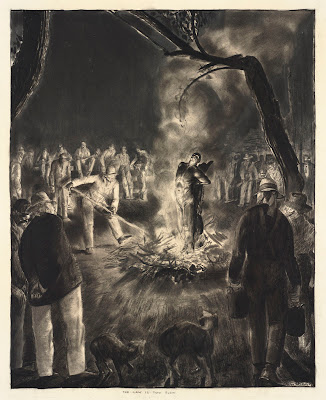
George Bellows. The Law Is Too Slow, Winter 1922-1923. Crayon on smooth, cream-colored, thick, wove paper, most likely Strathmore Drawing Board. Wiggin Collection, Boston Public Library.

Fortunately, over time, Bellows slowly slipped from under the influence of “Dynamic Symmetry” and allowed himself to follow his usually impeccable instincts. Through it all, Bellows “never lost his instinct for the right choice,” Conway writes. Perhaps the most strikingly “right” choice from the collection comes in the work The Law Is Too Slow (above), which depicts a vigilante killing in the 1920s, an all too familiar scene as the Ku Klux Klan rose to prominence within America. The central burning figure recalls the white-shirted man of Goya’s The Third of May, 1808 in its eye-arresting brilliance. The blood-thirsty crowd seems almost inhuman in their rough features as nature itself, in the form of the dark tree dominating the background, appears twisted by the injustice of their actions. Bellows’ personal thirst for justice comes through in the two-way title, which can be read as the rationale of the killers for taking justice into their own hands or as the lament of right-thinking people who mourn the death of an innocent man based solely on skin color.


George Bellows. Girl Sewing, Winter 1923. Crayon on lightweight cream wove paper. Wiggin Collection, Boston Public Library.

What makes the depictions of violence and injustice all the more striking are Bellows’ depictions of the joys of a simple home life, such as Girl Sewing (above), a portrait of his wife Emma. “You would not call him very affectionate,” a personal friend said of Bellows, “but he had a great deal of affection bottled up in him.” Such affection bubbles up in his drawings of his family, particularly of his children. Bellows died in 1925, only 43 years old, leaving behind a tantalizing glimpse of how much more he could have accomplished. The Powerful Hand of George Bellows demonstrates the technical prowess of Bellows as well as the complex mind and heart that guided that hand. In the Wiggins Collection, works by Durer, Rembrandt, Goya, Daumier, de Toulouse-Lautrec, and others rightfully take pride of place, but this exhibition and catalogue prove that George Bellows could stand toe to toe with any of them.


[Many thanks to the San Antonio Museum of Art for providing me with a review copy of The Powerful Hand of George Bellows: Drawings from the Boston Public Library and for the images above.]

Friday, June 13, 2008

Love and Death


I really wished I could have made it up to New York City in time to see the recent Met exhibition of the works of Gustave Courbet. I’ve seen most of the famous works in Paris at the Musee D’Orsay, but seeing them all together once again would have been nice. Born June 10, 1819, Courbet seems to be undergoing a renaissance of sorts in America. In addition to the Met show, Abbeville Press recently published a lavish, slip-covered study titled simply Courbet (which I plan on reviewing soon) and Petra ten-Doesschate Chu’s The Most Arrogant Man in France: Gustave Courbet and the Nineteenth-Century Media Culture remains one of my favorite art history books from last year (which I reviewed here). Courbet made his name as a founder of Realism, but, like almost everything else about Courbet, even that Realism is a carefully constructed concept. As Chu’s book asserts, Courbet realized quite early that the quickest way to make a name for yourself was to literally “make” a name for yourself—i.e., to shape a persona for the press to present to the public. In the Self-Portrait known as At the Easel (above, from 1847), we see Courbet trying on his artist hat in the grand tradition of Rembrandt and countless others. Aside from the beautiful use of charcoal and stumping, this image fascinates me in showing just how self-aware Courbet is in depicting himself. Courbet never stops watching us watching him.


It’s easy to dismiss Courbet’s identity antics as a ploy along the lines of the worst media capers of Andy Warhol, Salvador Dali, or even Damien Hirst in the twentieth and twenty-first centuries. However, I believe that Courbet truly found himself lost in a sea of possibilities, straddling both the Romanticism and Neoclassicism of much nineteenth century French painting while also recognizing the new, socially relevant realism of Honoré Daumier and Jean-François Millet. In the Self-Portrait known as The Desperate Man (above, from 1843), Courbet adopts the persona of the mad artist, driven insane by his fragile artistic temperament. In reality, Courbet’s sturdiness served him well in allowing him to juggle all these influences and still find his own way. In Burial at Ornans (1849-1850), Courbet finally found his subject—the French people—and shaped that public reality in his hands as easily as he had shaped his own personal truths.


Courbet’s fluidity in terms of subject and style made him a source of wonder for contemporaries, followers, and admirers today. In the Self-Portrait now known as The Wounded Man (above, from 1844-1854), Courbet actually changed the painting drastically over time. Originally, Courbet placed himself beneath a tree lounging with his lover after a tryst. When that woman left him in 1852, Courbet changed the topic from love to death, painting over the woman with a think blanket of brown and adding a wound to his chest, symbolizing his wounded heart. Just twelve years after Courbet finishes this romantic scene, he paints the frankest, most realistic depiction of sexuality in The Origin of the World. (Sorry, no link. This is a family blog.) As much as critics try to cubby hole Courbet into periods and styles, it’s much easier to take him as one giant, complicated whole. While some artists depict their aging (Rembrandt) or their personal struggles (Van Gogh or Frida Kahlo) in their self portraits, generating a consistent narrative of who they are, Courbet ‘s only consistency is his inconsistency, making his self depictions perhaps the most honest of them all.

Wednesday, February 20, 2008

Tilting at Windmills


When Honore Daumier caricatured King Louis Philippe as Gargantua (above, from 1832) he won a huge audience—and one very angry enemy. Born February 20, 1808, Daumier spent six months in prison for tweaking the king with his art, pointing out how the monarch placed in power by the July Revolution in 1830 wasn’t much better than the person he replaced. Daumier spoke truth to power—loud and clear. In both prints and sculptures, he showed the weaknesses and foibles of the rich and powerful as well as the effects of that class’ actions on the poor and powerless. Prison did little to blunt the sharpness of Daumier’s pen.


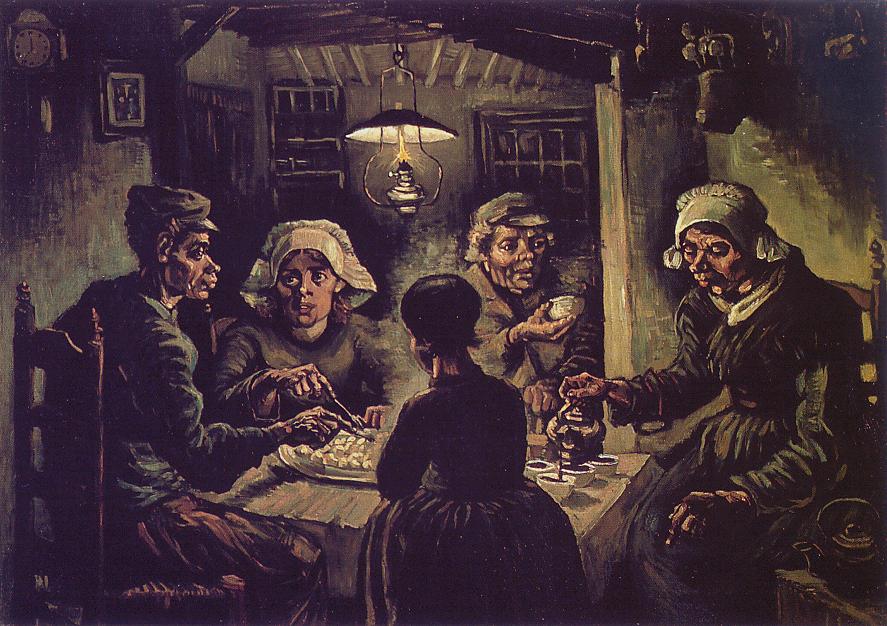
By the 1840s, Daumier shifted away from illustration and depictions of the upper class to painting and portrayals of the middle and lower classes. His The Third Class Wagon (above, from 1864) caricatures the faces and figures of the French peasant class huddled together like sheep, but with affection rather than disdain. Despite the cramped quarters, the people in the background seem vitally engaged in conversation, sharing in their common condition. The figures in the foreground—the woman and child, the elderly woman, and the little boy—each tell small little stories with the simplest details. I especially love the hat of the little boy sitting on the suitcase upon which Daumier has signed the painting. The old woman in the center brings to mind Van Gogh’s later paintings of peasants, such as his The Potato Eaters. Such a modern approach placed Daumier far beyond his peers, a man born before his time.


Despite his early success and abundant talent, Daumier’s choice of subject and political stance didn’t make him a rich man. Towards the end of his life, Daumier found himself part of the impoverished class he painted with such tenderness. Fortunately, his friend Jean-Baptiste-Camille Corot provided him with a home to live out his final years. “It is not for you that I do this,” Corot said to the protesting, still-proud Daumier. “It is merely to annoy your landlord.” To the end, Daumier could still get under the skin of those in positions of authority. Like the characters in his painting, Don Quixote and Sancho Panza (above, from 1849-1850), Daumier never stopped tilting at windmills, fighting the good fight with his imaginative, romantic spirit against all the odds to the bitter end.

Tuesday, January 15, 2008

Attention Must Be Paid

Henri Fantin-Latour, A Schumann Piece (Un morceau de Schumann), 1864, Etching on chine appliqué. Smart Museum of Art, University of Chicago, Purchase, Paul and Miriam Kirkley Fund for Acquisitions, 2006.97.

It’s hard to believe now, but concert goers in the days of Mozart would casually talk over the music, oblivious of the genius in the air all around them. The modern concept of silently experiencing music comes with the age of Beethoven and the Romantics, who elevate music to the status of an art form equal to that of the visual arts. With that change came a revolution in how the visual arts “saw” music, or more accurately, how the visual arts depicted the experience of appreciating music. In the exhibition Looking and Listening in Nineteenth-Century France currently at the Smart Museum of Art, the development of this relationship is examined through works such as Henri Fantin-Latour’s A Schumann Piece (above), which captures a moment in which the musicians perform Robert Schumann’s music as the intimate parlor audience watches them. This dynamic of the performer and listener provides a fertile field for the scholars writing in the exhibition catalogue to work within “the nexus of art history, musicology, history of science, and psychology,” as the introduction states.

Honoré Daumier, Mr. Babinet warned by his concierge of the arrival of the comet (Monsieur Babinet prévenu par sa portière de la visite de la comète), from the series La Comète de 1857 (The Comet of 1857), published in Le Charivari on September 22, 1858, Lithograph on original newsprint. Smart Museum of Art, University of Chicago, Purchase, Paul and Miriam Kirkley Fund for Acquisitions, 2005.31.3.

Originating in an interdisciplinary course conducted in the Spring of 2007 by the co-curators of the exhibition—Martha Ward and Anne Leonard—Looking and Listening in Nineteenth-Century France approaches the subject from multiple angles using a variety of artists. Honoré Daumier saw the new fascination with viewing, aided by technical innovations such as the telescope (above), and recognized, as Julia Langbein writes in her essay, “that ultimately those who lose themselves in observation make themselves vulnerable to be observed” and, therefore, the subject of caricature. Consequently, as Leonard writes in her essay, this results in “viewers’ self-consciousness about being on display while they behind the ostensible objects of display” in art galleries. The appreciation of art, whether painting or music, suddenly became a subject of interest in itself. Passively listening or looking would never be as “pure” again after such heightened consciousness.

Émile-René Ménard, Homer, c. 1885, Oil on canvas. Smart Museum of Art, University of Chicago, Purchase, Gift of Mr. and Mrs. Eugene Davidson, 1980.4.

Émile-René Ménard’s Homer (above) neatly encapsulates this controversy over sensory experience. “With eyes cast in different directions, their contrasting demeanors make for an odd combination of vacant starting, languorous sensuality, and plebian profile,” Ward writes in her essay on the painting. “All of these figures could be said, in some sense, to be blind to everything but their inner experience, including the viewer’s presence.” Ménard’s uses the blind poet Homer to symbolize the blindness of the creative artist totally immersed in the creative act, while the figures listening (or not) catalogue the different levels of immersion for those experiencing the creative act of another.


Henri-Michel-Antoine Chapu, Joan of Arc at Domremy, c. 1870–74, Cast bronze. Smart Museum of Art, University of Chicago, Purchase, Gift of the Friends of the Smart Gallery, 1986.12.

Elayne Oliphant examines the religious component of this sensory submission to the power of art. Looking at depictions of Joan of Arc such as Henri-Michel-Antoine Chapu’s Joan of Arc at Domremy (above) and Jules Bastien-Lepage’s Joan of Arc Listening to the Voices, Oliphant designates Joan as the ultimate audience. “To be absorbed in the task of contemplation,” Oliphant writes, “implies that one has overcome the distractions of the material world and, therefore, is capable of perceiving and understanding God’s words.” Where Joan heard the word of God through her powerful faith, the common patron of the arts can hear the artist’s message, regardless of the medium, through an equal leap of faith in the power of art to communicate. Joan of Arc thus becomes a patron saint for the newly enlightened viewer and listener of the increasingly secular nineteenth century.


Pierre Bonnard, Illustration for Le petit solfège illustré, by Claude Terrasse, Paris: Ancienne Maison Quantin/Librairies-Imprimeries Réunies, 1893, Printed book. Smart Museum of Art, University of Chicago, Purchase, Paul and Miriam Kirkley Fund for Acquisitions, 2007.106.

The true love of music so many nineteenth-century French artists had greatly helped forge this new connection and exploration between visual art and music. Michael Tymkiw examines how Fantin-Latour’s wide-ranging appreciation of the music of Robert and Clara Schumann, Berlioz, and, above all, Richard Wagner inspired him to illustrate those works, especially those relating to operas or ballets. (A CD accompanying the catalogue contains selections from many of the works Fantin-Latour and the other artists reacted to artistically, allowing for a truly multimedia experience that brings both the art and the music more fully to life. Many kudos to the developers of this catalogue for taking advantage of the available technology to provide this great enhancement.) Odilon Redon later viewed Fantin-Latour’s images as too illustrative, more reductive than truly in the spirit of the music. “My drawings inspire and do not provide definitions,” Redon wrote. “They do not determine anything. Just like music, they place us within an ambiguous world of the indeterminate.” With such striving for indeterminancy, Redon’s art truly aspired to the state of music itself, linking the wordless expressivity of the visual with that of the auditory explicitly. On a different level, Pierre Bonnard explicitly integrated visual art and music in his innovative drawings for a musical instructional book (above) that used amusing figures to illustrate musical notation in hopes of bringing this new way of "seeing" music to the next generation.

I’ve always toyed with the idea of art and music pairings, similar to the way that foodies obsess over wine and food pairings. The idea of walking through the MoMA while listening to John Coltrane, completely immersed in the dual experience and oblivious of everything else, always struck me as something to put on my personal “bucket list.” Looking and Listening in Nineteenth-Century France cuts to the heart of that interaction between the two media and how the whole is so much greater than the individual parts. In many ways, the nineteenth-century was a paradise for such cultural experiences. Although recorded music was not yet in existence, more people played instruments in the home, allowing for a more direct experience with the music. Classical music and the opera held a much more prominent position in the entertainment world than today, when they are both relegated to tiny, niche markets. Even the visual arts have fallen victim to the decline of arts education in America, leaving many museums empty and in financial peril. Looking and Listening in Nineteenth-Century France allows us to look back at that fertile time of true multimedia and, perhaps, regardless of the wonders of surround sound and IMAX theaters, make us conscious of what we’re truly missing.

[Many thanks to the Smart Museum of Art for providing me with a review copy of the catalogue to Looking and Listening in Nineteenth-Century France and for the images from the exhibition.]

Wednesday, October 24, 2007

It Takes a Thief


Art crime is “the only serious crime for which the public tended to root for the criminals,” complains one of the characters in Noah Charney’s The Art Thief: A Novel, a fictional examination of the world of art theft, forgery, and various and sundry art-related indiscretions. In real life, Charney founded the Association for Research into Crimes against Art (ARCA), a think tank dedicated to dealing with the growing worldwide epidemic of art crime. Brandishing his art history degrees from The Courtauld Institute and Cambridge University, Charney uses his powers for good rather than evil, essentially inventing the academic subspecialty of art theft. The Art Thief entertainingly wraps up this tangled web into an easily understood package, laying out all the issues for buyers, sellers, museums, and the police with charm and erudition.


Charney selects two very different works as the objects of criminal desire of his fictional felons: Kazimir Malevich’s Suprematist Composition White on White (above) and Caravaggio’s Annunciation (below). Once those works go missing, Charney populates the stage with an array of characters representing every strata of the art world: Genevieve Delacloche, the director of the Malevich Society and sworn protector of the artist’s reputation against fakes; Gabriel Coffin, bespoke British gentleman scholar, police consultant on art theft, and seeker of the lost Caravaggio; Inspector Jean-Jaques Bizot, the fussy French inspector hot on the Malevich’s tail; Harry Wickenden, the Scotland Yard inspector who just can’t learn how to pronounce “Malevich”; Professor Simon Barrow, lecturer in art history continually dismayed by the underwhelming students before him. A series of false leads, double-crosses, and even triple-crosses pulls the reader along a dizzying trail. Charney’s characters seem more two-dimensional than the paintings at times, mouthpieces for the art history and art crime editorials at the heart of his message, but Charney manages to inject enough humor and color to maintain interest. The fellows of a college “look like the cast of a Daumier cartoon.” Two characters “exude the color red, as if they were Titian-underpainted.” Charney peppers his prose with art history tidbits like that, as well as knowing pronouncements such as the sad fact that “for many tweed-and-bow-tied scholars, a vicarious life in 1598 in Rome, or in any other period for that matter, was safer and softer than the now.” Fortunately, Charney eludes that safe, soft trap and writes for the here and now.


In The Art Thief, Noah Charney does for the art history and art theft field what David Lodge’s novels Changing Places and Small World did for the literary criticism field, namely entertainingly and memorably educate the general public of the issues at hand and how those issues effect them. Works of art stolen from collectors and museums easily become the currency of organized crime and terrorism, making the world unsafe for more than just art lovers. Charney channels through Professor Barrow a bravura lecture on how Jan Van Eyck’s The Marriage Contract (aka, The Arnolfini Portrait) may be “the most influential painting in the history of the universe.” However, Charney never gets ponderously serious over art, joking at one point about sneezes caught on paper commanding huge prices at auction and how someone “should preempt Damien Hirst and corner the market on sneeze-related art.” By choosing a classic, religious Caravaggio and a blank, modern Malevich, Charney brings the two poles of art in the mainstream mind together—the unforgettably iconic and the minimalist iconoclastic—and, hopefully, converts a few casual art fans into devoted protectors themselves. The Art Thief won’t deter criminals, but it may steal your heart and enlist you in its cause.

[Many thanks to Atria Books for providing me with a review copy of this book.]

Friday, August 3, 2007

Taking it to the Streets


As the modern American city was born, John Sloan, born on August 2, 1871, was there to paint it. With scenes such as Fifth Avenue, New York (above) from 1909, Sloan captured the hustle and bustle of the emerging metropolis at the turn of the century, just as America’s role as a major world power was beginning. Although born in Pennsylvania and a student at the PAFA under Robert Henri, Sloan’s reputation as a member of the Ashcan School rests on his depictions of gritty New York City and its inhabitants.


Sloan’s earliest influences were the illustrations of Honore Daumier and William Hogarth, who, respectively, captured the essence of Paris and London in their days. Sloan himself worked as an illustrator for The Philadelphia Inquirer until demand for illustration work lagged with the introduction of photography, forcing him to travel to New York City to pursue his career in art. Dark, anecdotal scenes such as McSorley’s Bar (above), painted by Sloan in 1912, reflect Sloan’s reading of writers such as Emile Zola, Guy de Maupassant, and Walt Whitman, who celebrated the existence of the common man and woman as the true subject of art. The figures in Sloan’s bar scene resemble those painted by Edward Hopper years later, but without that same sense of loneliness Hopper always injects. Despite the poor social conditions of the era Sloan painted, he never adds a satiric (ala Hogarth) or maudlin note into his painting, choosing instead to show these common people in their own simple dignity.


Sloan joined a Socialist group in his youth, but never became deeply involved in politics. His choice of party reflected more his antiestablishment bent rather than any fully formed political faith. In Election Night (above) from 1907, Sloan shows the excitement of the celebratory crowd under the gaslights with no mention of the candidates, placing the emphasis on the people rather than the elite in power, perhaps reflecting the end of the days of the Robber Barons of the Gilded Age and the rise of the Progressive Era of Theodore Roosevelt. In later years, Sloan taught at the Art Students League in New York City and influenced future artists such as Alexander Calder, David Smith, and Barnett Newman. That Sloan, himself trained in the 19th century, could foster such 20th century talents testifies to his openness and empathy not only as an artist but also as a teacher.

Tuesday, July 31, 2007

Works of Charity


“There is only one master here—Corot,” Claude Monet once said. “We are nothing compared to him, nothing.” Jean-Baptiste-Camille Corot was born on July 16, 1796 and for the next 78 years of his life made the world more beautiful through his paintings and through the profound generosity of his spirit. A member of the French Barbizon School of landscape painting in the first half of the 19th century, Corot spent the second half of the 19th century helping usher in the Impressionist generation. Works such as his The Bridge at Narni (above) from 1826 attest to his earlier Barbizon style, a softened but still realistic depiction of nature that still looked back to the influences of his youth—Claude Lorraine and Nicolas Poussin.


Souvenir de Mortefontaine (above), painted nearly 40 years after The Bridge at Narni, shows the evolution of Corot’s style. Corot softens nature even more, paying greater attention to the effects of light, thanks in large part to his adoption of the en plein air painting style. Monet and the other Impressionists saw Corot as a father figure during the early days of their artistic revolution. Despite being 68 years old when Souvenir de Mortefontaine was painted, Corot maintained a clear eye and a sharp wit to go along with the generosity he showed to the younger generation of artists. Corot’s generosity was legendary in his time. In 1872, Corot donated what would be thousands of dollars today from the sales of his paintings to help the poor of Paris suffering the effects of the Franco-Prussian War. When Corot’s fellow artist Honore Daumier found himself homeless after blindness left him unable to paint, Corot bought him a home. Corot also favored a home for children in Paris with his loving support.


Whereas Corot’s landscapes influenced Monet and other Impressionist landscapists, Corot’s portraits took hold of the imagination of later artists such as Edgar Degas and Pablo Picasso. Corot brings the same softness, color, and light to his figures as his landscapes, which inspired Degas in his depiction of the figure as well as Picasso in his more classical periods. Woman Reading is from 1869, when Corot was 73 years old, yet he depicts her as lovingly as a young suitor. Perhaps it was his many acts of charity that made his heart forever young.


[This belated birthday to Corot is brought to you courtesy of the technical difficulties I experienced a while back.]