Showing posts with label Corot (Jean-Baptiste Camille). Show all posts

Thursday, March 24, 2011

Treasure Hunters: Rediscovering George Inness’ Italian Sojourn


When Michael Quick searched high and low in 2007 for paintings by 19th century American master George Inness to include in what would be his award-winning catalogue raisonne of Inness’ work, he came to the Philadelphia Museum of Art to see Twilight on the Campagna. The 1851 painting had entered the collection in 1945 and hadn’t been exhibited since 1952. An example of Inness’ earliest work in excellent condition, Twilight on the Campagna was one of those hidden treasures languishing in the darkness for want of wall space, because of critical blind spots, or both. The PMA recognized the treasure in their basement and conserved this masterpiece, which is now the centerpiece of their exhibition George Inness in Italy, which runs through May 15, 2011. Ironically, Inness’ Twilight began with his own treasure hunting, specifically a sojourn to Italy in search of artistry of the past he could take and transform into a new type of painting for the future. Please come over to Picture This at Big Think to read more of "Treasure Hunters."

[Image: Twilight on the Campagna, c. 1851. George Inness, American, 1825-1894. Oil on canvas, 38 x 53 5/8 inches (96.5 x 136.2 cm). Philadelphia Museum of Art, The Alex Simpson, Jr., Collection, 1945.]

[Many thanks to the Philadelphia Museum of Art for providing me with the image above and a review copy of the catalog to the exhibition George Inness in Italy, which runs through May 15, 2011.]


Monday, July 6, 2009

Graphic Content


One of the many joys of reading Vincent Van Gogh’s letters is his frequent references to other artists he admired. There are, of course, references to Millais, Corot, and others we still know well today, but it is the lesser-known names, the forgotten gems, that make you scour the internet for more. The English illustrator and painter Frank Holl appears in no less than eleven of Van Gogh’s letters. Born July 4, 1845, Holl drew Van Gogh’s attention with his graphic work in the socially conscious newspaper The Graphic founded by artist and social reformer William Luson Thomas. In the days before photographic reproduction in periodicals, magazines and newspapers relied on the talents of illustrators to capture the public’s eye and, in the case of The Graphic, the public’s heart and mind. While working for The Graphic, Holl painted such socially conscious works as Her Firstborn (above, from 1876), which shows dramatically and, yes, graphically the funeral procession of a family burying a young child. The poses and expressions of the figures are operatic in their emotion. You could almost hear a Puccini aria playing in the distance. In the Victorian age, infant and childhood mortality remained an agonizing reality. Holl’s poor British subjects and Van Gogh’s Dutch peasants both knew that reality well and both artists tapped into that emotion for their art.


In 1878, Thomas assigned Holl to visit Newgate Prison and create illustrations to accompany a story. In response, Holl painted Newgate: Committed for Trial (above, from 1878), which captures the pathos of a woman and child visiting the husband and father, respectively, held prisoner there. Holl actually painted this work inside Newgate prison to get all the physical and emotional details just right. The debtor’s prison remained another harsh reality for Victorians in England as the gap between the haves and the have nots widened to a chasm. For the upper classes in England, such sights were usually reserved for the lower classes. Holl brashly brings the dark side of British society in the 1870s to those in power by first painting such works and then exhibiting them at the Royal Academy alongside more genteel works. In many ways, Holl’s personal philosophy as enacted in his art mirrors that of the Ashcan School in America when they expanded their socially conscious graphic art to paint every corner, even the darkest, of urban American reality.


In 1877, Holl returned to the subject of childhood death with Hush! (above, from 1877). A mother asks an older child to be quiet as she anxiously watches over a sick baby. Both mother and elder sibling clearly know what might happen but don’t dare disturb the hushed silence by broaching the subject of death. In Hushed, the companion piece to Hush!, we witness the aftermath of the baby’s death. The mother covers her face while the surviving older child stands in stunned silence. The subtlety of the changed silence as conveyed in the two works illustrates Holl’s sensitivity and great psychological touch in portraying these people who too often remained invisible in British society. Unfortunately for Holl, such works did not sell well enough for him to support his own family. Holl painted portraits of the rich and powerful to provide for his family and to give himself the freedom to paint the socially conscious works closer to his heart. Working seven days a week, Holl eventually died from exhaustion at 43. "It is not too much to say that my father threw his life away by his utter inability to rest from work," Holl’s daughter later wrote. Thanks to Van Gogh, art lovers today can rediscover Holl’s paintings as well as his reforming passion.

Wednesday, February 25, 2009

Boy Wonder


At the tender of age of just 13, Fyodor Vasilyev began taking classes at night to learn how to paint. Born February 22, 1850, Vasilyev felt pressure to support his family after the death of his father and hoped to take the skills he’d learned as a painting restorer and use them as a maker of pictures himself. A few years later, Russian landscape painter Ivan Shishkin fell in love with Vasilyev’s sister and soon began teaching Fyodor his secrets. Shishkin eventually introduced his young protégé to other great Russian painters of the time, including Ilya Repin, who also took Vasilyev under his wing. Before turning twenty, Vasilyev, the boy wonder of Russian painting, was creating works such as Illumination in St. Petersburg (above, from 1869). It is truly amazing just how quickly Vasilyev put into practice the lessons and advice he received. Illumination in St. Petersburg looks like something Whistler might paint if he found himself in Russia on a cold, dark night pierced by gaslight. The way the moon silhouettes the great dome in the distance like a white nimbus brings the entire picture together. The quick execution of the people bustling along the street brings to mind the Parisians of the Impressionists, just beginning to work around the same time.


Like the Impressionists, Vasilyev was influenced by the artists of the Barbizon School, such as Jean-Baptiste Camille Corot, Jean-François Millet, and Théodore Rousseau. Vasilyev most likely learned of the Barbizon style through Shishkin, but once he knew the basics of the style, he quickly made it his own. Vasilyev’s Thaw (above, from 1871) unites the bleakness of earth and sky in the middle of an unforgiving Russian winter. The sky seems almost more solid than the ground, which is divided by swirling ruts that reveal the dark earth beneath the snow and give the surface as much a sense of movement as the clouds above. The great horizontals of Thaw make it seem to extend forever—as “endless” as the famous Russian winters themselves. Vasilyev takes care to derive maximum drama from every element of nature, just as Corot, Millet, and Rousseau took the Forest of Fontainebleau and squeezed every last drop of interest from it.


Vasilyev’s Wet Meadow (above, from 1872) shows how he was able to do more than winter snowscapes. The richness of detail in the foreground enhances the sense of depth as Vasilyev moves back into the picture plane and softens the focus. Again, the clouds above rival the best that the Barbizon artists have to offer. Still only 22 years old, Vasilyev seemed poised to rule over the Russian art world for decades. Sadly, after a little more than a year after painting Wet Meadow, Vasilyev was dead, a victim of tuberculosis. Vasilyev’s tuberculosis forced him to paint indoors. He painted Wet Meadow entirely from memory. Just as he was gaining fame and seeing more that Russia’s great landmass had to offer as subject matter, Vasilyev’s life and career were over. Fortunately, Vasilyev lived on in the sense of influencing the next generation of Russian landscape artists, who followed his example of taking the best of the French style and making it distinctly Russian.

Wednesday, June 4, 2008

Monet’s Master


When Claude Monet decided to join the French cavalry in Africa in 1861, signing a seven-year commitment, the chances that his fledgling career as a painter would succeed looked slim. When Monet contracted typhoid, the aunt who took Monet in after the death of his parents offered to get him out of the army if Monet enrolled in an art school. Monet’s aunt got the idea for the deal from a friend of Monet’s who believed in his art when few others did—Johan Jongkind. Born June 3, 1819 in the Netherlands, Jongkind spent most of his career painting in France, befriending fellow artists such as Monet, who saw paintings such as Jongkind’s Etretat Harbour (above, from 1852) while formulating the ideas that would flower into Impressionism. Monet called Jongkind the “master.” Etretat Harbour doesn’t look much like a Monet, but if you look at the horizon, flooded with the atmospheric effects of the sunset through the multicolored clouds, you can see the beginnings of the Impressionist style.


Would there have been a Monet or Impressionism as we know it without Jongkind? Monet hardly seems cut out for the military and too many people, from Corot to Manet, were thinking along the same lines for Impressionism and Monet to not have existed in some form eventually. However, the form we know owes something to Jongkind and works such as The Seine and Notre-Dame in Paris (above, from 1864), which certainly suggested the possibility of taking open air painting to an urban setting, thus finding beauty not just in the forest of Fontainebleau but on the streets of Paris, too. Struggles with alcohol and depression contributed to Jongkind’s lack of personal success, despite critical praise from tastemakers such as Baudelaire and Zola. In 1863, Jongkind married his fortunes to the young antiestablishment movement led by Manet and exhibited at the first Salon des Refusés. Acceptance into Impressionist exhibitions, however, eluded Jongkind for most of his career.


By the last few years of his life, Jongkind was painting in a recognizably Impressionist style in works such as Clair de Lune (above, from 1886). Monet the student had become Monet the teacher for Jongkind. The clarity found in seascapes such as Etretat Harbour thirty years before gives way to the free brushwork and overall suggestiveness of full-blown Impressionism in Clair de Lune. Declining health and fortunes forced Jongkind and his wife from Paris to live in a small town for his final years, far from the excitement of Parisian art circles and the latest movements. Twenty years older than Monet, Jongkind was born just too early to be part of that young man’s revolution but not early enough to be lauded as a true precursor. If nothing else, we may have Jongkind to thank for Monet the painter and not Monet the failed cavalryman.

Friday, May 2, 2008

Soul Train


For an artist often associated with a particular strain of American naturalism and spirituality, George Inness spent his fair share of time painting overseas and, when home in America, painting the intrusion of the locomotive on the American landscape. Born May 1, 1825, Inness belongs to the second generation of the Hudson River school, taking the lessons of Thomas Cole and Asher Durand and applying them to the second half of the nineteenth century. Inness’ The Lackawanna Valley (above, from 1855) belongs to a group of paintings commissioned by the Delaware, Lackawanna and Western Railroad to document their progress across the country. While Cole would have bemoaned the invasion of technology on the pristine land, Inness seems comfortable with the coexistence of the two—a sign of the receding influence of Romanticism and the impinging Victorian faith in progress.


Thanks to wealthy benefactors, Inness could travel to Europe and learn from the painters of Italy and France. Exposure to the Barbizon school added another dimension to Inness’ landscapes, softening them in the manner of Corot, Millet, and others. During his time in Italy, Inness painted The Monk (above, from 1873), showing a tiny figure walking the grounds of the Villa Barberini, a summer residence of the pope fifteen miles south of Rome. Compositionally, this could be a work by Caspar David Friedrich, but the feel is much more pantheistic than menacingly mysterious. The brushwork is also more abstract, showing the influence of another European master upon Inness—J.M.W. Turner.


Turner reportedly once said, “The Sun is God!” Inness would have agreed. Inness’ son, also a painter, claims that his father’s last words as they watched a sunset together were "My God! Oh, how beautiful!" before he collapsed to the ground. Looking at In the Gloaming (above, from 1893), painted 40 years after Turner’s death and a year before Inness’, you see a kinship between the late Turner of the swirling colors and atmospheric effects and the late Inness. Turner’s personal religious beliefs are unclear, but, despite the clarity of Inness’ choice of confession, the two artists clearly saw the world in the same way. Inness remains a true American original in the sense that he was able to immigrate all of these influences into his work, just as America itself is a nation of immigrants. Inness took the Swedenborgian belief that a common spirit runs through all creation and extrapolated it to the world of art, uniting disparate parts into a train of the artistic soul.

Thursday, April 3, 2008

Lost in the Woods

Jean-Baptiste-Camille Corot (1796-1875), The Forest of Fontainebleau, 1846; oil on canvas; Museum of Fine Arts, Boston, Gift of Mrs. Samuel Dennis Warren

Thanks to its unique combination of sand plains, limestone plateaus, and tree-filled forests, the region known as the Forest of Fontainebleau offers a tableau of natural beauty rarely seen. Add to that beauty a long, rich history dating back to the days of the Druids, it becomes easy to understand how these formal royal hunting grounds seized as national property during the French Revolution take on a unique place in the French national psyche. In the Forest of Fontainebleau: Painters and Photographers from Corot to Monet, an exhibition now at the National Gallery of Art, Washington, DC, tries to convey some of the depth and breadth of that hold the forest, once known as the “desert of the Gauls,” has on the soul of the French. From the time that Jean-Baptiste-Camille Corot began painting in the forest in the 1820s (his The Forest of Fontainebleau, from 1846, appears above) up through the advent of the Claude Monet and the Impressionists in the 1880s, many thousands of paintings were made there, an astounding 1,800 of which were exhibited at the Paris Salon. When photography became a viable artistic medium, some of the earliest experiments in landscape photography took place in that natural wonderland. In this exhibition and accompanying catalogue, we see the origins of the love of nature more commonly associated with Impressionism today, the heavy-handed commercialization of the pristine beauty, and the conservationism that ultimately saved the forest of Fountainebleau—all through the eyes of the artists who loved it most.

Jean-François Millet (1814-1875), Solitude, 1853; oil on canvas; Philadelphia Museum of Art, Purchased with the W.P. Wilstach Fund, 1906
In the early nineteenth century, Italy stood as the place where the aspiring open air landscape artist needed to learn his trade. Corot himself actually spent three years in Italy in the 1820s before returning to his native France and Fontainebleau. Although tastemakers such as Stendhal and John Ruskin disliked the unusual beauty of Fontainebleau (Ruskin called its “hideous rocks… never hideous enough to please me”), other authors such as George Sand and Gustave Flaubert seized upon the region’s appeal and promoted it to the intelligentsia. Within a short time, many artists follow Corot’s example and a small artists’ colony forms in the nearby town of Barbizon, which gave the Barbizon school its name. “For the group of artists who colonized Barbizon,” Kimberly Jones writes in her catalogue essay, “Landscapes, Legends, Souvenirs, Fantasies: The Forest of Fontainebleau in the Nineteenth Century,” “Fontainebleau was more than an open-air studio; it was a laboratory in which they examined the subtle shifts in time of day, season, and atmospheric change with an almost scientific rigor.” Jean-François Millet’s Solitude (above, from 1853) shows the forest in winter in a style that presages the Impressionists by decades. Fontainebleau offered a veritable cornucopia of landscapes and effects upon those scenes for the artist. This exhibition provides ample examples of this endless source of material mined by ambitious artists for decades.


Claude Monet (1840-1926), The Bodmer Oak, Fontainebleau Forest, 1865; oil on canvas; Lent by The Metropolitan Museum of Art, Gift of Sam Salz and Bequest of Julia W. Emmons, by exchange (64.210)

As word spread of Fontainebleau’s beauty, tourists began to flood the region in the footsteps of the artists. Contemporary cartoonists lampooned the distress of landscapists interrupted by people wandering into their pictures. In 1849, train service linking Paris and the forest put the natural setting a mere hour’s travel away, exploding the number of day trippers (while also making the forest more accessible to city-bound artists, too). Claude-Francois Denecourt, a local entrepreneur, saw an opportunity to unite his love of the area with his love of profit and began promoting the forest of Fontainebleau “experience” in a way that we would now call almost Disney-esque. “Denecourt peddled his own unique vision of the Forest of Fontainebleau,” Jones writes, “one in which every rock, tree, and clearing was a place of wonder, in which history and fantasy, nature and art merged into an extraordinary, if fictitious whole.” Denecourt slapped famous names from Charlemagne to Napoleon onto features of the landscape, many of which were later painted time and again. Artists such as Poussin, Claude Lorrain, and Delacroix found their names bestowed upon landmarks. Monet’s The Bodmer Oak, Fontainebleau Forest (above, from 1865) commemorates one of the many trees Denecourt dubbed with fame. Denecourt eventually designed pathways through the forest to help direct visitors. “He molded and shaped the visitor’s experience,” Jones laments. “The small blue arrows he placed throughout the forest to guide visitors were like bold brushstrokes against an otherwise virgin canvas.” By the 1870s, refreshment stands and souvenir shops plunged the final arrow into the heart of the artists who witnessed the commercialization of their inspirational source and spiritual sanctuary. The parallels between Denecourt’s work and modern despoiling in the name of commerce are too blatant for Jones to even mention.

Théodore Rousseau (1812-1867), The Cave, 1828-1830; oil on paper mounted on canvas; Los Angeles County Museum of Art, Gift of Frank Heller and the European Painting Acquisition Fund

Over time, Denecourt grew even more daring in developing his fictions, going so far as to create caves and caverns and devising elaborate “histories” for them to entice the curious. Théodore Rousseau, who painted The Cave (above, from 1828-1830), one of the natural rock formations, finally had enough of Denecourt’s fairytales and others who were ruining the forest with logging and the introduction of non-indigenous types of trees. Rousseau petitioned the government in 1861 and won, successfully protecting a large section of the forest from development, thus creating the first nature preserve in history. Rousseau “was the artist who most consistently represented the forest at the Salon,” according to Simon Kelly in his essay, “The Mystery of the Forest: Paintings of Fontainebleau at the Salon,” eventually earning the nickname “The Ruisdael of the Forest of Fontainebleau.” Kelly outlines the growth of landscape painting, especially depictions of Fontainebleau, at the Salon, with thirty percent of the works exhibited in 1860 being landscapes and a peak of seventy-seven landscapes in 1880. Rousseau and others worked to preserve the Fontainebleau they knew through these exhibited works as much as by their political action. Sadly, by the time that later artists such as Cezanne, Seurat, and even Picasso came to Fontainebleau, the damage had been done and the Fontainebleau of the Barbizon School existed only in paint and memory.

Eugène Cuvelier (1837-1900), Carrefour de l'Epine, early 1860s; salted paper print from paper negative; National Gallery of Art, Washington, Patrons' Permanent Fund, 1995

Sarah Kennel’s essay, “An Infinite Museum: Photography in the Forest of Fontainebleau,” helps bridge the perceived gap between landscape painting and landscape photography in the nineteenth century. Advances in photographic technology as much as the introduction of train access to Fontainebleau made it easier for early photographers to bring their gear into the open air. Gustave Le Gray, a painter turned photographer, brought his painterly sensibilities to the new medium. Eugène Cuvelier, who lived in Barbizon and knew both Rousseau and Millet, photographed the forest year round and in all types of weather conditions, taking the atmospheric “experiments” of the painters to another level. Cuvelier’s Carrefour de l'Epine (above, from the early 1860s) shows his use of the salted paper print, which, as Kennel explains, “offer[ed] a rich and subtle tonal range that both captures detail and suggests broad harmonies of light and dark,” making it perfect for landscape photography. In Cuvelier’s unpopulated photographs of Fontainebleau, we see the first true attempts at landscape photography as the technology of the medium itself began to catch up to the desires of it’s proponents.


Jean-François Millet (1814-1875), Two Men Turning over the Soil, 1866; pastel and black conté crayon on cream wove paper; Museum of Fine Arts, Boston, Gift of Quincy Adams Shaw through Quincy Adams Shaw, Jr., and Mrs. Marian Shaw Haughton

Cuvelier rarely photographed the people of the Fontainebleau region, but other photographers did. The catalogue and exhibit allow the viewer to put these photographs of these simple people next to the romanticized depictions of their life done by Millet in works such as Two Men Turning over the Soil (above, from 1866). After so many images of the landscape itself, it’s easy to forget the people who lived near the forest long before artists “discovered” it. The story of the Forest of Fontainebleau is really the story of the people who came to it and both took from it and gave to it, to varying degrees. For every Denecourt that robbed from it, there was a Rousseau to fill it up again. I remember seeing the Renoir Landscapes exhibition at the PMA last year (my review here) and coming away amazed at what an influence Fontainebleau and the Barbizon School had on Renoir, who came there with the second generation of the Impressionists as Fontainebleau itself began to fade away. After reading In the Forest of Fontainebleau: Painters and Photographers from Corot to Monet, it’s hard to imagine Renoir reacting any other way.


[Many thanks to the National Gallery of Art, Washington, DC, for providing me with a review copy of In the Forest of Fontainebleau: Painters and Photographers from Corot to Monet and for the images above from the exhibition.]

Wednesday, February 20, 2008

Tilting at Windmills


When Honore Daumier caricatured King Louis Philippe as Gargantua (above, from 1832) he won a huge audience—and one very angry enemy. Born February 20, 1808, Daumier spent six months in prison for tweaking the king with his art, pointing out how the monarch placed in power by the July Revolution in 1830 wasn’t much better than the person he replaced. Daumier spoke truth to power—loud and clear. In both prints and sculptures, he showed the weaknesses and foibles of the rich and powerful as well as the effects of that class’ actions on the poor and powerless. Prison did little to blunt the sharpness of Daumier’s pen.


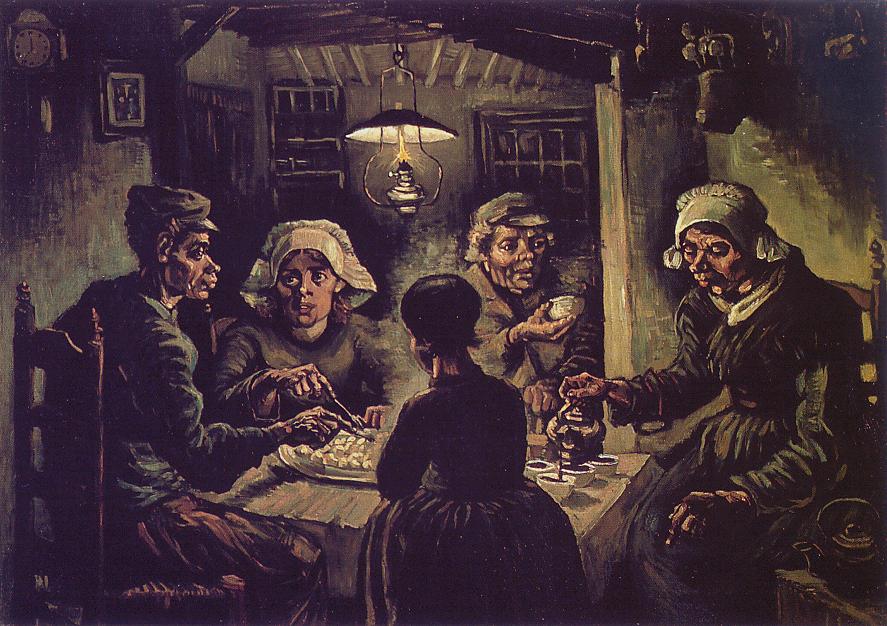
By the 1840s, Daumier shifted away from illustration and depictions of the upper class to painting and portrayals of the middle and lower classes. His The Third Class Wagon (above, from 1864) caricatures the faces and figures of the French peasant class huddled together like sheep, but with affection rather than disdain. Despite the cramped quarters, the people in the background seem vitally engaged in conversation, sharing in their common condition. The figures in the foreground—the woman and child, the elderly woman, and the little boy—each tell small little stories with the simplest details. I especially love the hat of the little boy sitting on the suitcase upon which Daumier has signed the painting. The old woman in the center brings to mind Van Gogh’s later paintings of peasants, such as his The Potato Eaters. Such a modern approach placed Daumier far beyond his peers, a man born before his time.


Despite his early success and abundant talent, Daumier’s choice of subject and political stance didn’t make him a rich man. Towards the end of his life, Daumier found himself part of the impoverished class he painted with such tenderness. Fortunately, his friend Jean-Baptiste-Camille Corot provided him with a home to live out his final years. “It is not for you that I do this,” Corot said to the protesting, still-proud Daumier. “It is merely to annoy your landlord.” To the end, Daumier could still get under the skin of those in positions of authority. Like the characters in his painting, Don Quixote and Sancho Panza (above, from 1849-1850), Daumier never stopped tilting at windmills, fighting the good fight with his imaginative, romantic spirit against all the odds to the bitter end.

Monday, January 14, 2008

Butterfly Kisses


Born on this date in 1841, Berthe Morisot is in many ways the First Lady of the Impressionists. After studying under Camille Corot and exhibiting in the Salon de Paris, Morisot threw caution to the wind and threw in with the ragtag bunch of upstarts joining forces under the leadership of Édouard Manet, who became her friend and second great influence. Manet’s 1872 portrait of Morisot (above) shows the confident, beautiful young woman painter at the beginning of her career, two years before she joined the Impressionist revolt. Although Berthe later married Manet’s brother, Eugene, and developed into a fine artist, she always had to struggle against sexism. Once, when Manet made a criticism of one her paintings and she agreed, he actually took it upon himself to correct it with his own brush. I just can’t imagine him doing the same thing to Renoir.


A common criticism of Morisot’s painting is that she painted only lighter subjects, clearly a code for “not serious” and, therefore, female. Considering the lighthearted subject matter of most Impressionist art, it’s hard to really buy into such criticisms. Morisot’s Chasing Butterflies (above, from 1874) epitomizes the airy, gentle touch and subject matter of much of her work. The difference between the “feminine” one sees here and the “feminine” aspects of Renoir, Degas, or Monet is entirely in the gender of the artist. Perhaps you can make the case for a “masculine” brand of Impressionism in the works of Manet, especially his more scandalous nudes, but that still wouldn’t differentiate the works of Morisot from any number of male Impressionists. I bet you could have easily slipped a work such as Chasing Butterflies into the Renoir Landscapes exhibition recently at the PMA without anyone noticing.


Morisot always placed a greater priority on her roles as wife and mother than on her life as an artist, which held her back to some degree. The Artist's Daughter with a Parakeet (above, from 1890) shows some of the pleasure Morisot took in the family life she fostered, unlike so many of her male contemporaries who buried themselves in their work and, perhaps as a consequence, suffered the woes of a dysfunctional family existence. In this respect, Morisot’s art resembles that of Mary Cassatt, who painted beautifully intimate scenes of motherhood despite never being a mother herself. In many ways I’ve always seen Morisot as the most well-adjusted of the Impressionists, the one who had her life always in balance. Some might say that she was never willing to pay the price to become a great artist. You could say equally that she was never willing to pay the price of being a great artist.

Tuesday, October 30, 2007

Sun and Fog


One of the second-tier figures of Impressionism, Alfred Sisley was born on this date in 1839. Sisley befriended both Monet and Renoir (who painted Sisley and his wife in 1868), painting many of the same subjects as they did, yet lacking the same spark of endless experimentation that those two used to rise to the next level. In works such as Fog, Voisins (above, from 1874), Sisley shows the influence not only of his fellow Impressionists but also that of J.M.W. Turner, whose paintings Sisley would have seen during his time living there from 1857 through 1861. The famous atmospheric fog of the late Turner seascapes appears here in the rural landscape of Sisley’s France, contrasting starkly with the usual Impressionist affinity for sunlight and clarity, a rare deviation from the Impressionist norm for Sisley, who depended on the financial support of his affluent parents through much of his life, a safety net that may have prevented him from flying too far or too high.


Another British influence on Sisley was that of John Constable. In Sisley’s Environs de Louveciennes (above, from 1873), Constable meets the Barbizon School, the generation of French painters painting out of doors around the Fontainebleau region just before the Impressionists came upon the scene. Renoir also painted around the region, attempting to recreate the landscapes of Corot, which must have influenced Sisley as well. Sisley moved to Fontainebleau in 1880, after the Franco-Prussian War of the 1870s ruined his father’s business and forced him to rely on his painting to support his family. In Environs de Louveciennes, we see Sisley’s sure, confident touch with landscape, a comfortable type of Impressionism that shows great skill but little of the boldness of Monet or Renoir.


Moret-Sur-Loing (above, from 1891) shows Sisley’s famous affinity for blue skies, which mimic those of Turner in their intensity and echo Turner’s own influence, Canaletto. The light in these skies seems more Mediterranean than French, an imaginative fancy amplifying an already beautiful scene. Sadly, Sisley’s work blends in with that of many of the second-tier Impressionists, mainly due to his choice of subject, which draws too direct a comparison with the first-tier artists of the same school. If nothing else, Sisley’s work demonstrates the link between Impressionism and the giants of nineteenth century England, especially Turner and Constable, proving that Impressionism wasn’t exclusively grown on French soil.

Monday, October 8, 2007

A New Wave

Seascape, 1879, Pierre-Auguste Renoir (French 1841-1919). Oil on canvas, 25 1/2 x 39 1/16 inches. The Art Institute of Chicago; Potter Palmer Collection. © The Art Institute of Chicago

Back in 2004, I found myself looking at and being disappointed by the PMA’s exhibit Manet and the Sea, when I came upon Pierre-Auguste Renoir’s Seascape (above) among the “other” works to provide context for Edouard Manet’s maritime works. That painting left an indelible impression on my mind, and perhaps on the mind of some others involved in the design of the current PMA exhibit in which it returns, Renoir Landscapes 1865-1883. Created through the cooperation of the PMA, the National Gallery of Canada, Ottawa, and the National Gallery, London, the exhibit and catalogue to Renoir Landscapes will open your eyes and see Renoir in a whole new light.


Springtime (in Chatou), 1872-73, Pierre-Auguste Renoir (French 1841-1919). Oil on canvas, 23 ¼ x 29 1/8 inches. Private collection

The exhibition takes aim at the misperception of Renoir as “just” a figure painter. John House of the Courtauld Institute of Art takes the first shot in his essay, “The Public Face of Renoir as a Landscapist.” House shows how the Salon, the arena of academic and financial art success at the time, was “Renoir’s primary focus” throughout the period covered by the exhibit. Although Renoir always found figure painting most intriguing, he used landscape, the genre most valued by the Salon and the collectors, to promote himself and his art. Instead of purely selling out, however, Renoir uses landscape painting as an opportunity for growth, “view[ing] landscape as the theme that allowed him the freest scope for technical experimentation.” “If landscape was primarily a recreation for him,” House asserts, “alongside the serious business of figure painting, it was a pastime that encouraged him to produce some of his most immediate and unconventional works,” such as Springtime (in Chatou) (above), which recreates the sense of the morning mists yielding to the coming heat of the day, nearly obscuring the tiny figure moving away from the viewer in the center of the picture.


Lunch at the Restaurant Fournaise (The Rowers' Lunch), 1875, Pierre-Auguste Renoir (French 1841-1919). Oil on canvas, 21 5/8 x 25 11/16 inches. The Art Institute of Chicago. © The Art Institute of Chicago. Photo Robert Hashimoto

Simon Kelly’s essay next places Renoir within the larger context of landscape painting and the emerging new, non-Salon markets for art sales in the rapidly changing France of the late nineteenth century. Artists such as Jean-Baptiste-Camille Corot, Charles-Francois Daubigny, Theodore Rousseau, and Gustave Courbet created rustic landscape scenes for the new, urban market. “New exhibiting venues—dealer galleries, auction rooms, and artistic societies—… transformed the nature of the Parisian, and French, art world in the mid-nineteenth century,” Kelly writes. Renoir placed himself squarely within this movement, admiring especially Corot and Courbet, whom he met while painting in Fontainebleau. Petra ten-Doesschate Chu’s The Most Arrogant Man in France: Gustave Courbet and the Nineteenth-Century Media Culture(which I reviewed earlier) provides a greater window on the market forces in play at this time, especially those of the mass media, many of which were honed by Courbet, who seems much more cunning and calculating than Renoir. Renoir, however, consciously understood and worked within these conventions in creating his art, such as Lunch at the Restaurant Fournaise (aka, The Rowers’ Lunch) (above), which plays to the audience of the time by referencing one of the contemporary pastimes of Parisian day-trippers, free of the city limits thanks to the new technology of train transport that could whisk them off to the rural landscape and back to the city all on their single day of rest. Renoir knowingly plays to the audience yet does not pander to it, painting the backdrop landscape in his revolutionary style as if smuggling his experimentation under the guise of a “simple” genre picture.

The Grands Boulevards, 1875, Pierre-Auguste Renoir (French 1841-1919). Oil on canvas, 20 1/2 x 25 inches. Philadelphia Museum of Art; the Henry P. McIlhenny Collection in memory of Frances P. McIlhenny

“Renoir in the City,” by Christopher Riopelle, co-curator of the exhibition from the National Gallery, London, examines the impact of the redesign of Paris in the 1850s by Napoleon III and Baron Georges Haussmann. In works such as The Grand Boulevards (above), we see Renoir’s conflicted reaction to the Haussmannization of Paris, in which the parks and private gardens introduced by the system that Renoir loved were offset by the new, banal architecture that came with it and that Renoir loathed. In many paintings, Renoir simply paints away the bad buildings, creating a personal utopia steeped in the Paris of his childhood yet still reaping the benefits of the urban facelift. “That such islands of privacy and peace” that were Paris’ many private gardens “were still to be found in the metropolis,” Riopelle writes, “was, for Renoir, a beguiling feature of city life.” Renoir, in turn, hopes to beguile his viewer into agreeing with his view of what Paris could be (i.e., what it once was, at lest architecturally) that Riopelle calls Renoir’s “corrective” or “subtle, utopian statement.” Where Hausmannization ruptures the social order, displacing the Parisian poor (including Renoir’s own family—twice!) in the name of progress, Renoir seeks to heal.


Monet Painting in his Garden in Argenteuil, c, 1873, Pierre-Auguste Renoir (French 1841-1919). 19 ¾ x 24 ½ inches. Wadsworth Athenaeum, Hartford, Conn.


Success allows Renoir to travel both within and without France. In Argenteuil, Renoir paints with Claude Monet, many times side by side, learning from yet always resisting total submission to Monet’s influence. Renoir’s affection and respect for Monet comes through clearly in his portrait of his friend painting in his garden behind his house (above). As Colin B. Bailey, co-curator of the exhibit from the National Gallery of Canada, Ottawa, writes in the concluding essay, Renoir never gave up the self-identification of himself as a figure painter, but always approached landscape as a personal escape, giving it “secondary importance” that gave him license to create works that verge on the abstract. Later, Renoir travels to Algiers and Italy. “As he traveled in these years,” Bailey writes, “Renoir—however much consumed by his ambitions as a figure painter—worked primarily as a landscapist, seeking out the picturesque tourist sites already made familiar by lithographers, photographers, and other painters.” Works such as Le Jardin d’Essai, Algiser (below) stun the viewer today with their originality and uniqueness. Renoir’s contemporaries went wild as well over these exotic scenes. Unfortunately, Renoir’s dealer followed up this success with an exhibition of his more commercial Italian scenes, which subtracted from Renoir’s reputation as much as the Arab pictures added to it.

Le Jardin d'Essai, Algiser, 1881, Pierre-Auguste Renoir (French 1841-1919). Oil on canvas, 31 ½ x 25 5/8 inches. MGM Mirage, Las Vegas, Nevada

Faced with incomprehension and often ridicule, Renoir for the most part gave up landscape after this period, concentrating on the figure. However, as the “coda” to the PMA exhibit shows, Renoir didn’t abandon landscape entirely, incorporating it into his later work and painting outdoors as late as 1915 while so racked with arthritis that the brush was strapped to the back of his hand and he had to be carried outside. One of the lectures scheduled at the PMA to accompany the exhibition is titled “Why We Love to Hate Renoir,” and I confess to an unenthusiastic response to Renoir previously, rooted in the misperception of him as simply the effete painter of “pretty pictures” and full-figured bathers. Renoir Landscapes 1865-1883 presents Renoir as anything but simple—in fact, Renoir emerges as a socially engaged and engaging artist, working within the conventions and simultaneously straining against them. Renoir Landscapes reveals a new dimension in Renoir, allowing him to step out of the two-dimensional caricature we “love to hate” and stand freely as a fully dimensional artist we can come to embrace.


[Many thanks to the PMA for providing me with a review copy of the catalogue to Renoir Landscapes 1865-1883 and the images from the exhibition shown above. The exhibit runs through January 6, 2008. The PMA is the only United States venue for this show.]

[BTW, my earlier impressions of the Renoir Landscapes 1865-1883 exhibition can be found here and here.]