Showing posts with label Degenerate Art. Show all posts
Showing posts with label Degenerate Art. Show all posts
Tuesday, March 25, 2014
The Sad, Strange History of “Degenerate Art”
“Crazy at any price!” read a sign above the modern art masterpieces at the Nazi-sponsored Entartete Kunst (“Degenerate Art ,” in English) exhibition in Munich, Germany, in 1937. The fevered brainchild of art-obsessed Adolf Hitler, Entartete Kunst
aimed at showing not only what “Jewish” and “Bolshevik” art looked
like, but also arguing how the degeneracy of those artists and their
work threatened the spiritual health of the German people, the “master
race” Hitler believed would rule the world, with him as their leader.
The Neue Galerie in New York City revisits that sad moment in modern art history with the exhibition Degenerate Art: The Attack on Modern Art in Nazi Germany, 1937,
which runs through June 30, 2014. The exhibition gathers together many
of the “crazy” works labeled as degenerate, holds them up against
examples of the Hitler-approved German art, and takes us down the long,
strange road that led up to that Munich show. The result is a sad,
strange history that will leave you shaking your head at the past, but
will also make you wonder if it could happen, again, here and now. Please come over to Picture This at Big Think to read more of "The Sad, Strange History of 'Degenerate Art.'"


Thursday, October 25, 2012
Did the Nazis Inadvertently Globalize Modern Art?

[Image: Nazi Reich Minister of Propaganda Joseph Goebbels views the Degenerate Art exhibition in Munich, Germany, in 1937. Image source.]
Wednesday, November 10, 2010
Out of the Ashes: Art Stolen by Nazis Rediscovered

It’s a sad fact of human history that the leadership regime most obsessed with art belonged to that of the Nazis. From Adolf Hitler the frustrated painter to obsessive collectors such as Herman Goering and Joseph Goebbels (who knew enough to step aside when Hitler lusted after an object), the Nazi power circles thought about art and its effect on their country’s culture continually, more often to art’s detriment than to its benefit. Exhibit A of the detrimental effects of that cultural concern is that dark episode in modern art history—the infamous Entartete Kunst (“Degenerate Art”) exhibition of 1937 that defined for Germans what was and what wasn’t acceptable art. Some of those “degenerate” works and the artists that made them escaped Nazi clutches, while much of that condemned art seemed lost to posterity in the same conflagration that consumed the Nazis themselves. A recent discovery, however, adds a small, but happy coda to the tragic symphony of the Nazis destructive love of art. Please come over to Picture This at Big Think to read more of "Out of the Ashes."
Thursday, May 7, 2009
Man on the Street

Life in the big cities of Germany inspired Ernst Ludwig Kirchner like no other artist of his time. Born May 6, 1880, Kirchner helped found Die Brücke in 1905 along with three other students in Dresden. Kirchner painted Street, Dresden (above) initially in 1908, when Brucke was at its height, but continued to return to make changes up to 1919, long after Brucke had moved on to Berlin in 1911 and even after Brucke disbanded in 1913. Kirchner’s style exemplifies German Expressionism for me, taking the facts of a simple street scene and imposing the vision of the artist upon it. Whenever you see well-dressed women in a Kirchner streetscape, you’re most likely safe in assuming they are prostitutes hawking their wares. The way Kirchner outlines the orange hat of the woman in the foreground with even brighter orange highlights makes me think of a neon sign in its garish, commercial advertising feel. The formless faces in Street, Dresden resemble those of Edvard Munch’s 1892 painting, Evening on Karl Johan Street. Kirchner and the other Brucke artists idolized Munch and even unsuccessfully invited him to join their group. In Street, Dresden, Kirchner captures much of the Munchian sense of alientation and unease.

By the time that Kirchner had painted Friedrichstrasse (above, from 1914), Brucke was over and he was ensconced in Berlin, a city much more international and cosmopolitan than the still-medieval looking Dresden. Kirchner paints Friedrichstrasse in a series of slashing lines, conveying a sense of endless movement similar to the Italian Futurists painting at the same time. The women, again, are most likely prostitutes. The pattern I’ve noticed in Kirchner’s art is that the naked figures are usually young and innocent, whereas the older, fashionably dressed women are far from innocent. Kirchner sets up that opposition to dramatize what he saw as the deadening and corrupting effect of modern civilization. Like Gauguin, Kirchner saw a simplicity and honesty in the art and lifestyle of Oceanic cultures and mimics their art in the angularity of his own. But even that angularity falls into two categories in Kirchner’s world—youthful innocence is simplified into flat planes and colors, rejecting all painterly illusion, whereas aged corruption becomes sinister in the sharp lines of faces and bodies that threaten to cut you like a knife.
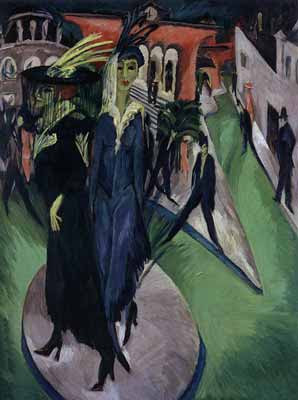
In Potsdamer Platz (above, from 1914), Kirchner merges his Munch-like instincts with his primitivism (although the two are certainly not mutually exclusive). The bodies and faces scream Munch, but the harsh angles of Kirchner’s later development appear. The street itself, however, now seems to shift and move, devolving into a nightmare landscape. World War I loomed on the horizon, and Kirchner volunteered to serve at its beginning. By 1915, a total breakdown left him unfit to fight. Kirchner channeled his anguish into even greater Expressionist works. He came to see himself as the heir to the mantle of greatest German artist, following in the footsteps of Albrecht Dürer and Lucas Cranach the Elder. Sadly, the Nazis in their rise to power redefined what constituted German-ness. Kirchner, the self-styled most German of artists, found himself and his work excluded from German museums and collections as part of the “Degenerate Art” declamation. After watching much of his art either destroyed or sold away, Kirchner took his own life in 1938. If Kirchner had been French, he would have been called a flaneur, a connoisseur of street life mingling among the people and diagnosing the ills of society. But, alas, Kirchner’s German roots not only provided his richest material but ultimately spelled his doom.
Tuesday, April 28, 2009
Bridge Over Troubled Waters
 Erich Heckel (1883-1970). Landscape in Dresden (Landschaft bei Dresden), 1910. Oil in canvas, 66.5 x 78.5 cm (26 1/8 x 30 7/8 in.). Staatliche Museen zu Berlin, Neue Nationalgalerie
“What is great in man is this: that he is a bridge and not an end,” wrote Friedrich Nietzsche in Thus Spoke Zarathustra in 1885. Two decades later, on June 7th, 1905, four young architecture students in Dresden, Germany, may have had those words in mind when they founded the artists group known as Die Brucke, or “The Bridge.” Ernst Ludwig Kirchner, Karl Schmidt-Rottluff, Erich Heckel, and Fritz Bleyl thus began an artistic movement that would stage more than seventy exhibitions before their disbanding in 1913, with twenty-seven happening in 1907 alone. “By joining together into a small, cohesive community with common goals, the Brucke artists hoped to stand up to [the] putatively fragmenting, debilitating effects of modern urban life,” writes Reinhold Heller in his essay “Brucke in Dresden and Berlin, 1905-1913” in Brucke: The Birth of Expressionism in Dresden and Berlin, 1905-1913, the catalogue to the current exhibition at the Neue Galerie in New York City. This exhibition, the first major exhibition of the Brucke in the United States, resituates these artists at the very beginning of the modern, international art world as they reached beyond Germany’s borders and invited the likes of Norwegian Edvard Munch (unsuccessfully) to join their band. “By reaching out, whether successfully or not, to such revolutionary painters,” Heller continues, “the Brucke established a network of communication with Europe’s most progressive artists and art institutions.” Dresden, known as “Florence on the Elbe” and famous for its many bridges (one of which is captured in Erich Heckel’s Landscape in Dresden, above, from 1910), thus became the starting point for the bridge-building across borders and between individual artists that the modern art world has become today.
 Erich Heckel (1883-1970). Studio Scene (Atelierszene), 1910-11. Oil on canvas, 70 x 48 cm (27 1/2 x 18 7/8 in.). Nachlass Erich Heckel, Gaienhofen.
In addition to their unsuccessful wooing of Munch, the Brucke successfully brought other artists, such as Emil Nolde and Max Pechstein into their fold. Staging group exhibitions and developing a signature style for their promotional material, the Brucke artists created a template for later artistic groups to follow. In all things, however, the Brucke set out to stand apart from the flow of contemporary, mainstream German life. They embraced “primitive” Indian, Oceanic, and African art, following in the footsteps of heroes such as Van Gogh and Gauguin and their search for primal forces untainted by modernity’s touch. This primitive approach, especially to the human figure, appears throughout their work, including Heckel’s Studio Scene (above), which also accurately depicts the everyday existence of the Brucke. For the Brucke artists, work and life were inseparable and models became friends and, sometimes, lovers. The artists even provided a “ruheraum” or “room of rest” for the models away from the labor of modeling. The German government’s crackdown on erotic images made the nude images of the Brucke artists all the more daring and avant-garde. In a musty old world suddenly thrown into an industrial age, the Brucke artists painted themselves as outlaws belonging to neither, but rather inhabitants of their own bohemian sphere of equality, fraternity, and, above all, beauty.

Ernst Ludwig Kirchner (1880-1938). Marzella (Fränzi), 1909-10. Oil on canvas, 76 x 60 cm (29 7/8 x 23 5/8 in.). Moderna Museet, Stockholm.
In the midst of this cultural separation, however, the Brucke longed to reconnect with what they saw as the essence of German art. Surrounded by the medieval art treasures of Dresden, the Brucke artists embraced forefathers such as Albrecht Dürer, Matthias Grünewald, and Lucas Cranach the Elder. Kirchner fashions himself as a modern Durer, who becomes “
 Ernst Ludwig Kirchner (1880-1938). Berlin Street Scene (Berliner Strassenszene), 1913-14. Oil on canvas, 121 cm x 95 cm (47 5/8 x 37 3/8 in.). Neue Galerie New York and Private Collection, New York.
Despite this German self-identification, the Brucke continually looked beyond national borders. Jill Lloyd’s “Brucke: National Identity and International Style” examines the tension between these nationalist and internationalist impulses. Dresden exhibitions of Van Gogh’s work in 1905 and Munch’s work in 1906 bring the cutting edge of art right to the Brucke’s doorstep. (The Neue Galerie’s Van Gogh and Expressionism exhibition in 2007 [my review here] covered that link extensively.) Lloyd sees the Brucke’s taking in of these influences not as “slavish dependence” but rather as “transformation[s].” Comparing the Brucke with their contemporaries, the Fauves, Lloyd writes, “Whereas the French artists worked within an established national tradition, the Germans pursued a self-conscious internationalism that went beyond the formulation of a new expressive style.” Criticism of the Brucke for not being “German” enough drove them in 1911 from Dresden to the more international city of Berlin. Berlin was the hub of the international art market at the time and provided easier access to the rest of the art world. In Berlin, Lloyd writes, the Brucke could “build more consciously on the elements of ‘Germanic’ or ‘Gothic’ style that had always co-existed with their modernism.” Kirchner’s Berlin Street Scene (above, from 1913-1914) shows how he adapted to his new, more cosmopolitan surroundings.
 Karl Schmidt-Rottluff (1884-1976). Corner of a Park (Parkecke), 1910. Oil on canvas, 83.5 x 75.5 cm (32 7/8 x 29 3/4 in.). Pinakothek der Moderne, Munich.
By 1911, however, the Brucke artists were beginning to grow apart. When Kirchner writes his chronicle of the movement and casts himself as the leader, Schmidt-Rottluff (whose Corner of a Park appears above, from 1910) and others take offense and finally disband in 1913. As Rose-Carol Washton Long explains in her essay, “Brucke and German Expressionism: Reception Reconsidered,” the Brucke soon drifted to the margins of art history for being not “modern” enough or not “political” enough. Only in the last twenty years, when “modernism” has been redefined as “one of the conflicting products of change in an industrial society,” Long writes, have the Brucke been rediscovered as an essential step in the progress of modern art. Brucke: The Birth of Expressionism in Dresden and Berlin, 1905-1913, the catalogue and exhibition, not only brings this neglected school to American shores for the first time, but also allows them to resurface from the depths of art history obscurity. Rather than being just a poor relation to Der Blaue Reiter, Die Brucke helped shape the international art world as we know it today in all its jet-setting internationalism. Able to embrace both their own national heritage and those of other civilizations, the Brucke artists set an example that artists continue to follow today, even if they don’t know where, how, or why it began. The Neue Galerie’s exhibition will answer all those questions, and more.
[Many thanks to the Neue Galerie for providing me with a review copy of Brucke: The Birth of Expressionism in Dresden and Berlin, 1905-1913 and for the images above from the exhibition.]
Wednesday, February 11, 2009
Animal Magnetism

When I left the Gustav Klimt exhibition at the Neue Galerie at the end of 2007, I came away with two calendars to grace my office walls for 2008: one by Klimt, of course, and another by Franz Marc. Born February 8, 1880, Marc’s work remains little known by the mainstream public, and I’ve always failed to understand why. Few paintings make me smile the way that Marc’s The Yellow Cow (above, from 1911) does. Pardon the pun, but it’s “udderly” ridiculous in the way the sallow sow leaps across the scene with a beatific grin upon her face. For all his close study of wildlife, Marc is not about photographic realism but spiritual realism. With bold, unreal color, Marc brings to life the inner life of God’s creatures, including this cow, who seems to transcend the bonds of gravity with pure joy. Marc belongs to the Expressionist movement in color and time period, but he has little of their existentialist angst. When the German Expressionists “discovered” Vincent van Gogh and adopted him as one of their own, many of them copied van Gogh’s depiction of his personal demons. Marc, on the other hand, took away from van Gogh the lesson of the felicity of unadulterated color, extending the technicolor fantasies of van Gogh into an almost abstract sphere and focusing on fauna rather than flora.

There’s a great sense of dignity in works such as Marc’s The Little Blue Horses (above, from 1911). Marc painted a whole series of blue horses, a major one of which was sadly destroyed in bombing during World War II. It’s truly amazing how Marc could depict different animals with distinctly different attributes and moods. Marc’s The Tiger is all dark, beautiful menace, while The Cat and The Hound show the gentleness and familiar type of beauty of a household pet. In 1911, Marc formed the Der Blaue Reiter group with Wassily Kandinsky and August Macke. I think the collaboration worked because Marc provided the patient, calm balance to the intensely driven Kandinsky, who wanted to revolutionize art with his words and images. Marc also wrote down his ideas on art, but I’ve always found his images to be much more articulate in their depiction of “dumb” animals.

Marc died in 1916, only 36 years old, during the Battle of Verdun of World War I. Just weeks before, Marc and several other prominent artists received word that they would be removed from the front lines, but Marc died before he could be moved to safety—yet another casualty of the senseless of combat. Before he entered the service, Marc’s art had taken an almost Cubist turn in works such as The Fox (above, from 1913). The sly, red fox seems to almost hide within the shard-like pattern of Cubist planes Marc constructs around him. The fox manages to poke a recognizable nose out from the jumble, almost taunting us to track him down in the Cubist jumble. Despite his record of service in World War I, Marc found himself on the Nazi’s list of “Degenerate Art” in 1937. Perhaps the Nazis found the eyes of Marc’s menagerie accusatory, challenging them to ask who was really acting like an “animal.” Throughout 2008, I had many people look at my Marc calendar and wonder who did such works. Perhaps in the near future people won’t have to ask that question.
Subscribe to:
Posts (Atom)