Wednesday, May 13, 2009

Star Search

O Lord my God! When I in awesome wonder
Consider all the works Thy hands have made.
I see the stars, I hear the rolling thunder,
Thy power throughout the universe displayed.

Then sings my soul, my Saviour God, to Thee;
How great Thou art, how great Thou art!
Then sings my soul, My Saviour God, to Thee:
How great Thou art, how great Thou art!

—From the Christian hymn “How Great Thou Art”

Growing up in the city, I rarely could look up into the night sky and see many stars. The light pollution thrown off by cities makes it almost impossible to stargaze with the naked eye. Moving out to the suburbs after we got married, I finally could see the stars. Many a thirty-second trip to take the trash outside at night has turned into several minutes of starry wonder. My friend Cathy recently sent me an old link to the top ten list of photographs taken by the Hubble Space Telescope as voted on by astronauts. (Pictures of the full top ten list can be found here.) All of these can be considered art in the fullest sense—creations of the ultimate artist. All of them testify to the fact that even as far as the human mind can go in terms of abstract imagery, nature can always go one better. The Hubble people titled the image above Starry Night after Van Gogh’s famous painting of the same name. The photograph shows “a halo of light around a star in the Milky Way.” Any discussion of stars and art is always going to roll around to Van Gogh’s painting, but I think that Vincent himself, a pious man, would be more humbled by nature’s beauty than gratified by the comparison.


The term “star” is thrown around too much today. You have sports stars and movie stars and rock stars in such abundance that might actually rival actual stars in number. The word doesn’t mean anything anymore. Ed McMahon hosted that horrible show Star Search in the 1980s and 1990s in pursuit of the idea that stars could be plucked out of thin air on command. The Hubble photo of the Trifid Nebula above shows a “stellar nursery” nine thousand light years from Earth in which new stars are actually born (without the help of Ed McMahon). The flip side of modern life’s loss of wonder is modern life’s lack of humility. We place ourselves among the stars as if we belong there by birthright rather than by earning that right. The trivialization of the term “star” marks how degraded our sense of wonder has become. Albert Einstein said that his sense of God was his sense of wonderment. Too bad he died before he could see for his own eyes the sights of the universe he only could picture in his mind.


Other people would argue that humanity needs to put itself among the stars or else feel small and insignificant in a large and mostly empty universe. The Cone Nebula above is two and a half light years long, or the distance covered in twenty-three million round trips from Earth to the moon. Yes, we are small. Yes, in some sense, we are insignificant. But, in the most important sense, we are highly significant. The same creator who created these wonders sprinkled throughout our skies gave us the intelligence and spirit to look up and pursue them. Physically, it is impossible for us to travel to almost all of these stellar regions. Through art, however, we can travel anywhere, from the universes stretching infinitely beyond to the tiny universes contained deep within us. I can sit on my deck and watch the stars with Annie and Alex on warm summer nights the way people have done for millennia. Such experiences, like art itself, link us to our humanity and the humanity of each other. As Casey Kasem would sign off, “Keep your feet on the ground and keep reaching for the stars.”

[Many thanks to Cathy for sending this link to me.]

Tuesday, May 12, 2009

Rules of the Game

Gertrude Stein Seated at Her Desk, in 27, rue de Fleurus, Paris, 1920. Photograph. Gertrude Stein and Alice B. Toklas Papers, Yale Collection of American Literature, Beinecke Rare Book and Manuscript Library, Yale University. © 2008 Estate of Gertrude Stein. Used with permission of Estate of Gertrude Stein.

One of the many things that sets Pablo Picasso apart from most artists is that, while he did associate with other painters, it was with poets and writers that he associated most often. When Picasso moves to Paris in 1901, he meets the poet Max Jacob and soon shares an apartment with him. Over the door, Picasso places a sign that reads, “The meeting place of poets.” Yale University Press’ Picasso and the Allure of Language, the catalogue to the exhibition at the Yale University Art Gallery organized by Susan Greenberg Fisher, analyzes how Picasso’s visual art drew inspiration from the techniques and ideas of the poets and writers around him. Gertrude Stein (shown above writing at her desk in 1920, surrounded by walls covered with the works of Picasso) served not only as a patron of Picasso’s art, but also as a modernist template upon which he could elaborate. “In Stein’s prose, the rhythmic play of repetition and difference acts to undercut the separation of one thought from another,” Patricia Leighten writes of Stein’s influence on Picasso’s still lifes. “In Picasso’s painting the elements of pictorial illusionism serve not to delineate objects, but to confound our expectations, acting to merge objects with their surroundings.” If “a rose is a rose is a rose” for Stein, a table is a table is a table for Picasso—a commonplace from which he could spin out endless variation leaving the original far behind. Subtle, yet stunning insights such as these shed new light on Picasso the poet in pictures who seems deeper and more complex as his art becomes sparer and more simplified visually.


Pablo Picasso, Dice, Packet of Cigarettes, and Visiting-Card, Paris, early 1914. Painted and printed paper, graphite, and watercolor, 5 1/2 x 8 1/4 in. (14 x 21 cm). Gertrude Stein and Alice B. Toklas Collection, Yale Collection of American Literature, Beinecke Rare Book and Manuscript Library, Yale University. © 2008 Estate of Gertrude Stein. Used with permission of Estate of Gertrude Stein. © 2008 Estate of Pablo Picasso/Artists Rights Society (ARS), New York.

In the 1914 collage still life Dice, Packet of Cigarettes, and Visiting-Card (above), Picasso cites Stein by name by including one of her actual calling cards in the collage. This collage acts out in art the real-life relationship between Stein and Picasso, which followed the pattern of Picasso’s writerly relationships throughout his life. “Picasso took from [writers] what they had to offer,” Fisher explains in her introduction, “namely a deep knowledge of the mysteries of language. He kept in his personal archive all the letters, postcards, and essays they sent to him, as if the disposal of these items would break the bonds of friendship.” Stein’s calling card, which is drawn with a folder corner to indicate that it was delivered in person, serves as a talisman for the writer herself that Picasso clings to by inserting directly into his art as he had into his mind and heart. One of the pleasures of Picasso and the Allure of Language is that you get a full sense of the literary richness of Picasso’s works thanks to the deconstructive techniques more commonly applied to literature applied to art. The fact that these techniques as implemented by the writers in the catalogue work so well with Picasso’s art is itself a confirmation that Picasso’s art stems from the same source as much modernist literature. In this scheme, Stein’s modernism fuels the innovations that help Picasso develop Cubism. Picasso does not necessary copy or, worse, steal ideas from literature, but translates the ideas of literature into ideas conceivable in painting and sculpture.


Pablo Picasso, Dog and Cock, 1921. Oil on canvas, 61 x 30 1/8 in. (159.4 x 76.5 cm). Yale University Art Gallery, Gift of Stephen Carlton Clark, b.a. 1903. © 2008 Estate of Pablo Picasso/Artists Rights Society (ARS), New York.

Picasso’s relationships with poets fall into two periods: the early, Cubist days with Max Jacob and Guilaume Apollinaire and the later, between the wars days with Surrealist poets Andre Breton, Louis Aragon, Paul Eluard, and Jean Cocteau. Peter Read’s Picasso and Apollinaire: The Persistence of Memory (my review here) argues for a continued influence of Apollinaire throughout Picasso’s life, like a phantom limb, which I’m sure this study’s writers would agree with. But they make a compelling case for a Surrealist Picasso, a label Picasso himself resisted. When Picasso gave up painting for a year from April 1935 through April 1936 for reasons still unclear, he turned to writing poetry, which Breton and his fellow Surrealists encouraged and even published. Fisher characterizes Picasso’s Surrealism as an “impulse” he couldn’t resist fully yet couldn’t embrace either because of his disagreement with their goals. Picasso’s Dog and Cock (above, from 1921) verges on the brink of Surrealism not only in its approach to the dog and cock, but also to how the newspaper comes into play. Fisher stresses how Picasso saw the newspaper as an example of the immediacy of the word in modern life. In addition to placing a newspaper on the table beneath a series of egg-like objects in Dog and Cock, Picasso arranges the entire painting in an almost columnar format. Plus, as Fisher points out, “[i]t may not be a coincidence that the overall shape of the cock resembles a large P, and the round shapes resemble the letters I, C, A, S, O.” Picasso thus “writes” his own name into the composition—a playful game with both language and paint. Picasso’s Surrealist “impulse” may come from this playful side, but his view of art as a serious force in the world for meaning prevented him from going all the way.


Pablo Picasso, pages 86–87 from Pierre Reverdy’s Le chant des morts (The Song of the Dead). Published by Tériade, Paris, 1948, Transfer lithograph, 17 x 13 in. (43.2 x 33 cm). Yale University Art Gallery, The Ernest C. Steefel Collection of Graphic Art, Gift of Ernest C. Steefel. © 2008 Estate of Pablo Picasso/Artists Rights Society (ARS), New York.

One of the most interesting parts of Picasso and the Allure of Language is the examination of Picasso’s book illustrations. As Irene Small explains, “Very few of Picasso’s images for illustrated books function as ‘illustrations’ in any ordinary sense of the word.” When Picasso illustrates Jacob’s Saint Matorel in 1911, Small writes, “rather than responding to Jacob’s existing text, Picasso’s etchings may have prompted a new text by the poet, as if to retroactively cement the tenuous relationship between text and image.” For Picasso and his authors, illustration was a two-way street of interplay and dialogue. In 1948, Picasso created abstract, almost calligraphic illustrations for Pierre Reverdy’s Le chant des morts (The Song of the Dead) (above). “The large and red abstractions are at once menacing and full of dignity against the black of Reverdy’s spaced-out handwriting,” Fisher writes, “and this baroque red and black against the white page, this blood and this mourning, are like the life of death, the very opposite of moribund.” Still reeling from the bloodshed of World War II, Picasso creates a new language of pure gesture in blood to accompany Reverdy’s attempt to put those feelings into words. Fisher cites Picasso’s study of illuminated medieval manuscripts as a source for these illustrations, which recapture and modernize the medieval view of death.


Pablo Picasso and André Derain, Four Still Lifes, Avignon, summer 1914. Oil on four ceramic tiles, 21 x 21 in. (53.3 x 53.3 cm). Yale University Art Gallery, The Philip L. Goodwin, b.a. 1907, Collection, Gift of James L. Goodwin, 1905, Henry Sage Goodwin, 1927, and Richmond L. Brown, 1907. © 2008 Estate of Pablo Picasso/Artists Rights Society (ARS), New York.


“Throughout a lifetime of friendships with writers,” Fisher writes in the introduction, “Pablo Picasso deeply understood language, both visual and verbal, and how it created meaning. But he was particularly sensitized to how language and textuality related to the ‘work’ that was closest to him: himself.” Picasso’s ultimate literary creation is the phenomenon of “Picasso” the character, the Proteus of modern art continually constructing and deconstructing personae while paradoxically maintaining a consistency in that very inconsistency. “My life has been the poem I would have writ,” Henry David Thoreau once wrote, “But I could not both live and utter it.” Similarly, the “poem” of Picasso’s life is his lifetime of visual art, which, except for one year devoted to poetry, consumed him entirely in the making. When Picasso and André Derain created Four Still Lifes in 1914, they painted on ceramic tiles and intended for the work to be laid flat, like a game board or writing desk. Thus, Picasso equates not only painting and writing, but also the idea of play. For Picasso, writing and painting and the ideas of writers and painters were all pieces in a great chess game played out in his mind. Picasso and the Allure of Language allows us to watch that game play out and challenges us to follow Picasso’s moves, which are always far, far ahead even today.

[Many thanks to Yale University Press for providing me with a review copy of Picasso and the Allure of Language and for the images from the exhibition.]

Monday, May 11, 2009

Authority Figures


The most fascinating and infuriating aspect of Salvador Dali is that you never really knew when he was kidding. Born May 11, 1904, Dali would say or do anything to provoke. On one level, he was a provocateur who could expose the hypocrisies of civilization. On a different level, where he wasn’t kidding, he could seem almost monstrous in his embrace of the unthinkable. For many critics, even when Dali was alive, Dali suffered from a fascism problem. Did Dali really admire fascist leaders, or was it all a big, decades-long joke? Either way, Dali’s examination of political strongmen goes a long way back, beginning perhaps with Partial Hallucination: Six Apparitions of Lenin on a Piano (above, from 1931). Like Warhol would do much later with Mao, Dali repeats Vladimir Lenin’s likeness until it loses all effect or actually becomes oppressive in effect. It all depends on how you see it, or think the artist sees it. By placing Lenin on a piano, Dali may suggest that Lenin’s policies were instrumental in making Russia an international powerhouse, as if a strong Russia could never have been orchestrated otherwise. Thanks to the rulelessness of Surrealism, however, Dali slips and slides away from any conclusive answers that could get him in trouble.


Dali’s fellow Surrealists surely didn’t think he was joking. André Breton accused Dali of defending Adolf Hitler as “enigmatic” rather than murderously insane or some other, more accurate description. Dalí’s The Enigma of Hitler (above, from 1938) embodies the artist’s strangely convoluted approach to Hitler around this time. Dali took the Surrealist apolitical credo to mean that even a Hitler could not be denounced. Breton and the other Surrealists expelled Dali from their ranks after a 1934 “trial.” Even after World War II, Dali flirted with fascism in the person of Francisco Franco, fascist leader of Spain. Dali would sometimes talk or write of the master-slave dynamic, casting himself in one role or the other and sometimes both. Philosophers from Hegel to Foucault have probed the depths of the master-slave relationship, often delving into the sexual component that Dali certainly injected into his discourse on the concept. Did Dali’s fascination with fascism come from some need for a master to enslave him? Or was Dali just playing at slavery before turning the whole thing on its head in the end, as he sometimes did, and declaring himself the master by virtue of his artistic talent? We just don’t know.


In the late 1960s, many intellectuals made a cultural hero of the Chinese leader Mao. Such a heroic vision came long before the atrocities Mao committed against his own people were known in the West. When a book of poems by Mao was to be printed in English, Dali created a series of prints to accompany them, including Bust of Mao (above, from 1968). Dali’s “bust,” of course, is anything but a bust, literally decapitating the head of the Chinese Communist Party. Like Lenin, Hitler, Franco, and other strongmen before him, Mao fostered a cult of personality around himself thinking that his personal charisma could keep his movement together. Oddly, Dali’s decapitation of Mao short-circuits the leader’s charismatic power. Faceless, Mao is just an empty suit. I’d like to think that Dali’s Bust of Mao says that Dali recognizes the emptiness of Mao’s cult of personality and, by extension, all cults of personality throughout time. I want to think that, but I just can’t be sure. Dali himself used personal charm to draw followers to himself. The magnetism of his magical artwork amplified his person to near-mythic status. Like Lenin, Hitler, Franco, and Mao, Dali can be identified by a single name. I love Dali’s art and mystique. I just wish he didn’t keep such bad company.

Friday, May 8, 2009

Up in the Air


For many people, the art of Giovanni Battista Gaulli, also known as Il Baciccio, is a big pain in the neck. Born May 8, 1639, Baciccio thrived during the age of the high-flying, illusionary ceiling frescoes of the High Baroque and early Rococo. Visitors still strain to look up at Baciccio’s The Worship of the Holy Name of Jesus (above, from 1685) in the nave of the Church of the Gesù in Rome. Other artisans helped out with the trickery of the faux architectural touches, but Baciccio is responsible for the breathtaking foreshortening that makes you feel as if the roof has come off and the heavens themselves are putting on a show. Baciccio’s painterly pyrotechnics belong to the armory of the Counter-Reformation as they fought back against the rising tide of the Protestant Reformation by appealing to the eyes and hearts of the still mostly illiterate masses. Where Martin Luther stressed the word, Baciccio and others stressed the image. Seven consecutive popes, from Pope Alexander VII through Pope Clement XI, picked Baciccio to paint their official portrait, demonstrating the trust the top men had in their artistic, not so secret, weapon.


Although Baciccio remains most remembered today for his grand frescoes, he did fine, more terrestrial work as well. His Pieta (above, from 1667) demonstrates what Baciccio could do with radical foreshortening closer to eye level. The drama Baciccio brings to this familiar religious scene shows the influence of Annibale Carracci and the Bolognese Baroque school, who tried to breathe new life into tired old tropes. By the time Baciccio paints this Pieta, the Baroque had begun to give way to the Rococo and the ostentatious displays of the frescoes of palaces and churches. This Pieta, however, shows just how precise and colorful Baciccio’s painting could be, a fact often lost when viewing his works set so high above. Baciccio achieves drama without resorting to deep, Caravaggio-esque chiaroscuro. For all the bombast of the frescoes, these humbler works by Baciccio may actually be his most deeply moving for those who believe. The expressions of sorrow worn by the angels on the left provide a perfect entry for empathy even today.


Baciccio learned the trade of being an artist from Gian Lorenzo Bernini, whom he painted in the portrait above in 1665. Baciccio learned Bernini’s style so well that this painting was originally thought to be a self-portrait by Bernini himself. Painted before the success of the great frescoes, Baciccio’s portrait of his teacher shows the love and respect he held for Bernini. Modern art is so much about the struggle of the individual artist and the development of an individual style, that we fail to appreciate the guild system that was in play for centuries in Europe as techniques were passed down from generation to generation and established artists nurtured younger ones. There were, of course, artists who used and abused the talents of their assistants, but the relationship between Bernini and Baciccio seems to have been a good one. Although Bernini is a fine artist in his own right, the work of Baciccio reflects on his talents as a teacher as well.

Thursday, May 7, 2009

Man on the Street


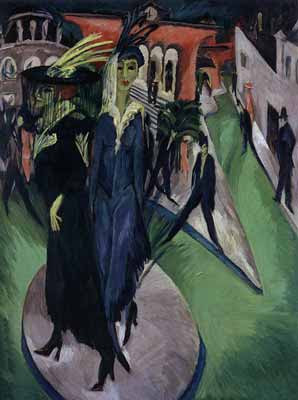
Life in the big cities of Germany inspired Ernst Ludwig Kirchner like no other artist of his time. Born May 6, 1880, Kirchner helped found Die Brücke in 1905 along with three other students in Dresden. Kirchner painted Street, Dresden (above) initially in 1908, when Brucke was at its height, but continued to return to make changes up to 1919, long after Brucke had moved on to Berlin in 1911 and even after Brucke disbanded in 1913. Kirchner’s style exemplifies German Expressionism for me, taking the facts of a simple street scene and imposing the vision of the artist upon it. Whenever you see well-dressed women in a Kirchner streetscape, you’re most likely safe in assuming they are prostitutes hawking their wares. The way Kirchner outlines the orange hat of the woman in the foreground with even brighter orange highlights makes me think of a neon sign in its garish, commercial advertising feel. The formless faces in Street, Dresden resemble those of Edvard Munch’s 1892 painting, Evening on Karl Johan Street. Kirchner and the other Brucke artists idolized Munch and even unsuccessfully invited him to join their group. In Street, Dresden, Kirchner captures much of the Munchian sense of alientation and unease.


By the time that Kirchner had painted Friedrichstrasse (above, from 1914), Brucke was over and he was ensconced in Berlin, a city much more international and cosmopolitan than the still-medieval looking Dresden. Kirchner paints Friedrichstrasse in a series of slashing lines, conveying a sense of endless movement similar to the Italian Futurists painting at the same time. The women, again, are most likely prostitutes. The pattern I’ve noticed in Kirchner’s art is that the naked figures are usually young and innocent, whereas the older, fashionably dressed women are far from innocent. Kirchner sets up that opposition to dramatize what he saw as the deadening and corrupting effect of modern civilization. Like Gauguin, Kirchner saw a simplicity and honesty in the art and lifestyle of Oceanic cultures and mimics their art in the angularity of his own. But even that angularity falls into two categories in Kirchner’s world—youthful innocence is simplified into flat planes and colors, rejecting all painterly illusion, whereas aged corruption becomes sinister in the sharp lines of faces and bodies that threaten to cut you like a knife.


In Potsdamer Platz (above, from 1914), Kirchner merges his Munch-like instincts with his primitivism (although the two are certainly not mutually exclusive). The bodies and faces scream Munch, but the harsh angles of Kirchner’s later development appear. The street itself, however, now seems to shift and move, devolving into a nightmare landscape. World War I loomed on the horizon, and Kirchner volunteered to serve at its beginning. By 1915, a total breakdown left him unfit to fight. Kirchner channeled his anguish into even greater Expressionist works. He came to see himself as the heir to the mantle of greatest German artist, following in the footsteps of Albrecht Dürer and Lucas Cranach the Elder. Sadly, the Nazis in their rise to power redefined what constituted German-ness. Kirchner, the self-styled most German of artists, found himself and his work excluded from German museums and collections as part of the “Degenerate Art” declamation. After watching much of his art either destroyed or sold away, Kirchner took his own life in 1938. If Kirchner had been French, he would have been called a flaneur, a connoisseur of street life mingling among the people and diagnosing the ills of society. But, alas, Kirchner’s German roots not only provided his richest material but ultimately spelled his doom.

Wednesday, May 6, 2009

Life, the Universe, and Everything


There it was, staring at me like an omen over and over—the number 42. Two days after the death of Harry Kalas, who along with the late Richie Ashburn served as the greatest storytellers of my childhood while announcing Philadelphia Phillies baseball on the radio and TV, I was watching a bit of a major league game on Jackie Robinson Day and getting a clear intimation of my own mortality. This year, Major League Baseball honored Jackie Robinson’s breaking of the color barrier by having every player wear the number 42 (above). Coincidentally, I turn 42 years old today. Baseball has always been a big part of my life, surprisingly so considering how poorly I played it. The whole history of America is so tightly bound up in baseball (cue James Earl Jones giving that speech at the end of Field of Dreams) that it pushes all my buttons. Baseball is great poetry, great history, great art, great everything to me. I’ve become my father in the respect that now I’m the Dad who can tell “I remember when...” stories about players from more than 30 years ago. Alex is still too young to understand such stories (and Annie asks me to tell her one only when she’s fighting insomnia), but I can’t wait to pass on that oral history to him when the time comes. Who knew that so much meaning could come in the shape of a ball?


The number 42 has equal significance to me thanks to Douglas Adams’ hilarious science fiction novel The Hitchhiker's Guide to the Galaxy (above). Adams has a computer named Deep Thought ponder “the Answer to the Ultimate Question of Life, the Universe, and Everything.” After 7.5 million years of computerized pondering, Deep Thought spits out the answer “42.” When I first read Adams’ geek ur-text, I didn’t know what Dada was, but that was a perfect Dada answer. As my age and cholesterol levels rise and footspeed and hairline recede, I find myself waxing philosophical more and more about the “Ultimate” questions. Many of those philosophical mini-quests play themselves out in the posts that appear here at Art Blog By Bob. Works of art, in any media, have always been touchstones for me. I come back to great paintings and poems at different times of my life looking for different answers to address the questions most present in my mind. At 42, the questions usually center on the idea that I’ve reached the halfway point of life. At the top of the metaphorical hill I turn around and survey where I’ve been, hoping it will give me some clue as to where I’ll be going. I guess Adams’ answer was that looking for answers is less important than the journey itself, the “hitchhiking” we all do through our slice of the universe. I recently read a great quote by a Sufi master named Abu Yazid al-Bistami: “This thing we tell of can never be found by seeking, yet only seekers find it.” Just because the answers may never come, doesn’t mean that you should stop looking for them. The answer is the looking.


Most of the answers to my life come from the two most important people in it—Annie and Alex (above, sitting in a giant flower at the Philadelphia Zoo). They are my life, my universe, my everything. I look at Annie and wonder what I did to be so lucky to have her love in my life. I look at Alex and marvel at what he is now and what amazing things await him in the future. Without their support and occasional kick in the pants, I wouldn’t be half the person I am today. They’ve made me a better “seeker” than I ever was before. I’m looking at a great leap into the relative unknown looming on the near horizon that will change my life (and theirs) not with dread but with a sense of excitement and purpose that I haven’t felt for years in my professional life. (More details to follow shortly. Sorry.) If all goes well, the same enthusiasm and joy I hope comes through in this blog will spill over into new compartments of my existence. In some ways this blog was the beginning of a quest that will end in a very different place than it started. Thanks to everyone who’s come along for the ride with me. I hope you stay and watch what’s to come over the course of the next 42 years, or more.

Tuesday, May 5, 2009

Revealing Photos


In October 2004, when the Louvre decided to move Leonardo Da Vinci’s
fragile masterpiece, the Mona Lisa, to a different frame as part of the conservation of the most famous painting in the world, the French National Museum Laboratory asked photographic engineer and inventor Pascal Cotte to photograph La Gioconda using his cutting edge technology. Using a “multi-spectral” process of thirteen different scans of the painting, Cotte created images at 240 million pixels resolution—eight times greater than any photograph ever made before of the painting. In Mona Lisa Revealed: Secrets of the Painting (above), we follow Cotte as he takes those images and studies them to reveal many of the secrets the grand lady of art history has kept to herself all these centuries. Combining Old Master artistry and New Age technology, Mona Lisa Revealed takes us back to the past while providing a glimpse at what may be the primary art history tool of the future.


Cotte easily confesses that he has no formal art history background. However, his lifelong fascination with the Mona Lisa inspired him to leap at the chance to get beneath the surface photographically and literally step back in time to see what remains of Leonardo’s handiwork as he intended it to be seen. Cotte’s photographs bring you closer than any visit to the Louvre possibly could, allowing you to study the cracks and fissures of the Mona’s face as if your own face hovered just inches above hers. Using documents throughout history, such as Giorgio Vasari’s contemporary account and copies of the work made by others throughout the ages, Cotte finds traces of the lost Lisa. As hinted at in the image above, the Mona Lisa may have once had eyebrows and lashes. The filmmakers enlist Da Vinci scholar Martin Kemp to explain how such details would have been among the last added and, therefore, quite easily the first to go, either by misguided restorations or the natural effects of time. Cotte brings scientific evidence that may finally decide much of the speculation surrounding the Mona Lisa. In addition to the Mona Lisa, Cotte has photographically studied Da Vinci’s Lady with Ermine, revealing that painting’s secrets as well. Cotte hopes to build on the success of these two studies to eventually photograph and study all of the acknowledged works of Leonardo.


The revelations of Mona Lisa Revealed are truly stunning. When Cotte pulls back the veil of time (above), we see the Mona Lisa as she first may have looked, in brilliant color with stunning details unseen for centuries. The fragile state of the Mona Lisa, like that of many of Da Vinci’s works, thanks to his endless experimenting with materials, makes actual restoration at this level impossible, so Cotte’s virtual restoration is the best possible. The film discloses all twenty-five secrets, as promised, and even throws in a twenty-sixth available only on the DVD. Cotte’s colorful personality comes across in the film, which follows his 2007 exhibition tour of Europe and America to disclose Mona’s secrets. The filmmakers try to recreate the breathlessness of the tour with globe-trotting graphics and a cheeky narrator posing as the Mona Lisa herself. These touches seemed cheesy to me at first, but eventually grew on me as being perfectly in synch with the overall liveliness of Cotte’s project, which is to breathe new life into the most hyped, most studied, most overexposed single image in Western civilization. Perhaps the most important secret revealed in Mona Lisa Revealed is that technology today can work with art history to recapture sights long thought forever lost. See Mona Lisa Revealed and you’ll never see the Mona Lisa the same way again.

[Many thanks to Microcinema for providing me with a review copy of Mona Lisa Revealed: Secrets of the Painting.]