Friday, May 22, 2009

Urban Myths


Henri Rousseau, better known by some as “Le Douanier” or “The Customs Officer” (his occupation until his retirement in 1893), painted in obscurity during his lifetime but is known well today for his mysterious, almost childlike paintings of wonder such as Sleeping Gypsy and The Snake Charmer. Born May 21, 1844 in the Loire Valley, Rousseau’s most famous works present a strange jungle world, yet he himself inhabited the urban jungle of Paris for most of his career. Rousseau’s Self-Portrait of 1890 (above) shows him situated in a civilized setting, yet still retains the simplicity and unstudied charm of his other works. During his lifetime, Rousseau withstood the ridicule of other artists who couldn’t understand his primitive style. However, Jean-Léon Gérôme, an academic painter himself, gave tips to his friend Rousseau as “Le Douanier” pursued painting past the point of being a hobby into a true outlet for his unique perspective. As much as I love Rousseau’s dark jungles, I find it equally fascinating how he applied his unique vision to the real world around him, spying modern wonders with that same childlike fascination.


When Rousseau painted The Eiffel Tower (above, from 1898), Gustave Eiffel’s colossus was less than a decade old. Anyone who has visited Paris has some visual memory of the tower, either from a vantage point in the city or, if you’ve taken the ride up, from above, looking down upon Paris itself. The Eiffel Tower anchors Paris like a lighthouse shining its beacon to guide lost travelers home. With that powerful effect in mind, it’s fascinating that Rousseau chooses to literally cut the Eiffel Tower down to size in a painting named after it. He reduces the landmark to the size of a gift shop replica hanging from a key chain. Instead, the waterways of Paris dominate the scene as the Parisians who work the banks go about their daily jobs. Rousseau flips the idea of importance on its head in this painting. All adults “know” that the Eiffel Tower is the most “important” thing in this painting, but children don’t know such things. Children visually value the waterways and the workings of the people just as much, if not more, as Rousseau tries to show in this painting.


Before his death in 1910, Rousseau got to witness the advent of powered flight, which began with the Wright Brothers first flight in 1903. In View of the Bridge at Sevres and the Hills at Clamert, Saint Cloud and Bellevue (above, from 1908), Rousseau paints a Wright Brothers-style plane sputtering across the sky. Nearby, a type of dirigible flies. The early twentieth century saw a “golden age” of blimps and dirigibles. Races were even held above Paris using the Eiffel Tower as a turning stake. In the distance between the plane and the dirigible, a hot air balloon floats. The first manned balloon ride happened in Paris in 1783 in a contraption built by the famous Montgolfier brothers. Rousseau’s arrangement of these three flying machines suggests the advent of the plane and blimp and the decline of the hot air balloon technologically. (Thomas Eakins’ 1871 Max Schmitt in a Single Scull creates a similar hierarchy by showing older, slower watery craft in the distance behind the Schmitt’s sleek racer.) To Rousseau’s old, yet young eyes, these new flying machines must have seemed magical. Critics credit Rousseau for opening up avenues of seeing that paved the way for the Surrealists, but in his more “real” works of wonder, Rousseau showed us more importantly the value of seeing as a child sees and recognizing the magic all around us every day.

Thursday, May 21, 2009

Superstar


The long and often tragic history of Germany is tied up in large part with an identity complex. Like many European countries, the idea of Germany as a country with clear borders is a relatively modern one. Wars and kingships have moved borders back and forth so often that what was German land and what wasn’t remained an enduring question. In the late nineteenth century, Germany tried to fill this identity void by creating truly Germanic heroes. In the world of art, Albrecht Durer was crowned the first and truest German superstar. Born May 21, 1471, Durer brought the Italian Renaissance north, where it became the Northern Renaissance. Yet, just as Germany itself was a work in progress, Durer had to grow into his superstardom. The Self-Portrait of 1493 (above) shows the 22-year-old Durer at the beginning of his career, just starting to travel across Europe to accrue the mixture of influences that would inspire his mature work. Durer painted this self-portrait in Basel and shipped it back to his intended back in Nurermberg, writing “Things with me fare as ordained from above” at the top of the picture. From the very beginning, Durer sensed his fate was in God’s hands.


Just five years after painting the awkward Self-Portrait of 1493, Durer paints the self-assured Self-Portrait of 1498. Durer now sits up straighter than before. Whereas the 1493 portrait is isolated, the 1498 portrait includes a window onto the world. Durer had just returned from Venice with the Italian Renaissance still fresh in his mind. The world had literally broken wide open for Durer in the span of just five years. Legend has it that Durer’s dog barked and wagged his tail upon seeing the 1498 portrait for the first time, fooled into thinking it was actually his master. The realism of this portrait as well as the opulence of the clothing Durer wears show that Durer had mastered the techniques of the Renaissance masters and was turning a fine profit for himself. Yet, Durer remains turned slightly away, as if he can’t yet bring himself to face the viewer full on. His mission was not yet complete.


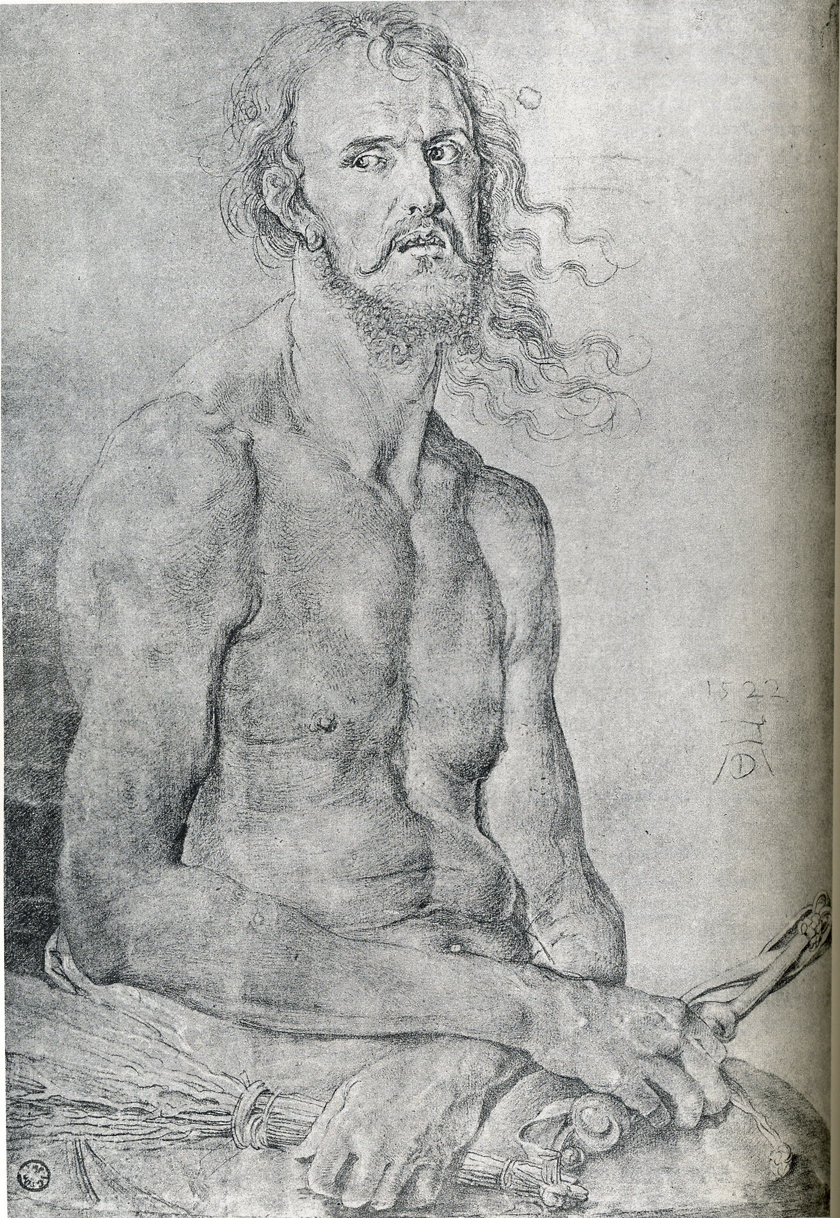
In the final painted Self-Portrait of 1500 (above), Durer faces the viewer directly in total confidence of his powers. He wears kingly clothing and his hair cascades down like a lion’s mane, proclaiming him the king of the German cultural jungle. Durer assumes visually the mantle of the King of Kings, Christ himself, in this final self-portrait not out of blasphemous braggadocio but instead to illustrate how the artist imitates God himself in the creative act. If imitation is the sincerest flattery, Durer imitates Christ to praise him as the source of all artistic and creative power. In a 1522 drawing, Durer lent his features to Christ again, but this time as the Man of Sorrows instead of Christ triumphant. As age began to take its toll on Durer, he identified increasingly with the Suffering Servant side of Christ’s story, recognizing that his ascension to the rank of creator had ended. Of all the artists in different media adopted by the Nazis at the apex of German nationalism, Durer and perhaps Beethoven seem to be the two left untainted by that association. As the German Expressionists recognized (especially Ernst Ludwig Kirchner, who fashioned himself a modern-day Durer through his own self-portraiture), the stellar light of a superstar such as Durer can never be tarnished by mere mortals.

Wednesday, May 20, 2009

Crowded Out


Along with Peter Paul Rubens and Anthony van Dyck, Jacob Jordaens helped make the Antwerp school famous during its day. Born May 19, 1593, Jordaens was younger than Rubens and slightly older than van Dyck, who sandwich him in the minds of art historians today to the point of being crowded out, much as he crowded himself out in his Self-Portrait with Parents, Brothers, and Sisters (above, from 1615). Jordaens forces us to play some Dutch version of Where’s Waldo? to find him among the familial fray, and even squeezes in a pair of cherubs over his head to fill out the last empty space. The individuality of the portraits in this group recalls the touch and technique of van Dyck, whose portrait style took England by storm and continued to influence British artists centuries later. At the same time, the comedy of the crowded room, which reminds me of the “stateroom scene” from The Marx Brothers’ movie A Night at the Opera, follows the line of conventional Dutch genre painting illustrating daily life with all its ups and downs. Rubens and van Dyck walked with royalty, but Jordaens never lost his common touch, which may be why he’s become the Zeppo of the Antwerp School.


Rubens actually hired Jordaens to create larger-scale versions of some of his original designs—a common practice in the apprenticeship world of guilds. This outsourcing proves that Rubens recognized Jordaens’ talent as well as his Rubenesque style. Jordaens’ Prometheus (above, from 1640) reinterprets Rubens’ famous Prometheus Bound of 1611. First, Jordaens flips the composition of Prometheus Bound and the vulture, creating a mirror image. Next, he concentrates more on showing Prometheus’ anguish facially rather than through the contortion of his body, thus inserting a van Dyck style portrait into a Rubens. Finally, whereas Rubens left Prometheus alone on the crag to fight the vulture forever, Jordaens shows the moment at which Hermes comes to the rescue. It is almost as if Rubens was comfortable with the idea of eternal torment (perhaps reflecting an idea of man’s inherent sinfulness), whereas Jordaens couldn’t allow the story to not have a happy ending. Jordaens desire to save Prometheus falls in line with his happier view of humanity, flaws and all.


Of course, not everything is sunny in Jordaens’ world. The shadow of Caravaggio falls heavily on some of Jordaens more mysterious work, particularly the enigmatic Apparition by Night (above, undated). A young man tosses and turns in his sleep as a ghostly nude female figure walks across the room. Two women open the door to look in on the youth and their candle lights the room just enough for us to see the spectral seductress. Whereas Caravaggio’s chiaroscuro sharpened his scenes with the stark dark and light drama, Jordaens’ brand of chiaroscuro forces us to look as through a glass darkly. The nude ghost seems to walk not only in darkness but also underwater, making her murkier and more apparitional. I can’t help contrast Apparition by Night with Henry Fuseli’s Nightmare and Silence, which also muddy the visual waters to conjure ghosts in the night. Jordaens’ Apparition by Night seems almost Romantic by that association with Fuseli even though he paints a full two centuries before the “Romantic” age. Like the apparition, we see Jordaens only fleetingly in the shadows of his bigger countrymen, but wish we could see him in a stronger, more revealing light.

Tuesday, May 19, 2009

Brotherly Love


Before you even open Holman Hunt and the Pre-Raphaelite Vision, edited by Katherine Lochman and Carol Jacobi, you know that this is a different kind of art history book. The faux Victorian exterior design and endpapers transport you back to that time and prepare you to see the Pre-Raphaelite Brotherhood of William Holman Hunt, Dante Gabriel Rossetti, John Everett Millais, and others through their eyes and not through the distorting lens of a century and a half of critique, including the help (and sometimes harm) of fellow Victorian John Ruskin’s writings. In his 1905 book, Pre-Raphaelitism and the Pre-Raphaelite Brotherhood, Hunt railed against depictions of Rossetti as the clear leader of the group, calling himself the “true” Pre-Raphaelite adhering to the original tenets of the Brotherhood. “The book ends with an attack on decadence [i.e., French Impressionism and Modernism in general] and an expression of anxiety about the downfall of the noble British artistic tradition,” Carole Silver writes in her essay, “Visions and Revisions.” In a painting such as Hunt’s The Flight of Madeline and Porphyro During the Drunkenness Attending the Revelry on the Eve of Saint Agnes (above, from 1848), taking a scene from Keats’ poem The Eve of Saint Agnes, Hunt rewrites Keats’ lines to emphasize his moralizing mission. In casting the fleeing lovers as moral rather than the drunken partiers, “Dreams are compared with truth, appetite to love, social rules and rituals to personal freedom,” Carol Jacobi writes in “Pre-Raphaelite Rebellion: Brotherly Love.” As Jacobi puts it, the Pre-Raphaelites arose from “[s]tylistic innovation… generated by a shared interest in vision that was part of a timely and sophisticated inquiry into the nature of subjectivity… artists, poets, and critics alike debated the predicament of the individual in modern circumstance and the role of art in a material age.” This collection sets out to show how Hunt and his “brothers” set out to save the world through art by reaching back to the “Pre-Raphaelite,” pre-corrupted age of morality that the materialism of their society had left behind.


The most concrete example of Hunt’s personal mission to spread the word remains The Light of the World (above, the second, 1854 version). In “The Light of the World: Mission and Message,” Jonathan Mane-Wheck retraces the steps of the most traveled artwork in history, seen by more than seven million people on a 1905 tour of the British Empire, Canada, Australia, and South Africa. Mane-Wheck sees modern distaste for Hunt’s Light originating in confusion between the work itself and the “kitsch industry” surrounding and, in many ways, stemming from it. Hunt paints Christ holding a lantern and knocking on a door—an embodiment of opportunity knocking, in this case the opportunity to embrace salvation. Hunt himself, however, rejected harsh dogma. “Possessing a more synthetic, universalist concept of religion,” Mane-Wheck asserts, Hunt “was open to Judaism and Islam.” In fact, when Hunt created a smaller version of his Light in 1854, he modified the lamp with a star and crescent as a nod to Islam “to show the breadth of the Christian system, which takes in other systems,” Hunt told an interviewer at the time. Unfortunately, over time, Hunt’s personal intentions have been clouded not only by a religious intolerance he did not practice, but also by political appropriation. “In its journey across the globe,” Mane-Wheck writes, “The Light of the World had become an icon of British Imperial Protestantism.” Hunt certainly believed in the nobility of British art and its power to save, but may have been uneasy in his Christ being “drafted” in the battle for colonization.


In “Textile Background: Cloth and Costume,” Linda Parry examines Hunt’s life-long relationship with fabrics and costume and how that experience played out in his painting. Both Hunt’s father and grandfather worked in the London textile industry. Hunt grew up in a home just above the textile works and even worked in the industry for two years before devoting himself to art. The drawings of the clothing designers were among the first artworks Hunt saw firsthand. This world of color and textures easily translated into the opulence of such works as The Finding of the Savior in the Temple (above, from 1860)—Hunt’s retelling of the story of the young Christ found lecturing in the temple. Many of the rich colors in Hunt’s painting copy newly developed dyes of the 1850s. (Joyce H. Townsend and Jennifer Poulin discuss elsewhere Hunt’s painstaking approach to pigments to the point of pointing out defects to the manufacturers.) Photographs of costumes Hunt designed for his models accompanying Parry’s essay as testimony not only to Hunt’s love of fashion, but also of his exacting brand of realism. Thanks to his travels in the Middle East and the Holy Land, Hunt developed a taste for exotic dress that he satisfied with costumes for himself, which allowed him to feel closer to the religious subjects centuries in the past that he painted in the Victorian present.

It is Hunt’s relentless search for fidelity in his depiction of matters of faith that truly sets him apart from his Pre-Raphaelite brethren. As a pilgrim in the Holy Land, Hunt identified with the plight of the Jewish people to the point of becoming an outspoken Zionist in support of the founding of a Jewish state. As Nicholas Tromans explains in “Palestine: Picture of Prophecy,” Hunt “saw himself as a kind of avant-garde Christian intellectual, looking confidently (on the whole) to the future of an ever-changing world in which a divine centre nevertheless held steady.” Neither Darwinism nor Zionism could shake Hunt’s faith. In fact, Hunt saw a continuity not only between the symbolic typology of Judaism and of Christianity but also between, as Tromans puts it, “divine revelation and modern science.” Hunt’s humanism spurs him to paint works such as The Shadow of Death (above, from 1871), which combines the realism of Hunt’s research in the Middle East with the symbolism of the cross-like shadow in the rear that horrifies the Virgin Mary. In fact, Hunt’s humanism as played out in the realistic depiction of Christ as carpenter stretching his limbs drew criticism for being too real and ignoring the divine side of the savior. In his religion, his politics, and his art, Hunt refused to draw the same lines of distinction that others did. Tromans paints a picture of Hunt the Zionist as a Victorian Bono. “Like a rock star of today seeking to shame politicians into acting on African poverty,” Tromans writes, not naming names, “Hunt’s credibility to speak [on a Jewish state] lay paradoxically exactly in his political inexperience and overt individualism.” I couldn’t help smiling at Tromans comparison, which cast Hunt, the “stodgy” “pious” Victorian in a whole new light. I almost immediately put amber, wraparound sunglasses on Hunt in my mind’s eye.


Carole Silver sums up the whole Hunt (above in his Self-Portrait of 1867) nicely: “Today we see him as a man of his era, replete with its visions and blindnesses, at times a rebel, at others deeply conventional, intensely nationalistic and filled with British imperialist ideology, yet capable of great religious and ethnic tolerance, at times patriarchal, at others somewhat radical in view of relations between the sexes.” As much recent research on the Victorian era suggests, the Victorians were never as “Victorian” as we believe them to be. They were as inconsistent, intolerant, and individualistic as any other age but perhaps slightly more conscious of the modern turn towards materialism and away from the spiritual to the point of wanting to reverse the course. In his 1867 Self-Portrait, Hunt paints himself as painter-prophet adorned in the richly colored dress of a Middle Eastern wise man while holding a palette full of colors with which he could paint his next tale of moral instruction. Holman Hunt and the Pre-Raphaelite Vision wipes away much of the false imagery of intervening discourse and takes us back to the source, lighting the path back to The Light of the World and other works to illuminate their original intent, which is invariably more interesting than the conventional wisdom handed down to us. The Victorians stood on the brink of the modern life that we continue to deal with today. William Holman Hunt and the Pre-Raphaelite Brotherhood tried to turn back the clock to the fundamentals of life and art that they believed would make the future brighter and better.

[Many thanks to Yale University Press for providing me with a review copy of Holman Hunt and the Pre-Raphaelite Vision, edited by Katherine Lochman and Carol Jacobi.]

Monday, May 18, 2009

The Dark Ages


Any adult who has received a Catholic education and survived will have plenty of “interesting” stories to tell of the more mystical or, as we liked to call them, weird aspects of the faith, which were usually remnants of the theology born during the time not so affectionately known as the Dark Ages. (They prefer the Middle Ages now.) Domenico di Pace Beccafumi, better known simply as Il Beccafumi, died on May 18, 1551, as the Dark Ages were giving way to the enlightening humanism of the Renaissance. Born 1486, Beccafumi, whose name translates roughly as “catching smoke,” painted the dark, smoky Self-Portrait above around 1525, at the height of his career. Little did he suspect that he was one of the last of his kind, the last of Mannerist painters of the Sienese School of Il Sodoma and others. For modern art lovers, the Florentine School stretching from Giotto to Michelangelo and Botticelli overshadows the work of their Sienese cousins, but the art of the Sienese Mannerists, particularly that of Beccafumi offers us a glimpse of the medieval Catholic mind.


Perhaps the most repulsive of all the torture-centered saints is Saint Lucy (above), painted by Beccafumi in 1521. It was common to portray saints with some token of the method of their martyrdom. Even Michelangelo’s Last Judgment shows several saints in the circle around Christ brandishing the weapons of their own destruction. Because legends has it that Saint Lucy’s eyes were gouged out before her execution, she is often shown holding her eyes. Because she’s holding the eyes, or other times (as here) displaying them on a plate, while the eyes in her head are restored, I was confused as a child as to whose eyes she was actually serving up for our viewing, uh, pleasure. The gruesomeness of this imagery emphasized the physicality of the saint’s suffering to a mostly illiterate church-going population. In an age of plagues and all-around short life expectancy, suffering was the common coin of life, the language people understood easiest. Saint Lucy’s eyes to my modern eyes seemed grotesque, whereas the eyes of a sixteenth-century boy may have recognized them as par for the course.


It’s hard for us to step into the shoes of Beccafumi and think like him and the people he worked for because we live in a post-Renaissance, humanist world (or at least like to think we do). We just don’t see ourselves as fallen into sin as Beccafumi’s time did. Beccafumi’s Christ in Limbo (above, from 1530-1535) shows Christ’s Harrowing of Hell during the time between the Crucifixion and the Resurrection. Today, the idea of Christ’s Harrowing of Hell and his visiting of the good, but unbaptized souls relegated to Limbo seem politically incorrect in our polytheistic world. Beccafumi might have sensed the unfairness of this doctrine of the early church by sympathetically portraying the souls approaching Christ and asking for redemption. Beccafumi unbalances the composition by outweighing Christ on the left with the abundance of dead on the right. Christ’s expression mixes both compassion and almost surprise at how death had undone so many. Yet, in Beccafumi’s world, rules are rules. Christ’s crucifixion opened the gates of Heaven for the Old Testament saints awaiting that redemptive moment, but for the unbaptized remainder, nothing could save them from a life of aimless limbo. My bleeding liberal’s heart would have made me a bad Medieval man, but I really should judge Beccafumi’s theology since I don’t know how I would have acted in his time and place. Beccafumi’s art is truly a glimpse into another worldview at the near the very end of its reign.

Friday, May 15, 2009

All in the Timing


It’s very ironic that it took a comedian—the manic Michael Palin of Monty Python fame—to resurrect the reputation of an artist known for the deathly quiet and stillness of his art—Vilhelm Hammershoi. Of course, Palin’s mind is much more versatile than that of a simple madcap, as his thoughts on Hammershoi prove, just as Hammershoi is much more than a kind of grand claustrophobic of art. Born May 15, 1864, Hammershøi studied painting as a young man and exhibited a portrait of his young sister Anna, titled Portrait of a Young Girl (above, from 1885), as his first public attempt at success. Although many, including reportedly Renoir admired Portrait of a Young Girl, Hammershoi failed to win the prize, just the first of many slights that would drive Hammershoi further and further into himself. Today, Hammershoi has become a “name” in the lexicon of Danish art thanks to several touring exhibitions of his work in the United States and Europe. Although portraits such as that of Anna and even nude studies by Hammershoi exist, the “branding” of Hammershoi as a reclusive, obsessive painter of interiors, almost exclusively the famous apartments he shared with his wife, has taken hold, possibly forever. Like Edvard Munch and Vincent Van Gogh, Hammershoi suffers from an overabundance of psychobiography when critics try to grasp his work and understand the artist himself.


Part of the reason why Hammershoi seems to perpetually recline on the art historian’s psychobabble “couch” is the lack of source materials. Hammershoi’s silent works seem even more silent thanks to the lack of words left behind by the artist. Whereas someone such as the recently departed Thomas Chimes surrounded his works with volumes of verbage, Hammershoi deafens us with his quietness. Hammershoi himself seems to have been extremely shy, once famously traveling to England to meet his hero Whistler and then never mustering the courage to knock him up. Regardless, Hammershoi’s paintings, such as Interior with Woman at Piano, Strandgade 30 (above, from 1901), stand for more than agoraphobia. Painting his wife Ida in their home, Hammershoi captures the coziness of his domestic setting while also creating a fascinating composition of shapes. The frames on the wall echo the larger frame of the wall itself. The plates lined up on the table draw us into the picture, as if inviting us to sit down and eat as we listen to the music. The colors are somber, but the mood is not funereal. Hammershoi feels at home here, and wants us to, too.


I have no idea if artists such as Andrew Wyeth or Edward Hopper were ever aware of the work of Hammershoi. The plates in Interior with Woman at Piano, Strandgade 30 remind me of the plates in Wyeth’s Groundhog Day. Hammershoi’s Sunbeams, or Sunshine: Dust Motes Dancing in the Sunbeams (above, from 1900) reminds me of Hopper’s quote that all he wanted to do was paint the play of light on a wall. Just like Wyeth made an entire universe out of his Chadds Ford surroundings, Hammershoi created whole galaxies out of a simple set of connecting rooms. Light coming through the window of his parlor served as the doorway to infinite. If William Blake could see infinity in a single grain of sand, Hammershoi could find it in a dust mote dancing in sunlight. If artists’ reputations can be likened to stocks, Hammershoi stock is rising slowly and, characteristically, quietly.

Thursday, May 14, 2009

Maneaters


The idea of the “maneater” or, as the French would say, femme fatale is one of the oldest tropes in Western civilization, going all the way back to Samson’s Delilah in the Bible and further back into the darkness before recorded time. Much of the look of the modern maneater comes from the brush of the most sensual member of the Pre-Raphaelite Brotherhood, Dante Gabriel Rossetti. Born May 12, 1828, Rossetti founded the PRB with John Everett Millais and William Holman Hunt and followed the religious and moralizing trend of the Brotherhood at the beginning. However, Rossetti drifted more and more to the carnal over the spiritual, especially after the death of his one-time model, fellow-artist, wife, and everlasting muse Elizabeth Siddal. A year after Lizzie’s death, Rossetti began painting Beata Beatrix (above, from 1864-1870), which casts his departed wife as Beatrice Portinari from Dante Alighieri's poem La Vita Nuova. Dante Alighieri held Beatrice up as the epitome of purity, and Dante Gabriel Rossetti seems to follow suit, but there are hints that Siddal as Beatrice isn’t as snow white. The dove that brings flowers isn’t the conventional white of purity but rather the red of passion. Rossetti ostensibly shows the moment when Beatrice dies and experiences the rapture of the divine embrace, but like Bernini’s Ecstasy of Saint Theresa, the difference between an expression of religious thrill and that of sexual orgasm is clearly blurred. As discussed in Jay A. Clarke’s Becoming Edvard Munch: Influence, Anxiety, and Myth (my review here), Edvard Munch recognized this dual nature in Rossetti’s Beata Beatrix and translated it into his Madonna. Rossetti’s Beata Beatrix perfectly embodies the In Freudian idea of the Madonna-whore complex decades before Freud himself coined the term.


After the death of Lizzie Siddal, Rossetti struggled to find firm footing in her personal life, even as his artistic career blossomed. Rossetti careened among a traffic jam of mistresses, experiencing his fair share of total wrecks. One of those mistresses, Fanny Cornforth, served as the model for Lady Lilith (above, from 1868). Mythology paints Lilith as a strong, usually destructive female force and sometimes even as the first wife of the first man, Adam. Rather than mythologize the scene, Rossetti paints his Lilith in contemporary clothing. Fanny’s Lilith lounges in her bedclothes rather than the corseted garb of Victorian days and contemplates her pouty lips in a mirror. Fast forward a century, and Lady Lilith becomes Sharon Stone crossing her legs in Basic Instinct. Rosetti accompanied Lady Lilith with Sonnet LXXVIII, entitled "Body's Beauty," from his book of poetry The House of Life:

Of Adam's first wife, Lilith, it is told
(The witch he loved before the gift of Eve,)
That, ere the snake's, her sweet tongue could deceive,
And her enchanted hair was the first gold.

And still she sits, young while the earth is old,
And, subtly of herself contemplative,
Draws men to watch the bright web she can weave,
Till heart and body and life are in its hold.
The rose and poppy are her flowers; for where
Is he not found, O Lilith, whom shed scent
And soft-shed kisses and soft sleep shall snare?
Lo! as that youth's eyes burned at thine, so went
Thy spell through him, and left his straight neck bent
And round his heart one strangling golden hair.

The long hair Lilith dithers with in the painting becomes literally a noose that strangles unfortunate men in the poem. Whereas Beata Beatrix was equal parts Madonna and whore, Lady Lilith is pure harlot of the black widow variety.


It’s easy to see Rossetti as an embittered chauvinist in his portrayals of his maneaters. Just as the dangerous Lilith is also the strong woman of Lilith Fair fame, Rossetti’s femme fatales are also copies in some respect of the highly accomplished Lizzie Siddal, the supermodel of Pre-Raphaelitism that added a sister to the Brotherhood. With Venus Verticordia (above, from 1863-1868), Rossetti maintains the sense of danger while simultaneously exposing the full power of womanhood. As with Lady Lilith, Rossetti appended a sonnet to Venus Verticordia:

She hath the apple in her hand for thee,

Yet almost in her heart would hold it back;

She muses, with her eyes upon the track

Of that which in thy spirit they can see.

Haply, 'Behold, he is at peace,' saith she;'

Alas! the apple for his lips, - the dart

That follows its brief sweetness to his heart,

-The wandering of his feet perpetually.'

A little space her glance is still and coy;

But if she gets the fruit that works her spell,

Those eyes shall flame as for her Phrygian boy.

Then shall her bird's strained throat woe foretell,

And as far seas moan as a single shell,

And her grove glow with love-lit fires of Troy.

Rossetti mixes the message of menace found in the poem by adding natural touches to the painting. The arrow and apple of doom remain in the painting, but the lack of clothes (hence, all trappings of civilization) and addition of flowers portray Venus as Mother Nature, and you don’t fool with Mother Nature. Rossetti painted the face of Venus from one of his model-mistresses, Alexa Wilding, but he painted the body from a tall nanny that he happened to pass in the street. Only a woman who literally stood head and shoulders above the crowd would fit the bill for this painting. Rossetti painted all three of these maneaters around the same time, showing how he moved back and forth in his view of the subject—a complex and complexing concept that consumed him as he created the most unforgettable images and poems of his career.